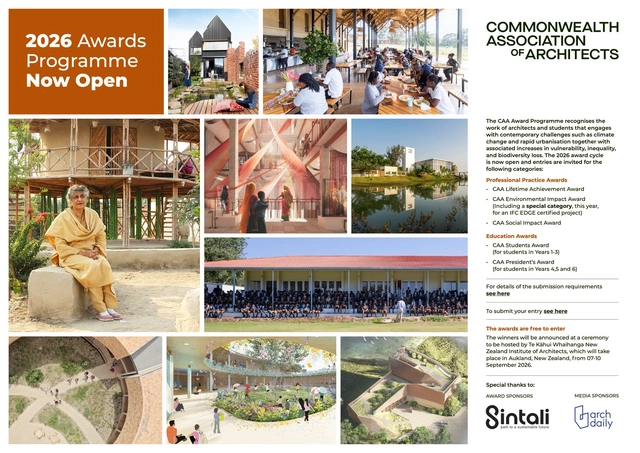
The Commonwealth Association of Architects (CAA) is pleased to launch its 2026 Awards Programme, inviting architects from across the Commonwealth to submit work that demonstrates significant contributions to addressing contemporary global challenges including climate change, rapid urbanisation, biodiversity loss, and social inequality. Aligned with the CAA's charter objectives to maximise the contribution by architects to the well-being of society, the awards programme recognises projects and individuals whose work advances the United Nations Sustainable Development Goals (SDGs) while demonstrating exceptional design quality and measurable impact.
The Commonwealth Association of Architects (CAA) has launched its 2026 Awards Programme, with the Education Categories inviting students across the Commonwealth to submit work that demonstrates significant contributions to addressing contemporary global challenges including climate change, rapid urbanisation, biodiversity loss, and social inequality. Aligned with the CAA's charter objectives to maximise the contribution by architects to the well-being of society, the awards programme recognises projects and individuals whose work advances the United Nations Sustainable Development Goals (SDGs) while demonstrating exceptional design quality and measurable impact.
Kodaňská 1441 International Urban Design and Architectural Competition
"Kodaňská 1441" is the international competition launched by the developer Daramis for Vršovice, a vibrant district located in the centre of Prague. Leading architectural firms are invited to apply and propose innovative solutions to transform an existing administrative building plot into a new contemporary urban block. Registration runs until 12 January 2026.
The Master in Collective Housing (MCH), in collaboration with TC Cuadernos, a renowned architecture magazine, has announced the second annual call for research grants. This grant, aimed at supporting architecture thesis or research projects, offers up to €6,000 to help transform the work into a published book.
Where cities were once shaped by simple structures that could adapt to new uses, they are now packed with rigid dwellings—often designed with a single use in mind and fixed in both layout and lifespan. As climate deadlines tighten, communities demand more resilient, resource-conscious spaces, and work and living patterns continue to shift, this rigidity is becoming a liability. When buildings refuse to bend, they are often treated as disposable, triggering cycles of demolition, downtime, and loss. Adaptability, once considered an added convenience, is becoming an imperative—something the inaugural Adaptable Building Conference (ABC) in Rotterdam aims to put front and center.
Patrick Bateman (American Psycho); Carrie Bradshaw (Sex and the City); Travis Bickle (Taxi Driver); Fleabag; Thomas Magnum (Magnum, P.I.); Sinterklaas; Batman; Theodore Twombly (Her); Automat (Edward Hopper); Zaha Hadid; Mary Poppins; Bridget Jones; L. B. "Jeff" Jefferies (Rear Window); Coco Chanel; The Scream (Edvard Munch); Amélie Poulain; WALL-E; Wanderer above the Sea of Fog (Caspar David Friedrich); Yayoi Kusama; Whoopi Goldberg. Image
When I recently found myself flooded, during the ever-expanding shopping frenzy of the so-called Black Friday season, with offers branded as Singles' Day deals, it struck me: singles have become a remarkably powerful force in our societies. The prominence and intensity of Singles' Day—a celebration that began among students at a Chinese university in the early 1990s and has since grown into one of the largest global shopping festivals—underscores that singles are no longer just a demographic statistic, but a transformative presence reshaping cities and economies worldwide. That is why we aim to investigate, with this new issue of MONU entitled "Singles Urbanism", how singles transform cities and to understand the spatial consequences of life lived alone, and the growing prevalence of living outside the traditional structures of coupledom and family, and its urban influence.
The Zváračák brownfield area close to the Bratislava city center
One of the last large brownfields in Bratislava has been awaiting its transformation for years. Today, a new phase is beginning for the area known as "Zváračák," located on Račianska Street near the Bratislava's city center.
Image of an Open House Miami attendee. Image credit: MCAD.
Open House Miami (OHMIA) returns for its third year, February 27–March 1, 2026, offering special access to the architecture, culture, and design of Greater Miami & Miami Beach through free experiences and events—tours, workshops, and more.
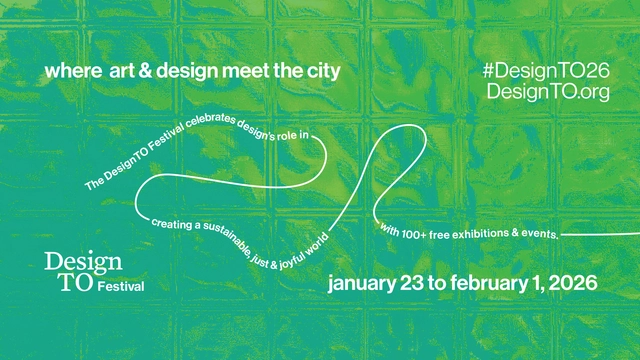
Attention art and design lovers! The 16th annual DesignTO Festival returns January 23 - February 1, 2026. Join us at multiple venues across Toronto for 10 days of inspiring exhibitions, installations, and events.
All architecture is grounded in the earth. This pliant, resilient raw material is the origin of extruded ceramic tiles—clay transformed from its natural state into an architectural solution without relinquishing any of its authenticity. Exagres' work is rooted in this natural material, carefully transforming the clay with skillful precision and guiding it on this journey rather than forcing it.
Videos
AI powered architectural concept generation. Image Courtesy of AIRI Lab
As artificial intelligence tools sweep through creative industries, architecture stands at a pivotal moment: how to adopt systems that amplify design thinking without eroding authorship or craft. To understand how the profession is responding, AIRI Lab surveyed designers and leaders from practices including LWK+P, MVRDV, Gensler, Büro Ole Scheeren, CUBE, HUAYI, and others. Their responses reveal a nuanced, pragmatic view: AI is a collaborator rather than a substitute.
Join us in Berlin to explore how water shapes urban life. Over two weeks, students and experts in design, ecology, and urban studies will investigate Berlin's water systems and their role in shaping cities. Through site visits and collaborative work, we will study water as a connector, resource, and driver of change. Discover new ways to rethink urban resilience through the lens of water.
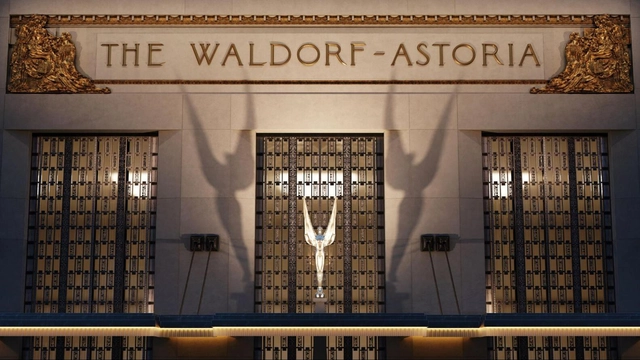
The quintessential symbol of Manhattan, Waldorf Astoria New York officially reopened for the public this year after an extensive renovation. Over its long history, the property has undergone numerous transformations, from its 19th-century beginnings to the modern landmark that stands between Park Avenue and Lexington Avenue.
Reimagining a building that pioneered modern hospitality—a jewel in New York's skyline—posed a challenge that required close collaboration between preservationists, 3D visualizers, architects, and designers. Together, they worked to preserve its protected architectural heritage while meeting contemporary expectations for craftsmanship and comfort.