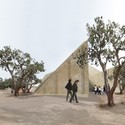
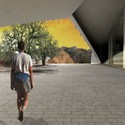
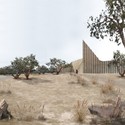
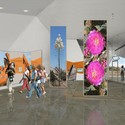
Henn Architekten shared with us their proposal for the international competition to design the new ‘Nano-Polis Masterplan’ in Suzhou, China where they won the first prize. The proposal was designed by HENN ARCHITEKTEN’s Design & Research Studio HENN StudioBwho drew their inspiration from both traditional Chinese urban planning and modern science for their concept on the research and development park for Nanotech. The use of innovative technologies and environmental strategies help to make their design a more comfortable place for its users while decreasing its energy consumption. More images and architect’s description after the break.
For this temporary hotel, IAA Architects created a shelter where the occupants become a form of entertainment to passersby. Designed in collaboration with artists and Aneta Grzeszykowska Jan Smaga, the hotel is part of a temporary installation and envisioned as a piece of art. With five screened bedrooms, a shared gardens and common facilities, the hotel offers an inexpensive place to lodge and creates a simple aesthetic for the Grenswerk Festival of Arts.
More images and more about the project after the break.
Gonatas+Lantavos Architects designed the Social Housing Project for the competition sponsored by the Greek Social Housing Organisation and the Hellenic Institute of Architecture. Located in Axios, a municipality 27 km from the center of Thessalonica in Northern Greece, the residential complex is composed of small buildings that make up the larger complex. The existing landscape and context of the site helped formulate the design approach as an electronic microcircuit of connections.
Read on for more information and images after the break.
To coincide with the launch of their new Personal Factory 4 services, Google SketchUp is announcing the Ponoko 3D Printing Challenge. Basically, the challenge is to produce a piece of instructional content that’s equal parts enlightening and entertaining. Each entry must be titled “How to use Google SketchUp for Ponoko 3D printing,” but aside from that, the format is pretty open. Text, images and video (or some combination of the three) are all fair game.
Turkish ArchitectsMETEKIYAN have shared with us their proposal for the Landmark Project on Cebeli Hill in Antalya, Turkey. Additional images and a description of their proposed arboretum after the break.
Designed as a temporary residence for an oyster farmer, French firm Raum Architects have created a simplistic structure based upon an acute attention to detailing and material selection. Located in the countryside of Bretagne, the residence reflects the nature of the site through the large glazing and movable partitions that open the residence to the outdoors. The house is composed of two main areas; a hangar and an office/lounge space that includes a kitchen, dining room and seating area. A patio, which can either be open or closed off, offers the transitional space between the two. The inner patio allows light to permeate through the different interior areas, even when these interior spaces are closed off from the exterior with the large sliding doors. The hangar, an open work space for the oyster farmer, is articulated by its exposed wooden frame. A translucent plastic SITS behind the house’s vertical slatted skin, allowing diffused light into the space. While this component is set aside as a separate ‘wing’ to the dwelling, the space can easily be integrated both visually and physically by opening up the patio area.
Two more weeks and we have our 25th selection of the best from Flickr. With almost 33,000 photos, we invite you to check them all right here! As always, remember you can submit your own photo here, and don’t forget to follow us through Twitter and our Facebook Fan Page to find many more features.
The photo above was taken by pedro kok in Amsterdam, The Netherlands. Check the other four after the break.
When Thanksgiving rolls around, even the most cynical, edgy writers start spewing sentimental drivel about family or the meaning of being thankful. They are weak and clearly under the influence of this fake holiday—you know it was invented by Abraham Lincoln, right?
Suddenly, all my Twitter tweeters have ceased shamelessly promoting themselves or constructing clever little comments about the great things they are doing, or the great things they are thinking, or something great that someone else is doing or thinking. Now it’s a constant stream of kindness and sincerity. Good Magazine asks, “What are you thankful for?” I am thankful that this insanity will be over by Friday. I’ll also be thankful when they return my calls.
I wasn’t going to write about Thanksgiving. It is not my favorite holiday. You eat too much and have to sit around and talk with relatives. This year, my wife and I were given an alternative: we were invited by a neighbor to eat too much and sit around and talk with her relatives. This sounded entertaining. In fact it turned out to be more entertaining than I ever would have imagined.
ACDF* has shared with us their design for the new library at Saint-Eustache, which is north of Montréal, Canada. The library is founded on the notion of creating a contemporary project that also shares a story that reveals the historic value of its site. The project symbolizes the reconciliation between the urban form of the Saint-Eustache as it is today, and the history of the riverside site. The concept for the project further integrates fundamental ecologically responsible principles which focus on building compactness, energy economy, and the use of high quality, sustainable materials ensuring the permanence of the project. More images and architect’s description after the break.
The expansion will make a significant impact in the cityscape, with a science tower which will form an identity-creating, sculptural focal point for the entire Nørre Campus. The project also includes an urban park which will benefit both the Panum building and the surrounding city.
More images and architect’s description after the break.
Department of Unusual Certainties is a Toronto-based research and design collective working at the interstices of urban design, planning, public art, spatial research and mapping have shared with us their contribution to the John Street Ideas Competition, held by the Toronto Entertainment District BIA, entitled StairSpace. The competition called for a new public space concept as the center point of what has been dubbed a major cultural axis in the Toronto – John Street. More details of DoUC’s submission after the break.
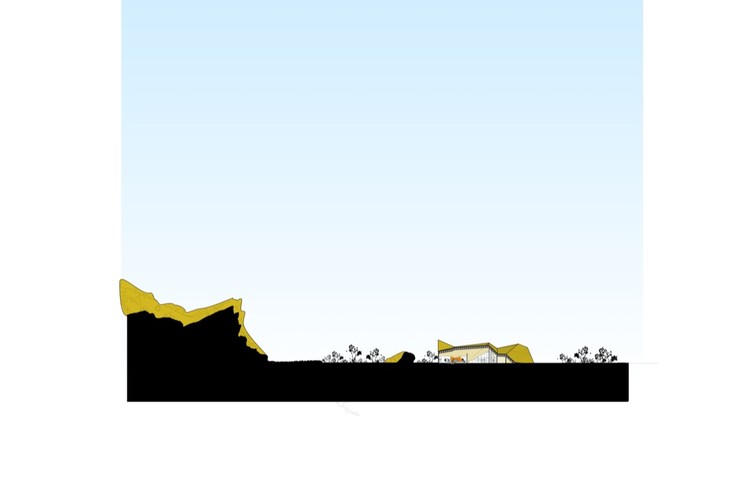
The Vasquez Rocks Nature and Interpetive Center is a vital gateway to a unique asset in the Los Angeles County Parks system. The high-desert site is one of the most significant natural areas in the region; its sculptural rock formations have inspired generations of visitors. Its location along the Pacific Crest Trail affords hikers on a 2,650-mile walk from Mexico to Canada an unforgettable point of reference.
The new Vasquez Rocks Nature and Interpretive Center communicates the feeling that it is at one with its environment, treading lightly upon the land but leaving a significant cognitive impact upon the visitor. It is at once visually arresting and subtly integrated – it’s as if it has been there as long as the rocks themselves.
First of all… Happy Thanksgiving everybody! Second, here’s our 4th part of our selection of previously featured cultural centers. Check them all after the break.
Passy Cultural Center / Beckmann N’Thepe “Although unusually set within the site, the building subtly blends in with the surroundings. With its long timber roof, it creates a new horizon, a cut-out silhouette that forms a huge sculpture on the scale of the landscape. In this way, the project takes on a symbolic, contemporary dimension (read more…)
Rasmus Svingel shared with us a movie of a model he put together, part of his current work at Aarhus School of Architecture in Denmark. It’s an investigation of space and program diversity through movement. The model arose from a digital model that were processed into an anolog structure.
Burke Culligan Deegan’s design for the Aoibhneas Children’s Centre won the international competition administered by by the RIAI (Royal Institute of Architects of Ireland). The new children’s centre is an addition to the existing women’s refuge in Dublin, Ireland. The philosophy of the design was to aid growth and recovery in an uplifting environment for women and children who were temporary residents in the refuge.
Read on for information and images after the break.
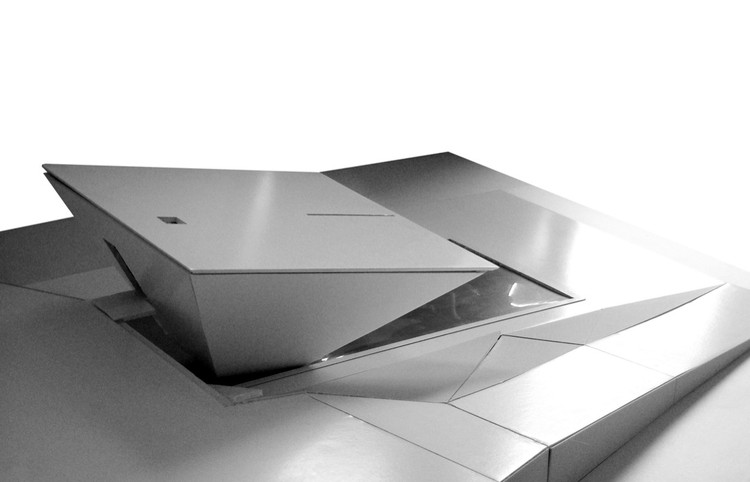
Situated at the based of a steep field, the Chapel of Eternal Light offers views to the water beyond, an ideal location. With its slanted walls, the inverted pyramid shape is anchored by a concrete slab and formed from a metal structure. Follow the break for more construction photographs, drawings, and model pics of this in progress project.
Architects: Bernardo Rodrigues Arquitecto Location: Ponta Garça, San Miguel, Azores Project Team: James Grainger, Peter Mosca, Natasha Viveiros, Malheiros Nuno, Nuno Rodrigues Specifications: Ana Fortuna Structures: HDP Engineering Mechanical: Maria Odette de Almeida, Paulo de Faria Queiroz Ltd Electrical: Fernando Gomes Project Year: 2003-2011 Photographs: Courtesy of Bernardo Rodrigues Arquitecto
This just in from UNStudio, Ben van Berkel, in collaboration with DP Architects, has been chosen to design the Singapore University of Technology and Design (SUTD). Selected from a shortlist of five practices, UNStudio + DP Architects have created a proposal that reflects the university’s curriculum by “using the creative enterprise of the school to facilitate a cross-disciplinary interface; interaction is established between the professional world, the campus, and the community at large.”
More images and more about the proposal after the break.
Scott Draves (aka SPOT) produces software art that makes my brain melt. I’m almost positive it’s doing something neurological similar to the pink beam of light fired at Horselover Fat’s brain in Philip K. Dick’s novel, VALIS. These self-generative, evolving, extremely beautiful and complex images are encoded with information words do not adequately capture. Moreover, they warp conventional understandings of computer-generated imagery.
It’s appropriate to mention VALIS (Vast Active Living Intelligence System) because Draves’ art operates like some crazed living system, a rhizomatic artificial intelligence bouncing through space and beamed off-world. What will the aliens think of us when they receive these transmissions millions of years from now? If NASA ever does Voyager 3, this should be in its memory.
Architects GilBartolome ADW won the first prize in the competition Smart Future Minds Award with the project Lighting Device which aimed at anticipating technological and environmental aspects for the future of the city. Jurors selected this project for its viability, its vision for the future and the exclusive use of renewable energies and its potential as a social activator in the urban realm.
Read on after the break for more images and information.
We received this interesting competition which proposes a new concept. The aim is to build a know-how on running alternative, open license-based two-phase architectural competitions. Participants of the first phase are required to submit their works under Creative Commons licenses – this allows in the second phase to feel freely inspired by and reuse others’ designs without critical legal restrictions.
We’ve featured a few projects by Nicolas Dorval-Bory, such as his extension for an artist residency and a sustainable house for winter sports; and now, he and Raphaël Bétillon have shared their latest conceptual project focusing on re-thinking Parisian bistros. A strong cultural component of Paris, the bistro offered a place of intense life and intellectual dynamism, with its typically noisy ambiance and chattering clients. However, recently, Dorval-Bory and Bétillon have felt that the bistro has slowly begun to loose its sense of vitality, as bistros are becoming “often disappointing, stuck up in ornaments of another century, mimicking with decors for tourists times when the lively creative atmosphere filled the place alone.” So, the pair decided to explore the atmosphere of such bistros in an effort to improve the quality of this traditional space. This approach has created a bistro that literally responds to the people occupying the space, leading to some interesting scenarios on an experiential level. ”Our intervention would then be about the control and expression of these atmospheric bodies, a contemporary way to celebrate climate as the primary user’s envelope. Architecture would split into two : on one hand, a built layout designed as a structuring machine, a back frame controlling, on the other hand, flows, phenomenons and invisible particles,” explained the architects.
More images and more about the project after the break.