The approach for the Amsterdam pedestrian bridge by Kamvari Architects challenges the basic principles of a bridge as their design takes on a completely new form as it attempts to create space by looping across the river. They hope that ‘The Rink’ will become a new icon in the city by becoming an active and public node within the city fabric. More images and architects’ description after the break.
In a letter presented at a House subcommittee hearing Tuesday, Frank Gehry expressed his willingness to change the design of the controversial Dwight D. Eisenhower Memorial in order to resolve objections from the 34th president’s family.
“My detractors say that I have missed the point, and that I am trying to diminish the stature of this great man,” Gehry wrote. “I assure you that my only intent is to celebrate and honor this world hero and visionary leader.”
Continue reading for more information on the hearing.
With the realization that disasters are an unavoidable reality, Architecture for Humanity and the American Institute of Architects (AIA) have launched ArchitectsRebuild.org in an effort to eliminate “that first awkward and uncoordinated period when people, eager to put their talents into response and recovery, can’t find the means.”
As we announced last month, the two organizations formed a strategic partnership to better coordinate advocacy, education and training that will allow architects to become more involved in helping communities prepare, respond and rebuild after a disaster, known as the Disaster Resilience and Recovery Program. As promised, they have now completed the first task on their agenda, establishing a Disaster Plan Grant Program. Continue reading to learn more.
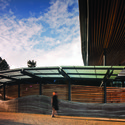
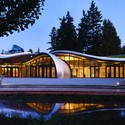
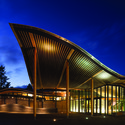
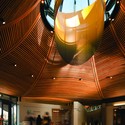
Perkins+Will‘s VanDusen Botanical Garden Visitor Centre in Vancouver, BC is designed to meet the Living Building Challenge, the most rigorous set of requirements of sustainability. Formally and functionally, it encompasses the goals of environmentally and socially conscious design. The building is an undulating landscape of interior and exterior spaces rising from ground to roof level and providing a vast surface area on which vegetation could grow, thus reoccupying the land on which the building sits with the landscape. The building also features numerous passive and active systems that reuse the site’s renewable resources and the building’s own waste.
More photos after the break, including a video about the project!
Slogans like these constantly inundate us across media sources, and the premise is always the same: a healthy body is sexy, desirable, better. The opposite is similarly true: if you’re fat or obese, you aren’t just unhealthy, you’re sick. You need to be ‘cured.’
This moralization of “healthy” is symptomatic of a greater obsession and anxiety over our health in general, an obsession that has led to what Giovanni Borasi and Mirko Zardini, editors of Imperfect Health, call “medicalization; a process in which ordinary problems are defined in medical terms and understood through a medical framework” (15). The book has been published by the Canadian Center for Architecture with Lars Müller Publishers, and it is part of an exhibit accompanied by an online TV channel.
This process has similarly formed a concept that design and architecture are tools for healthiness and well-being; hence the proliferation of Green built environments that supposedly (1) recuperate nature from dastardly human deeds and (2) “craft a body that is ideal or at least in good health, apparently re-naturalized or better yet, embedded in nature” (19). Just think of the NYC High Line‘s recuperation of land left “damaged” by technology, a vastly popular project that motivates the human body to walk, run, and play in nature rather than sit sedentarily (unhealthily) in a toxin-emitting vehicle.
But is this idea itself a healthy way to conceptualize of Architecture? Is this goal of “healthiness” even possible to attain?
I know It’s only been 2 weeks since my Architectural world tour, but, I was still emptying my suitcases this morning. Sorry, I got caught up in the pressure at the office and just had not gotten around to unpacking. Mainly, because I’m awesome. And,wouldn’t you know it?, right in the bottom of the suitcase, were 6 more postcards that I totally forgot to mail. No wonder Herzog was so pissed at me…
Anyway, I’ve scanned them here for you to enjoy… (here’s the one’s I did mail, in case you missed those - HERE )
Beijing urban expansion _ The fast and enormous urban development of Beijing has transformed the city into a metropolis made of suburban residential compounds, abandoned industrial plants, community housing blocks from the 70s-80s and popular self-grown villages. A mix of high rise residential areas, business districts, impressive infrastructures enclosing spontaneous house areas surviving the demolition and renovation dictated by the construction market. The population has grown from 1 to 18 millions in 60 years, and the size of the city has reached 5 times the ancient capital within the walls – the 2nd Ring Road.
The urban expansion, mostly based on imported urban models and low quality constructions, has been exploding in the past 30 years, and it is rooted with political and economical decisions, as well as local culture and history. Briefly, Beijing is a stunning showcase of urban consequences happening in the world’s first growing economy, during an explosive industrial revolution.
With less than 70 days until soma’s grand opening of their “One Ocean” Thematic Pavilion, we are anxiously anticipating the final result of the firm’s biomorphic creation. Unlike most pavilions, this building will become a permanent part of the grounds after serving as the central point of the EXPO 2012 in Yeosu, South Korea. As we reported earlier, soma’s pavilion focuses on creating an experiential journey as visitors enjoy introductory exhibitions on the Expo’s theme, “The Living Ocean and Coast”.
More about the pavilion, including more construction photos, after the break.
Francesco Piffari shared with us the design proposal for the Amsterdam Pedestrian Bridge. To design a new iconic bridge, it is essential to reflect on the concept of bridge; what a bridge is in the collective imagination. Considering the bridge in its core meaning, it can be said that the peculiarities of a bridge is to “touch” the ground in just two points, to hover in the air and to be suspended over the obstacle; it is very clear that a bridge establishes a strong relationship with air and water, the two elements it is surrounded with. More images and architect’s description after the break.
From March 20 – May 11, the “American City: St. Louis Architecture: Three Centuries of Classic Design” exhibition will be up at the Willis Tower (formerly the Sears Tower) in downtown Chicago. The show consists of 83 large prints of over 40 historic buildings in St. Louis, including acclaimed landmarks such as Louis Sullivan’s Wainwright Building, James Eads’ Eads Bridge, Eero Saarinen’s Gateway Arch and Tadao Ando’s Pulitzer Foundation for the Arts Building. The timeline stretches from 1839 to 2010. The show is being staged in the Willis’ ground floor atrium and lobby and is free to the public. More information on the exhibition after the break.
The first prize winning proposal for the Museum Nasional Indonesia by Aboday aims to bring back this massive institution to its original role as a public facility. Their design addresses the question of urban context by inserting a new corridor between the existing museum building (A) and building (B) that will maintain an openness to the pedestrian and city park on the Eastern part of the complex. More images and architects’ description after the break.
Winners of the National Exhibition of Migrating Landscapes have been announced! This nation-wide, open ideas competition is the main process for creating Canada’s official entry to the 2012 Venice Biennale in Architecture, entitled Migrating Landscapes. Themed around migration and cultural identity, entrants comprised of young Canadian architects and designers, ages 45 and under, where invited to reflect on their migration experiences and cultural memories, and design dwellings onto a new landscape that would be showcased through a series of seven regional exhibitions across the country. Together with the Winnipeg-based Migrating Landscapes Organizer (MLO), the jury has selected 18 winners out of 26 finalists to represent ‘Team Canada”. Continue after the break to review the winning competitors.
We announced last month that the LEGO® Architecture series will now include Jørn Utzon’s Sydney Opera House, the 12th building in this popular series. Thanks to LEGO® Architecture, four of our readers will win a LEGO® Architecture Sydney Opera House.
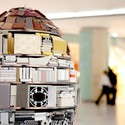
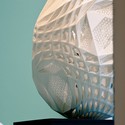
‘The Fabergé Big Egg Hunt’, launched on the 21st of February, has provided London, England with 209 giant and stunningly crafted Easter eggs, designed by artists, architects, jewelers and designers. The four presented here were designed by architects Zaha Hadid, Sir Nicholas Grimshaw, Fourfoursixsix and interior design firm Candy & Candy. The designs are unique, structural and conceptual. Thirty-one among the 200 will be chosen for a live auction on March 20th. The rest can be bid on on-line. The proceeds from the auction will go towards the £2million target for Action for Children, a charity for vulnerable and neglected children, young people and families, and Elephant Family, a charity for the endangered Asian elephant. This Easter egg hunt invites the whole public to participate in finding these eggs throughout the city; the scale of this event is set to break Guinness World Records for the most participants in an Easter egg hunt.
Just in time for the warm weather, Visiondivison has shared a great collection of summer houses with us. Entitled the Spröjs Series, the residences stem from an organizing modular system present in their built project Spröjs House (previously featured on AD). And, in this collection, in typical Visiondivision fashion, the firm has exploited the potential of the module and crafted residences ranging from a simple shed and cabin to a crazy castle.
Check out the range of residences after the break.
GRAPHISOFT® recently announced it has joined forces with buildingSMART® International, Tekla® and several leading software vendors to launch a global program in order to promote Open BIM collaboration workflows throughout the AEC industry.
From their release: Open BIM is a universal approach to the collaborative design, realization and operation of buildings based on open standards and workflows. Open BIM is an initiative of buildingSMART and several leading software vendors using the open buildingSMART Data Model.
The winning proposal for the new Theater of Cachan, designed by O-S Architects, acts as a curtain that rises over the city with the aim to transform the neighborhood with an urban, cultural and social point of view. The overall image of the project is conceived as a technological and functional tool that confirms the dynamism of the city of Cachan, for the sake of architectural and landscape quality. More images and architects’ description after the break.
The Lavance Shade Screen, a project designed and built by Benjamin Hall & Michael Lavance, was created out of appreciation for the desert climate and its harsh effects on specific materials. This inspiration and architectural concept led to this unique and regionally specific approach in providing much needed shade to a custom residential outdoor barbecue and bar near the downtown of Scottsdale, Arizona. More images and architects’ description after the break.
The public space proposal for the Urban Intervention competition creates a new way of creating a dialog between the park and the city. Designed by PRAUD, each solid and void creates its own topography, and thus the topography of the solid provides different experiences for pedestrians and joggers, while topography of the voids provide different types of functions and landscape fields. More images and architects’ description after the break.
A short while ago we received Pamphlet Architecture 11-20, the second volume that accumulates the continually growing series. Steven Holl and William Stout started the Pamphlet series back in 1978. They wanted to create a venue “for publishing the works, thoughts, and theory of a new generation of architects.” The resulting publications are graphically pleasing and theoretically engaging. Interestingly, as Steven Holl points out, many of these once theoretical ideas are be realized in contemporary ideas. For example, Steven Holl says his “Horizontal Skyscraper” in Shenzhen, China “could be considered an outgrowth of experiments began in 1996′s Edge of a City (PA 13).
https://www.archdaily.com/209761/pamphlet-architecture-11-20Amber P
Due to the popularity of last weekends video exploring Little Big Berlin, we present to you this stop-motion video capturing a Spring day in the city of Kiev. Created by Tel Aviv-based artists Efim Graboy & Daria Turetski, MiniLook Kiev highlights the movement of the colorful city. Over a course of five days and two nights, the artist captured 25,000 images only to select 4,500 frames for the final edit.
The Graduate School of Architecture, Planning, and Preservation (GSAPP) at Columbia University will be holding the Interpretations: Promiscuous Encounters Syposium taking place Friday, March 23rd from 12:00pm – 8:30pm. Promiscuous Encounters, which is free and open to the public, has two main ambitions: first, to examine the fascinating blurriness and productive interplay between the critical, curatorial and conceptual capacities of architecture, including how and where they intersect and overlap and, second, to expand the definitions of what these terms mean in relation to theory and practice by reexamining the sites of criticality and their modes of operation. More information on the event after the break.