Produce personalized presentation boards that distill complex concepts into simple visual representations with a few helpful tools and effects.


Produce personalized presentation boards that distill complex concepts into simple visual representations with a few helpful tools and effects.

The project developed by RTA-Office belongs to a large masterplan that includes three different museum buildings surrounded by a big green area. The Anhui Provincial Paleontological Fossils Museum and the Anhui Provincial New Museum are already built. RTA-Office was involved in the design of the third one, the Anhui Provincial Art Museum. Located in a new politic and cultural district in Heifei, China, the new building will occupy the southwest corner of the park. More images and architects’ description after the break.

Sponsored by Cannon Design, the ‘(un) Made in China’ Exhibition will be taking place April 20 – June 20 at the ide@s gallery in Shanghai, China.Thirty years of unprecedented growth have transformed China’s built environment and given it the reputation as a land of opportunity for architects today. While much attention – and some criticism – has been focused on major completed works, little is known of those projects that disappear, fizzle out, or sit abandoned in spite of the rich tradition within architecture of both celebrating and criticizing unbuilt work. “(un) Made in China” seeks to bring light to these could-have-been-transformative projects and the experiences they produced. At its heart is a series of interviews conducted with 12 international architecture practices, which generate a wealth of interesting, insightful, and often humorous accounts and accompanying these are architectural models and images of the unrealized projects. For more information, please visit here.

RUA shared with us their second prize winning proposal in the Ideas Competition for the Re-qualification and Redevelopment of the Beach and Seafront of Figueira da Foz and Buarcos. Their proposal is for a light concrete structure that “fly’s” over the dunes allowing for a gradual and controlled re-naturalization of the area between the existing promenade and the waterfront. More images and architects’ description after the break.

Designers in the Northwest and Pacific Region create some of the world’s most sustainable buildings. What Makes it GREEN? (WMIG?) celebrates the region’s achievements and the interdisciplinary teamwork required to meet the 2030 Challenge®. For over a decade, WMIG? has educated and inspired the larger design community with creative solutions for sustainability.

Contributing to the Vancouver skyline, the 490-foot-tall Beach and Howe mixed-use tower by BIG, Westbank, Dialog, Cobalt, PFS, Buro Happold, Glotman Simpson, and local architect James Cheng marks the entry point to downtown, forming a welcoming gateway to the city, while adding another unique structure. BIG’s proposal, named after its location on the corner of Howe & Beach next to the Granville Street Bridge in downtown Vancouver, calls for 600 residential units occupying the 49-story tower, which would become one of the city’s fourth tallest buildings. More images and architects’ description after the break.

The proposal for the New Building for the Nantes’ Conservatory & the Pole of Higher Learning Performing Arts by RAUM + l’Escaut proposes to open the different practices to the city. Dance studios and music classrooms create a perception of artistic practices from the outside and make it readable within this new cultural center of the Nantes Island. Beyond the shared nature of the equipment, transdisciplinary practices will be offered by a set of situations that offer the linking of different disciplines and will thus create a direct link between the building and operation of contemporary pedagogies relating to higher education. More images and architects’ description after the break.

You can get into Architecture for one of two reasons: good architecture or bad.
For Cameron Sinclair, the co-founder of Architecture for Humanity, it was the latter. As a kid, Sinclair would wander his rough-and-tumble South London neighborhood, contemplating how it could be improved (and creating elaborate Lego models to that effect). Instead of soaring skyscrapers or grand museums, he was inspired by buildings that “integrated your neighborhood in a way that made people feel like life was worth living.”
But that’s not Architecture. Or so he was told when he went to University.
Architecture Schools have created curriculums based on a profession that, by and large, doesn’t exist. They espouse the principles of architectural design, the history and the theory, and prepare its hopeful alumni to create the next Seagram Building or Guggenheim.
Unfortunately, however, the Recession has made perfectly clear that there isn’t much need for Guggenheims – certainly not as many as there are architects. As Scott Timberg described in his Salon piece, “The Architectural Meltdown,” thousands of thousands are leaving the academy only to enter a professional “minefield.”
So what needs to change? Our conception of what Architecture is. We need to accept that Architecture isn’t just designing – but building, creating, doing. We need to train architects who are the agents of their own creative process, who can make their visions come to life, not 50 years down the road, but now. Today.
We’ve been trained to think, to envision and design. The only thing left then, is to do.
More on the public-interest model and the future of Architecture, after the break…

Beginning in 1955, the American Academy of Arts and Letters have awarded architectural accolades to those who made a significant contribution to architecture as an art. Recently, the organization began giving such awards, formerly called Academy Awards, to honor American architects whose work is characterized by a strong personal direction or explores architectural ideas through any medium of expression. This year’s winners include Kathryn Gustafson (Arnold W. Brunner Memorial Prize in Architecture), Hilary Ballon (Arts and Letters Award for medium expression), Marlon Blackwell, Elizabeth Gray & Alan Organschi and Michael Maltzan (Arts and Letters Awards for personal direction)- a mixture of architectural academics and practitioners, landscape designers and fabricators.
More about the winners after the break.

Curated by the Tadao Ando Architect & Associates studio, an exhibition dedicated to Tadao Ando’s last ten museum projects will be held at the Duvetica Store and Showroom in Milan April 17-22. The projects, realized between Europe and Japan over a period stretching from the mid-1990s until 2010, will be presented through a large selection of drawings, models, videos and photos. The event will be held in the building that was the Japanese architect’s latest project in Europe, the Duvetica Store and Showroom in Milan, opened in October 2011 and comprising a vast open space and a showroom below the store, both measuring 220 square meters. More images and information on the exhibition after the break.

AllesWirdGut won the first prize of the Esterházy Domain Private Foundation competition for the conversion of a Burgenland Meierhof in a multifunctional complex. The specific nature of the project results from the partially worth protecting historic buildings. The design of AllesWirdGut strengthens existing qualities, but combines the old architecture with contemporary enhancements. An hour away from Vienna, a multifaceted system of a restaurant, offices and homes is about to be created. More images and architects’ description after the break.

Drawing from creative minds of Guillermo Bernal, Eric Ameres, Zackery Belanger, and Seth Edwards, and with the support of Smartgeometry, Grimshaw Architects, and Rensselaer Polytechnic Institute‘s Experimental Media and Performing Arts Center, Manta represents the potential of multidisciplinary design. that required expertise in architecture, fabrication, interactive technology, and acoustics. This combination drove the assembly of the design team, who came together for the first time from disparate careers and backgrounds. The result could only be achieved with a holistic design approach: all team members worked together on all aspects of Manta. More images and the team’s description after the break.

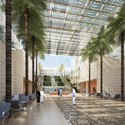
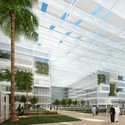
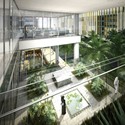
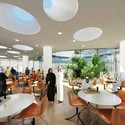
Saif Bader Al Qubaisi, Chairman of Abu Dhabi Health Services (SEHA), has unveiled plans for the new three-million-square-foot, 838-bed Sheikh Khalifa Medical City (SKMC). The new complex, designed by Skidmore, Owings & Merrill LLP (SOM) in a joint venture with ICME and Tilke, will replace the existing Sheikh Khalifa Medical City and provide expanded medical, pediatric, and trauma care for the residents of Abu Dhabi.
Mustafa K. Abadan, Design Partner for the project, says “The new Sheikh Khalifa Medical City balances the technical demands of a world-class medical center with the psychological well being of its visitors. The design allows for the flexible integration of next generation medical technologies, while the incorporation of amenities, such as trees and hanging gardens coupled with restaurants and retail, provides tranquility, relief and a sense of normalcy for patients and their families.”
Continue reading for more images and the architect’s description.

Patrick Dougherty is best known for his sculptures that break down over time. You may have seen one of his temporary works without realizing it. Built primarily from tree saplings woven together, each sculptures is approximately a three-week construction project where Dougherty and his group of volunteers carefully create the habitat or environment of this a tangled web of all natural materials. Because the sculptures are made of organic matter they disintegrate, break down and fall apart, becoming part of the landscape once again. Most people see habitats and shelters in his work – which is what many of them are meant to be – but “castles, lairs, nests and coccoons” isn’t what usually comes to mind. In an interview with Dougherty for the New York Times, Penelope Green discusses his only permanent work and the origin of his interest in what is referred to as Stickwork, now available through Princeton Architecture Press.
Patrick Dougherty has made over 200 sculptures in the 25 years that he has been creating Stickwork. But his construction work began when he was 28, working for the Air Force in the health and hospital administration. He decided to buy property in North Carolina and build his own house from the materials on the site. Collecting fallen branches, rocks and old timber, Dougherty was able to construct his home, in which he still lives with his wife and son, with a few additions. By 36, Dougherty decided to return to school for sculpture and attended the art program at the University of North Carolina. His interest in what nature had to offer led him to develop his tangled sculptures. Each sculpture is different and depends greatly on the site. Each project is different and depends on the volunteers that participate and the public that never fails to stop and watch the sculptures being woven together.
View some of his projects after the break.

Last week, we partnered with Moleskine to celebrate our 500,000 in Facebook! We asked you which architect would you like to see featured in Moleskine’s ‘Inspiration and Process in Architecture’ collection. We received more than 1,500 comments with great proposals for Moleskine to pick up. Here are the winners:

Studio Mode / modeLab is putting on Material Matters II, a two-day intensive design, prototyping, and fabrication workshop to be held in New York City during the weekend of May 12-13. As the next installment in the modeFab series and building upon the research developed in Material Matters I, this workshop will examine the procedural distinctions between two modes of design production: the first relying primarily on cerebral processing (a conceptual domain isolated from the wildness of matter and energy) and the second motivated by material’s capacity to act as an agent in the discovery of form.

Architects: Kris Yao | Artech Architects Location: Kaohsiung, Taiwan Clients: China Steel Corporation (CSC) Design Team: Willy Yu, Hua-Yi Chang, Nai-Wen Cheng, Jun-Ren Chou, Yen-Hsun Li Site Area: 11,037 sqm Lot Coverage Area: 2,590 sqm Total Floor Area: 81,054 Completion: Expected 2012 Photographs: Jeffrey Cheng

Taking place at the Center for Architecture in New York April 16 from 6-8pm, the ‘Documenting Your Work in a Digital Age: An Interactive Discussion’ will be an informal panel discussion put on by AIA New York focused on the range of digital tools currently in use to describe and define architecture. The discussion will range from architectural photography to other forms of digital communication, 3D display, and user experience design. Presenters, including Peter Aaron, Sam Travis Ewen, and Matthew Bannister, will integrate ideas about how to optimize digital content so that it can be easily found and viewed online by target audiences. To register and for more information, please visit here.

The winning proposal for the Albi Major Theatre, designed by Dominique Perrault Architecture, aims at transforming the texture of the city as well as its cultural influence. Appearing as an outstanding architectural symbol, on the outskirts of the historic center, the architects gave priority to the presence of the Major Theatre instead of the cinemas, in order to organize around it a network of public spaces and of cultural facilities. Therefore, the Major Theatre will be its center. More images and architects’ description after the break.

Coinciding with the exhibition Alturas de Macchu Picchu: Martín Chambi – Álvaro Siza at work on view at the Canadian Centre for Architecture (CCA) for an extended run until 29 April 2012, Pritzker prize-winning architect Álvaro Siza will give a not-to-be-missed lecture on Thursday 26 April 2012 at 7 pm at the CCA. The event is a rare opportunity to hear the preeminent architect speak in person. Siza’s lecture discusses his design development of the Iberê Camargo Museum in Porto Alegre, Brazil, completed in 2008 and noted for its sculptural volumes and tight integration with a coastal escarpment. As with all of Siza’s projects, hand sketches play a key role in the design process, from massing studies to fine-tuning details. For more information, please visit here.

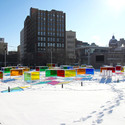
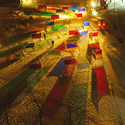
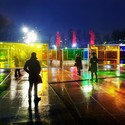
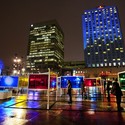
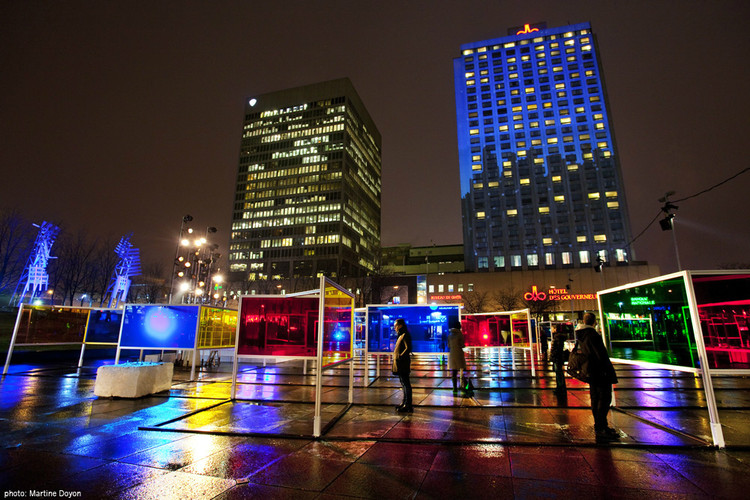
Montreal has long been known as the ”city of a hundred steeples”. Through the heart of this northern metropolis, ATOMIC3 has scattered Éclats de verre: a giant shattered stained-glass window reorganised into a playful maze that offers a unique immersive experience to its visitors, and a colourful panorama to passersby.
Winner of the Créer l’hiver competition, Éclats de verre is one of three works that make up Luminothérapie 2012. The goal of this event produced by the Partenariat du Quartier des Spectacles in Montreal is to beat the winter blues, using interactive light-based installations.
Continue after the break for more.

Despite many opposing residents, Fremont County Board of Commissioners has unanimously agreed to approve the Temporary Use Permit for Christo and Jeanne-Claude’s Over The River. This will allow the world famous artist to temporarily suspend 5.9 miles of silvery, luminous fabric panels high above the Arkansas River, along a 42-mile stretch between Salida and Cañon City in south-central Colorado. After remaining on the drawing boards for 20 years, the Over The River installation plans to begin in early 2014 with an exhibition planned for August 2015.
“The Fremont County permit is essential to realizing this temporary work of art that Jeanne-Claude and I first envisioned nearly 20 years ago,” said Christo. “I am very pleased that the Commissioners have voted to approve this public work of art for Fremont County, and I want to thank them for their hard work and efforts in evaluating our application. I am glad to be moving forward with our plans to complete Over The River.”

Future Cities Lab’s HYDRAMAX Port Machines project, which is currently on exhibit at SFMOMA until July 29, proposes a radical rethinking of San Francisco’s urban waterfront post sea-level rise. The proposal renders the existing hard edges of the waterfront as new “soft systems” that would include aquatic parks, community gardens, wildlife refuges and aquaponic farms. A synthetic architecture is introduced that blurs the distinction between building, landscape, infrastructure and machine. More images and architects’ description after the break.

Vamvakidis Simos, Tzortzis Antonis, and Zapantiotis Fotis shared with us their proposal for the Park & Agricultural Heritage Museum in the Eptagonia community of Limassol, Cyprus. The individual volumes of the museum follow the gentle slope of the existing terrain, creating an “organic” connection to the landscape while creating individual passes and plateaus that are interconnected, in a composition close to the human scale and built context of the village. More images and architects’ description after the break.
But you can browse the last one: 417