A call for entries is now being made for the Tenth European Prize for Urban Public Space, 2018. Since 2000 this biennial honorific award has aimed to recognise, promote and publicise examples of good practice in dealing with the many challenges faced by public spaces in European cities. The Prize aims to support the open, compact city of universal access, guaranteeing harmonious coexistence among its citizens, a mixture of uses, and sustainable mobility, preserving the historical memory of places, and favouring participation of citizens in projects designing shared spaces.
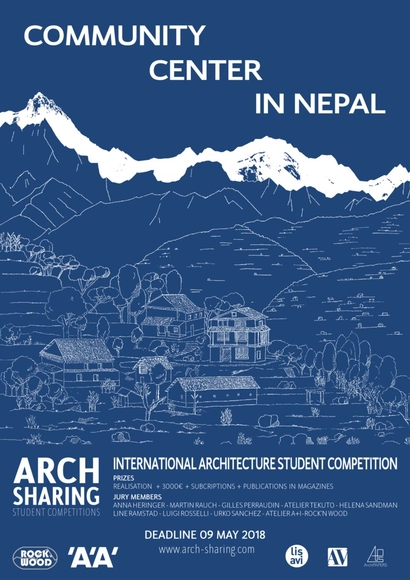
Located between China and India, Nepal is all along the Himalayas. These high mountains offer a range of beautiful landscapes with the eight highest summits of the world. Nepal gets an important profit from the hiking tourism, which represents at least 10% of the GDP of the country. Although well exploited by the country, its environment is a difficult aspect for its development with a complex topography and a rough climate. Seasons rhythm the country’s activities with dry winter and summer marked by important monsoons. The diversity of its ethnic groups, its castes, and its languages contribute to the richness of the culture of this country. Cults and religions take an important part of the Nepalese daily life; Hinduism, practiced by the majority of the population, has been coexisting with Buddhism for centuries. Architecture, culture and religion are tightly connected in Nepal, where the most beautiful wood or rock sculptures mainly stand in temples and monasteries. Nowadays cities and villages still come alive at the rhythm of religious festivities. With 29 million inhabitants, more than 85% of the population live in rural area. Nepal is divided in 75 districts, then in «VDCs» (Village Development Committee) who correspond to municipalities. Villages’ structure can differ from one place to another. Some are composed by groups of houses, with a dense typology. Other are more scattered, with houses separated from each other. Time perception is felt differently: it is common to have to walk for a few hours to walk across a village. These villages are sometimes badly connected or even not connected at all to the main cities, which is why education has been hard to access for a long time. Nowadays an important improvement is visible, with 84% of alphabetisation in the young population. Nepal has been benefiting of its geographic situation between its bordering countries for a long time, being a natural stop for merchants and travellers. Today, it is left behind as compared to its neighbours. There are many challenges to development: drinkable water, electricity support, communication infrastructure, wastewater management, infrastructure for transportation… However, these last years, some aspects of the development have been considerably improved. Electricity support became constant in the major part of the country and communication infrastructure have improved even in really retreated villages. During the last ten years, Nepal has got through economic and political crisis, but its biggest challenge is to recover from the terrible earthquake that has devastated part of the country on 25 April and 12 May 2015. In the area around Kathmandu, earthquakes have destroyed a huge amount of constructions and caused more than 9000 deaths. In the aftermath of this disaster, international assistance has worked together to rebuild the country. The outcome was positive but not to the scale of the real needs. Two years after, the mains NGOs are leaving to other assignments, but the damage is still present.
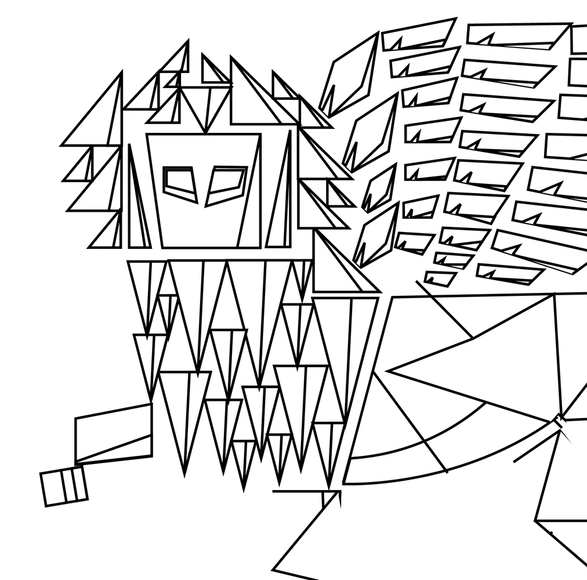
Russian architectural site Archplatforma.ru and Tchoban Foundation Museum for Architectural Drawing (Berlin) invite architects and artists of architecture to take part in ArchiGraphicArts 5 International Contest of Architectural Hand Drawings.
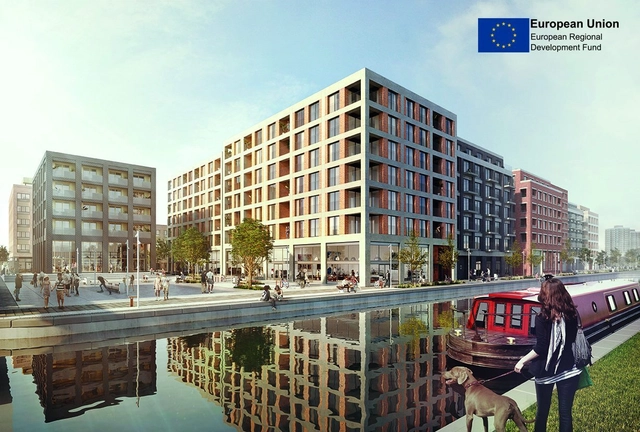
Fish Island Village and Hertford Union Canal from the North East
The Trampery is London's leading provider of workspace and support for creative entrepreneurs with a reputation for sumptuous and boldly-designed interiors. We are looking for an interior designer or architectural practice to work with us on the interior for Fish Island Village. The scheme represents London’s largest new development of affordable creative studios and The Trampery’s most ambitious project since its formation in 2009:
BACKGROUND Carl Sandburg has accurately described language as the most indispensable tool in the life of us social animals, men. Men have traversed through ages and grown into the most superior race on Earth because of their advanced linguistic and communication skills. Human language is unique in comparison to other forms of communication, as it allows us to produce a vast range of expressions and emotions from a finite set of elements.
The timeline for the development of modern day languages spans thousands of years. Sounds have developed into words, meanings, scripts, grammar, fonts and a formal system of communication called linguistics. One organization suggests that there are about 7099 living languages in the world, but which are not evenly distributed around the world geography. Only 23 languages account for more than half the world’s population. Roughly a third of languages are now endangered, often with less than 1,000 speakers remaining.
Language is much more than just a means of communication. It is also an inseparable part of our culture. In fact, language allows culture to exist. Language allows us to pass on ideas, knowledge, and even attitudes on to the next generation. Language allows culture to develop by freeing people to move beyond their immediate experiences”. Language is intrinsic to the expression of culture. As a means of communicating values, beliefs and customs, it has an important social function and fosters feelings of group identity and solidarity. It is the means by which culture and its traditions and shared values may be conveyed and preserved.
Languages are the most important part of a particular cultural heritage. As one culture dies and another grows, the same happens to their languages. Language is a relic that needs preservation as other inventions and objects of importance. It is an intangible resource that can also unlock some of the lost secrets and even civilizations that existed on the face of the earth. The aim of the competition is to design an iconic museum of language in the heart of London that will deconstruct the science of linguistics into various aspects of- speech, script and sense. The proposal must not only become an archive for the past and present world languages but also serve as a learning center that works to develop languages and future communication systems.
Architecture Fringe 2018 open call banner - credit Architecture Fringe
The Architecture Fringe has launched an open call for submissions to its 2018 open programme.
The Architecture Fringe was launched in 2016 by a group of architects, designers, photographers, engineers, visual artists and curators to encourage public debate about architecture and design in Scotland within its broader socio-political context.
SHOW ME YOUROPE ARTS is a contest organized by the students of the Executive Master in communication and European politics at IHECS Academy in Brussels. This year, the 2017-2018 team is organizing the third edition of SMY ARTS: “Designs for European Democracy."
SHOW ME YOUROPE ARTS 3rd Edition gives you the opportunity to express your vision on European democracy by participating in a design competition. The objective of this contest is to make your voice heard as a European citizen. Show us in an artistic way your own representation of European democracy.
The award ceremony for the Prix Versailles, the world architecture award for stores, hotels, and restaurants, will be held at UNESCO Headquarters in Paris, France, on 15 May 2018.
Entries can be submitted online between now and 11:59 pm CET on 31 January 2018 via www.prix-versailles.com.
Border research emphases on the discourse analysis on critical issues and connotation of separation - demarcation – segregation and conflicts and translated and theorizing these issues in various patterns of urbanism. Borders determine the degree of how regions are positioned in the global maps with the condition with which regions are valued, categorised and marked by its capacity to create individual geographical identities and unique settlement patterns. Borders define socially and economically incompatible systems that influence the nature of mobility of goods, human traffic, and economic transactions that suggest temporal, subdued, blurring socio-cultural entities defined by urban orders. Borders create these blurring urban orders along its boundaries defined by lack of cohesiveness with either sides of a border. Borders are more than geographically defined separations, but accounts of metamorphoses and metaphors that two neighbouring states are defined by the economy, politics, culture, and religion – manifested by its typological entities. Borders Research Issues Typologies under investigations Mapping Borders reflecting on the following issues: • Characteristics of social displacement at the borders • Transient/temporal settlement • Typologies and Form of Settlement • Conflict and Cultural hybridity • The architecture of weak forms on borderlines • Regenerative architecture as a socio-cultural policy • A phenomenology of generic places • Borders invoke centres: is there a new foundation? • The occupation of place: between reality and authorities • Crisis communication and the ‘architecture’ of media • Quick solutions: the printed habitat • New Social formation/Social Capital
The Amsterdam Light Festival is now accepting submissions for the 2018-2019 edition of the event, which will take place Nov. 29, 2018 through Jan. 20, 2019. The deadline is Jan. 17, 2018. Artists, designers, engineers, architects, professionals and students alike, are invited to submit their concepts for the festival’s 2018-2019 theme: “The Medium is the Message.”
Study Architecture seeks proposals from architecture students and faculty at ACSA Full and Candidate member schools for the design of a Study Architecture exhibit booth and interactive experience for the 2018 USA Science and Engineering Festival. The 10 x 10 foot booth should reflect the branding and messages of ACSA’s Study Architecture and #IMadeThat campaigns. The proposed activities within the booth should engage visitors in understanding how architects and architecture school graduates use science, technology, engineering, and math to design the world.
In preparation for the first World Forum on Urban Forests promoted by FAO (Food and Agriculture Organization), which will be held from November 28 to December 1, 2018 in Mantova, Italy, Stefano Boeri Architetti has launched a global call for action regarding projects, strategies and ideas in relation to urban forestry.
We, designers of the first Vertical Forest in Milan, invite architects, urban planners, botanists, agronomists, forestry corps, tree growers, geographers, ethologists, landscape scientists, technicians, researchers and experts in green care and urban forestry, real estate developers, administrators and representatives of local institutions and civil society, members and representatives of international organizations, funding agencies, universities and research institutes, and NGOs,
Courtesy of Istanbul Foundation for Culture and Arts (İKSV)
The 16th International Architecture Exhibition, La Biennale di Venezia will take place from May 26th to November 25th 2018, in Venice, Italy.
As the coordinator of the Pavilion of Turkey, Istanbul Foundation for Culture and Arts (İKSV) will host a series of events and student workshops throughout the Biennial.
This open call by the curatorial team invites students of architecture from all over the world to apply for these workshops in the Pavilion of Turkey.
Few people know that Native Americans serve the U.S. armed forces at higher rates per capita than any other ethnic group and have served since the American Revolution. That is about to change. On Veterans Day, Saturday, Nov. 11, the Smithsonian’s National Museum of the American Indian in Washington, D.C. will begin accepting entries for designs for a National Native American Veterans Memorial to be built on the museum's grounds on the National Mall. The international competition is open to all; architects, artists, designers, students and anyone else who wants to submit a design. Entries will be accepted until 3 p.m. EST Jan. 9, 2018.
ArchDaily is looking for a motivated and highly-skilled architecture-lover to join our team of interns for Spring 2018! An ArchDaily Content internship provides a unique opportunity to learn about our site and write engaging, witty and insightful posts.
Interested? Then check out the requirements below.
a competition that looks at exploring disruptive design ideas using shipping containers that will transform the future of public spaces.
The world today has become aware of the reckless utilization of natural resources and is now making conscious efforts to move towards a sustainable future. In this endeavor, it has become imperative to rethink our approach towards building materials to ease the pressure on the conventional ones.
The Shipping Container is one such potential building material that boasts of good structural quality, can be recycled easily and is universally available. With over two million unused containers docked on ports around the world, the UnBox 2017 aims to explore the prospective functionality of these as efficient structural components that aid in the creation of ingenious ideas and in re-imagining sustainability.
UnBox 2017 intends to illustrate the inventive functionality of the material to the masses by using the containers to craft spaces in the public realm. The competition wants to enhance the future of public spaces with material innovation that fosters disruptive architecture and sustainability.