Make Architects was just granted planning permission by the Crown Estate for the £450million St. James Market development plan located in the heart of Westminster, UK. Also given the go ahead by Westminster Council, their plan also includes three associated residential developments, hinging around the creation of a new public square and two new buildings. One building sits on Regent Street and retains an historic facade while the other presents a completely new facade to Haymarket. More images and architects’ description after the break.
STUDIO architecture and urbanism magazine is currently accepting proposals for our forthcoming issue TRANSFORMATION. This issue aims to investigate which were, are, and will be the dynamics and the transformation processes of the cities. Through their decisions, men repeatedly adapt space to their necessities, in a path of programmatic choices and transformations caused by uses and customs that are always different. The city is a place involved in a continuous Transformation where man is the main creator and user. The city withstands continuous changes in its form, generating new and different landscapes. Abstracts are due January 31st will final pieces due February 28th. For more information, please visit here.
Designed by Aflalo & Gasperini Arquitetos, the Trump Towers is an innovative project that will contribute to the development of the port area of Rio de Janeiro, the future home of the 2016 Olympic Games. Defined as five rather slender towers, with broad front to Francisco Bicalho Avenue, they are similar, equal in height and in geometrically tessellated form. This development is carefully arranged creating a sinuous line suggested by gardens occurring at different heights in each tower. This language gives a sense of order that connects with the landscape and stimulate diversity. More images and architects’ description after the break.
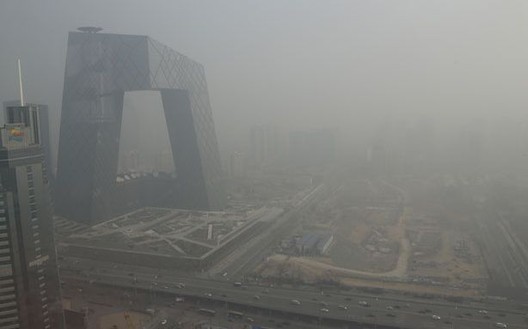
I remember the smog in Beijing rendering the most beautiful skies. There was an innocence to the air pollution back then, before the engines of economic development really got going.
It was just a pretty sunset, or a delicate brown haze that romantically softened the edges of things—while wrecking your lungs, of course. But, like the sand storms, pollution gave the city a different, rarified quality.
Going back to where it all started, TEX-FAB will be holding their Parametric Design and Digital Fabrication Conference at the University of Texas Arlington School of Architecture from February 28 to March 3. The event will include their largest selection of workshops and a full day symposia, which will culminate in the exhibition opening of the APPLIED: Research Through Fabrication competition winner. Ranging from basic for beginners to advanced for the experienced user, a broad spectrum of cutting edge workshops will be offered for this year’s conference by industry leaders. To register, and for more information, please visit here.
Opening tomorrow, January 17, at the Danish Architecture Centre (DAC) in Copenhagen, Denmark, the ‘In Dialogue with the World’ exhibition, which runs until March 10, will show how architects today engage far beyond aesthetics when designing buildings. schmidt hammer lassen architects, along with Henning Larsen Architects, and ADEPT will invite visitors to listen to their accounts of what it is like to work in the field of architecture in the 21st century. With the title Give more, the schmidt hammer lassen architects’ part of the exhibition uses eight selected projects as examples of how buildings, aside from being beautiful, give more. More information after the break.
Designed by STAPL Architects at the popular diving hub of the Philippines, the Oceo Drive tourist resort is a beachfront property which has multiple dwelling options ranging from single studio rooms, suites, sky villas, bungalows and beach facing villas. With the intention to be on an axis which aligns all its rooms and public spaces towards the overwhelming view of the beach and sea beyond, the resort makes for a perfect summer getaway. More images and architects’ description after the break.
For the 4th consecutive year, we are proud to announce the Building of the Year Awards. During the past year we continued to grow, reaching over 280,000 daily visitors and close to 70 million page views per month. We also expanded our ever-growing network of architects on social media: 640,000 fans on Facebook, 105,000 followers on Twitter, 40,000 followers on Instagram and more than 100,000 photos contributed to our Flickr group.
But ArchDaily is more than numbers. The world faces fundamental problems, related to health, energy, climate, and more. And almost all these problems are related to the built environment.
We launched ArchDaily Mexico this year, which joins ArchDaily, ArchDaily Brasil and Plataforma Arquitectura in our mission to improve the quality of life for the 3 billion people who will live in cities in the next 40 years. How can we do this? By providing the inspiration, tools and knowledge to the architects who will face this challenge. By connecting the traditional hot-spots of architectural production with emerging economies (where a lot of innovation is happening). We believe that, in this way, the constant iteration of architecture will accelerate and result in better and faster solutions to the world’s issues.
That’s why the Building of the Year Awards are so important for us. It is a peer-based award process that identifies and recognizes projects with impact. It will be up to you, the architect, to nominate and choose the winners for each category. It will be up to you to be a part of a collective intelligence that will judge more than 2,700 projects – a scope we think is unprecedented in the world of architecture.
For the next 4 weeks, you’ll be in charge of nominating buildings for the shortlist, and then voting for the winners. We will give away iPad Minis and 4th Generation iPads for voters, and will include amazing plotters (courtesy of our friends from HP) for the firms behind the two projects with the most votes.
Rules at a glance: During the nominating stage, each registered user of the My ArchDaily platform will be able to nominate once per day for their favorite projects (published between Jan 1st 2012 and Dec 31st 2012), the counter resets at midnight EST. This stage starts on Jan 15th and ends on Jan 29th at 11:59PM. After this, five projects per category will move into the voting stage, starting January 30th and ending on February 13th. The winner will be announced on February 14th. Start voting here.
Created and conceived by Patrick Duffy, the creative director of the OUT NYC, and designed by award-winning Italian designer and architect Antonio Pio Saracino, the Arches of Hope installation will be launched at its opening reception on Thursday, January 17, from 6:30pm-8:30pm at the OUT NYC and be on display until January 24. In collaboration with Lifebeat: Music Fights HIV/AIDS and the MTV Staying Alive Foundation, the stunning and inspiring interactive art installation will be unveiled on the eve of President Obama’s second inauguration as part of a multi-faceted campaign aimed at raising awareness of the rise of HIV and AIDS in young people. More images and information after the break.
At almost a mile long Superkilen wedges through one of the most ethnically diverse and socially challenged neighborhoods in Denmark creating a truly unique urban space with a strong identity on a local and global scale. The park is divided into three zones: the red square, the black market and the green park and is conceived as a giant exhibition of urban best practice - a collection of global everyday objects from the 60+ home countries of the local inhabitants. Initiated by the City of Copenhagen and Realdania Foundation, the project started construction in 2009 and opened to the public in June 2012. The American Institute of Architects (AIA) has selected Superkilen as one of the winners of the 2013 Institute Honor Awards, the profession’s highest recognition of works that exemplify excellence in architecture, interior architecture and urban design.
John Robertson Architects (JRA) just won an international competition to design a new 16,400m2 headquarters for BANKMED in Beirut, Lebanon. Located at the center of the Mina El Hosn district and near to central Beirut, will become a landmark in Beirut and provide an innovative, stimulating and practical environment for employees, executives and the bank’s customers. Their proposal includes three interconnected office pavilions, which step up in height from 9 to 19 storeys. More images and architects’ description after the break.
Mexican architect Fernando Romero will be speaking tomorrow evening, January 16, at NewSchool of Architecture and Design in San Diego on the topic of “You are the Context” as part of the school’s lecture series. Free and open to the public, the event focuses on how we must reconsider the definition of context as it pertains to architecture as the global reach of projects increases through digital communication. Named to Fast Company’s Co.Design “Designers Shaping the Future” 2012, his recent Soumaya Museum in Mexico City is described by CNN’s Great Buildings series as “jaw-dropping.” For more information, please visit here.
Finalists of AECOM’s fourth annual Urban SOS student competition have been announced! Understanding that this rapidly globalizing world is currently undergoing mass migrations, geo-political shifts and new patterns of commerce, which enhance the role of cities as the stage sets for these massive changes, Urban SOS challenges design, architecture, landscape, planning, engineering and environmental studies students to address a specific brief around urban sites in distress with an implementable architectural intervention that is grounded in a truly cross-disciplinary response.
This year, the competition identified ‘Frontiers’ as the driving theme of the Urban SOS competition. The challenge attracted hundreds of student teams representing universities in more than 60 countries. Three finalist teams have been selected after a series of internal judging sessions involving AECOM designers, planners and engineers around the world. Now, these finalists will present their ideas tomorrow, January 16, at a free event in New York’s Center for Architecture (RSVP here!). Continue reading for more details.
Two key events are coming up at SCI-Arc this month starting with the ‘Dwayne Oyler & Jenny Wu: Lineworks’ lecture which takes place tomorrow, January 16, at the W.M. Keck Lecture Hall at 7pm PST. Established in Los Angeles in 2004, Oyler Wu Collaborative, ‘has utilized the last five years to establish a way of working that is committed to experimentation through a relentless hands-on approach to our work’. Also, starting January 18 until March 3, the ‘Marcelyn Gow + Ulrika Karlsson: AQUEOTROPE’ exhibition focuses on materializing the mathematical, the exact translation of virtual instructions in the form of drawings or codes to their material actualization, is a fundamental procedure in the production of architecture. For more information on the events, please visit here.
Brad Feinknopf, a nationally recognized architectural photographer, kindly shared with us his recent photographic work on Zaha Hadid‘s Eli & Edythe Broad Art Museum at Michigan State University. Known for his traditional, yet cutting edge approach to photography, his quality work here emphasizes the unique exterior and interior spaces of the building created by Hadid’s investigation into the lines of circulation and visual connections. Photographed during the day and night, he also captures its interface between city and campus. Additional images by Feinknopf can be viewed after the break.
Located in the heart of Jerusalem, next to Israel’s government assembly building, the second prize winning proposal in the Jerusalem Museum of Nature & Science competition creates a vibrant flexible building that integrates seamlessly into the landscape and urban setting. Designed by MYS Architects, their design approach was sustainability driven from the get go. More images and architects’ description after the break.