


Buildner, in partnership with the Government of Dubai, has announced the results of the 2024/25 House of the Future competition. Following the success of its inaugural edition in 2023, this second edition invited architects and designers worldwide to develop an affordable, expandable, and forward-thinking prototype home tailored to the evolving needs of Emirati families.
Organized in collaboration with the Mohammed bin Rashid Centre for Government Innovation and the Sheikh Zayed Housing Programme, the competition offered a total prize fund of €250,000 (1 million AED). Winning entries are now being reviewed for potential inclusion in the UAE's national catalogue of housing designs, which provides citizens with a selection of pre-approved, innovative home models.
Participants were asked to propose a model single-family home for modern Emirati living — one capable of adapting to future expansion, integrating sustainable technologies, and responding to the social and climatic conditions of the UAE. Each submission addressed a standard 450-square-meter development plot.
The response was significant: entries arrived from individuals and teams across 122 countries, demonstrating global interest in shaping the future of Emirati housing.
The international jury assessed the submissions based on a balance of visionary thinking and practical feasibility. Emphasis was placed on compact planning, clear circulation, and material choices suitable for local construction. Passive cooling, wind towers, and water features were commended where technically feasible and meaningfully integrated. The panel also valued designs that proposed strong street-facing frontages and cohesive community layouts while maintaining cost efficiency.
Jury Panel:
- Alison Brooks – Alison Brooks Architects, UK
- Ahmed Bukhash – Founder of Archidentity, UAE
- Micael Calatrava – Calatrava Grace and Calatrava International, UAE
- Sumaya Dabbagh – Dabbagh Architects, UAE
- Andrew Mason – Director of Contracts, Calatrava International, UAE
- Will Plowman – Partner, Foster + Partners, UAE
- Bertrand Schippan – Partner, MVRDV, Netherlands
- Charles Walker – Director, Zaha Hadid Architects, UK
Full details of the winning projects are available on the 2024/25 House of the Future competition website.
Buildner's other ongoing competitions include The Unbuilt Award 2025 celebrating visionary architectural designs that have yet to be realized, open to architects, designers, and students worldwide, with a €100,000 prize fund; the 10th edition of the Kingspan Microhome Competition, inviting designers to propose innovative, sustainable microhomes with a total prize fund of €100,000; and the third edition of the Kinderspace Competition, which challenges architects to reimagine early childhood learning environments that foster creativity, flexibility, and engagement with nature.
Projects:
Innovation Award
Project title: The Local House
Authors: Griffin James Collier and David Alston Langdon of Archipelago, United Kingdom
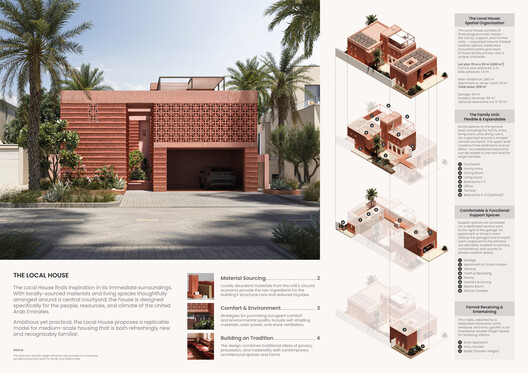
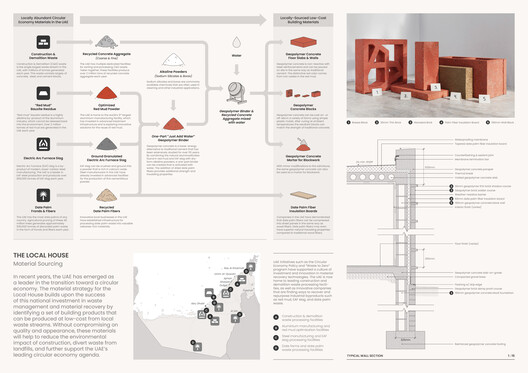
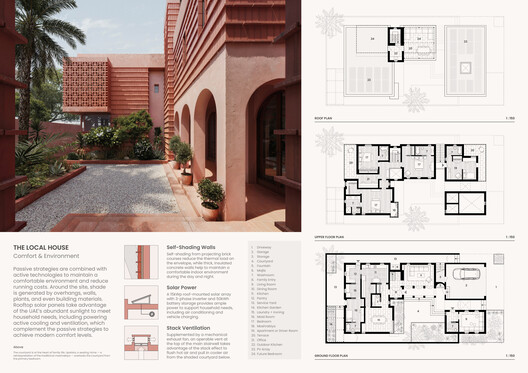
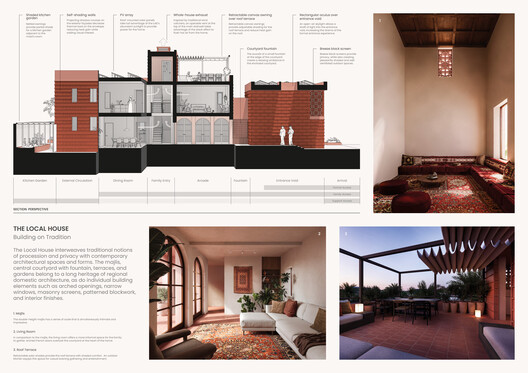
The Local House is a medium-scale residential prototype designed for the UAE that integrates traditional spatial hierarchies with contemporary environmental performance. Organized around a central courtyard, the house separates family, formal, and support functions into distinct volumes to provide privacy and clarity of use. Self-shading brick facades, stack ventilation, and rooftop solar panels support passive and active climate control strategies. Materials are sourced from the UAE's circular economy, including geopolymer concrete, recycled aggregates, and palm fiber insulation. The project proposes a replicable model that respects local customs and environmental conditions while addressing modern comfort and resource efficiency.
Buildner Sustainability Award
Project title: regenerative vernacular
Authors: Nicolas Lapierre, Canada
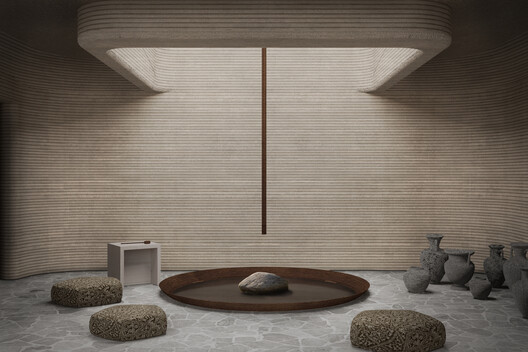
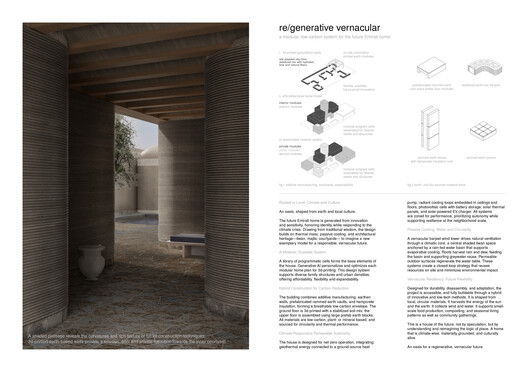
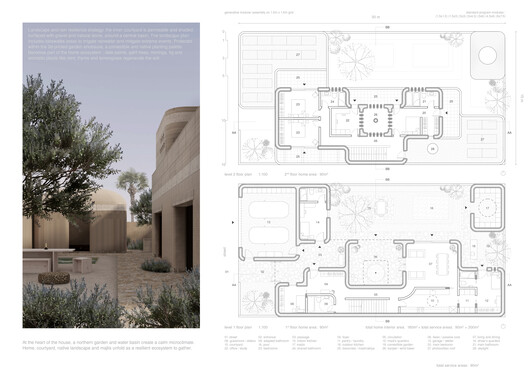
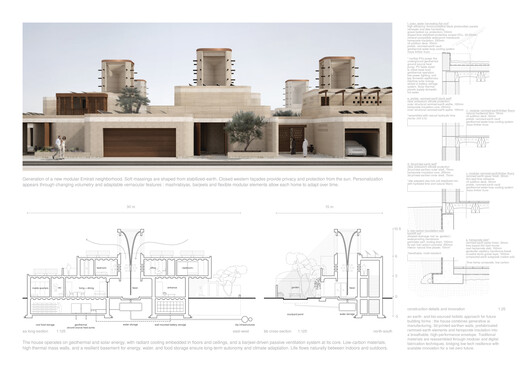
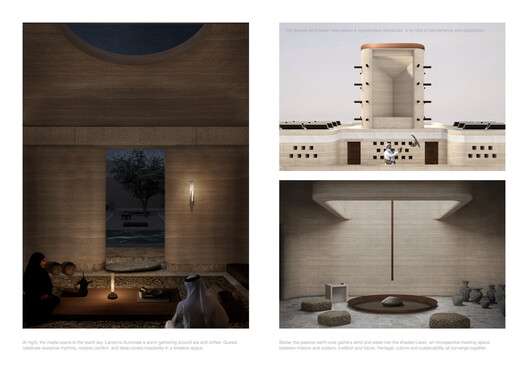
re/generative vernacular is a modular housing system, rooted in low-carbon construction and traditional spatial forms. The design employs a flexible kit-of-parts strategy using 3D-printed rammed-earth walls, vaulted ceilings, and modular timber or stabilized-earth components. Spaces are arranged around a shaded courtyard and passive cooling core, integrating a barjeel wind tower, rainwater harvesting, and geothermal systems. The layout supports privacy, adaptability, and resilience, with zones for living, working, and gathering organized by thermal performance and use. Circular economy materials and site-responsive planting strategies enhance sustainability, positioning the house as a scalable model for future Emirati living.
Highlighted submissions
Project title: House of the Future – Building Resiliency
Authors: Martin Knap and Kate Margaret Kittredge, Canada
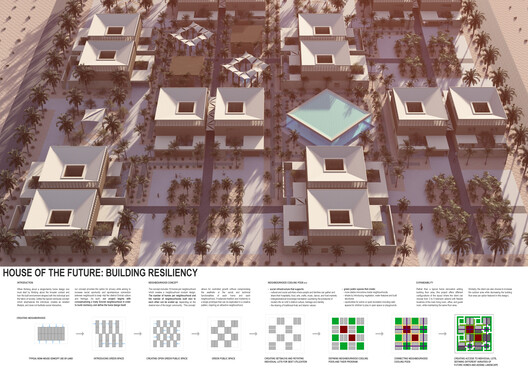
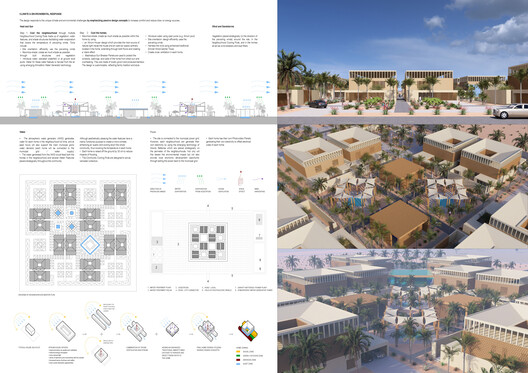
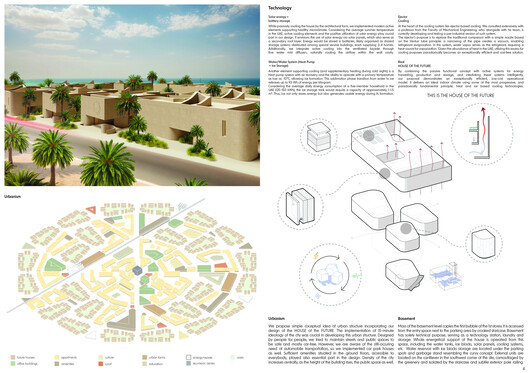
House of the Future – Building Resiliency proposes a modular neighborhood strategy rooted in Emirati cultural traditions and climate responsiveness. Sixteen courtyard-centered homes form each neighborhood module, creating a flexible urban grid that scales to different community sizes. Central green corridors, shaded pedestrian paths, and integrated cooling pools generate comfortable microclimates while reducing energy demand. Each home employs a layered passive design: solar-oriented roofscapes, high thermal-mass walls, and integrated wind channels inspired by traditional barjeel systems. Private interiors open to shared semi-public courtyards, blending privacy with neighborly interaction and reinforcing social continuity. Modular building envelopes combine lattice shading, photovoltaic panels, and locally sourced materials to minimize embodied carbon and construction waste. This systemic approach unites architectural typology with environmental strategy, enabling controlled expansion, low-impact infrastructure, and a future-ready living model where homes and neighborhoods adapt seamlessly to both cultural and ecological needs.
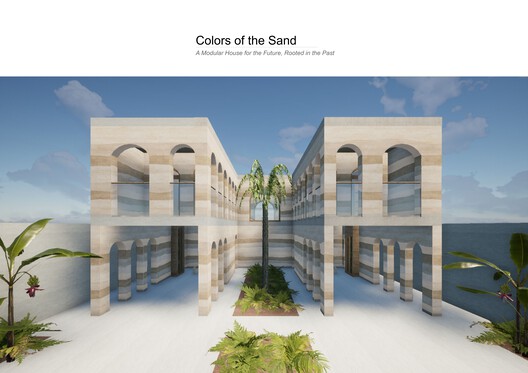
Project title: Colors of the Sand
Authors: Elena Stoyanova Marangozova – New Bulgarian University, Sofia, Bulgaria
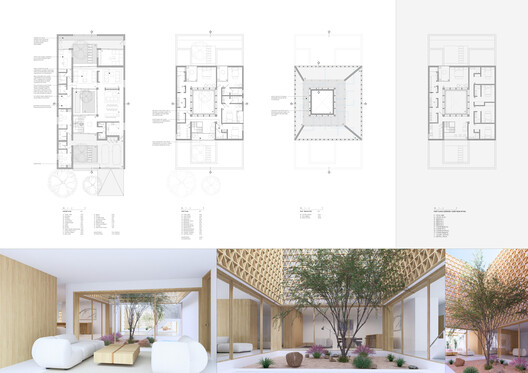
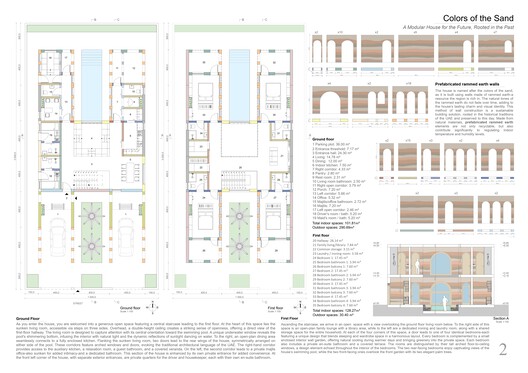
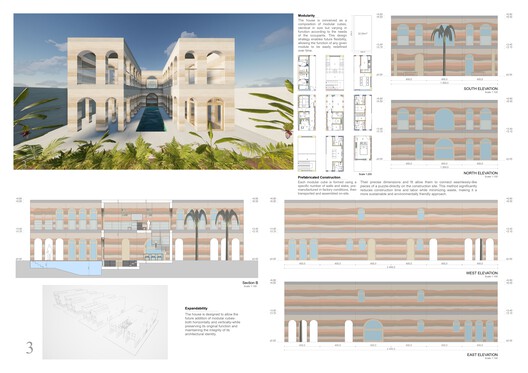
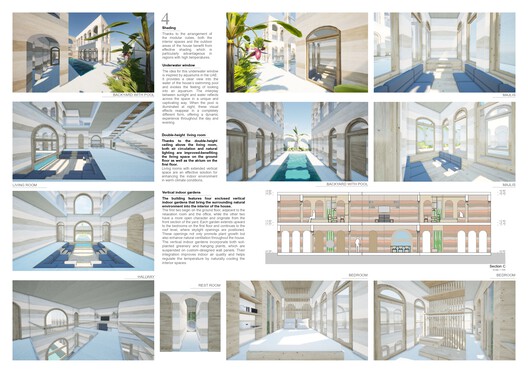
Colors of the Sand is a modular house concept that merges traditional Emirati architectural language with contemporary, climate-responsive design. Built from prefabricated rammed earth cubes, the house maximizes the natural resources of its context while allowing for horizontal and vertical expansion without compromising its original form or identity. Arched doors and windows reference UAE heritage, while double-height living spaces improve air circulation and natural lighting. An innovative underwater window overlooks the courtyard pool, capturing dynamic reflections of sunlight and water to animate the interiors. Four vertical indoor gardens extend through multiple levels, naturally cooling and ventilating the house while visually connecting indoor and outdoor environments. Prefabricated modular construction reduces on-site waste and accelerates building time, creating a resilient and adaptable housing model rooted in regional tradition yet geared toward future living.
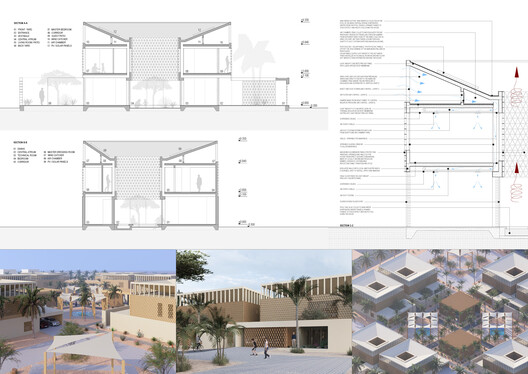
Project title: Zenith Balance
Authors: Bogdan-Constantin Neagu and Valentin Pirvu – Romania
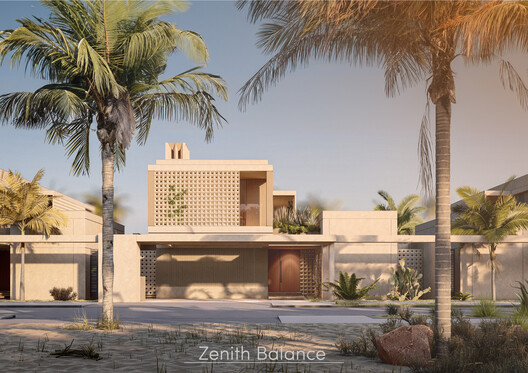
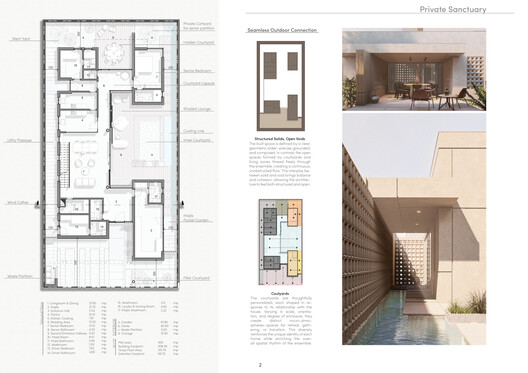
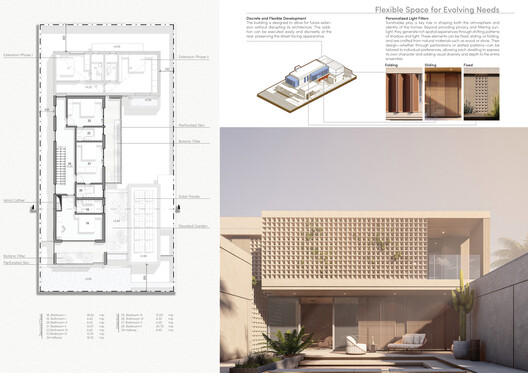
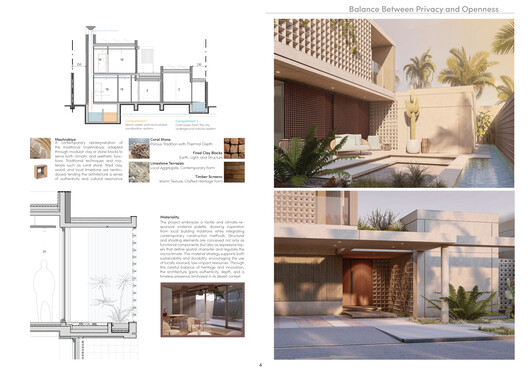
Zenith Balance reinterprets the Emirati courtyard house as a modular, climate-responsive dwelling organized around a sequence of distinct courtyards—majlis, main, intimate, and service—that create microclimates, enhance privacy, and naturally cool interior spaces. Solid geometric volumes and perforated skins balance enclosure with openness, allowing daylight and airflow to move through the home while maintaining a clear spatial hierarchy. The façades employ a modular mashrabiya system of clay or stone blocks combined with coral stone, fired clay, timber screens, and limestone terrazzo to regulate temperature, filter light, and anchor the architecture in local tradition. Interior layouts are designed for adaptability, with precast concrete panels reducing construction waste and embedded expansion zones enabling discreet growth without disrupting the street frontage. This single system unites heritage materiality, passive cooling strategies, and flexible planning to produce a low-impact, culturally resonant home suited to the UAE's evolving domestic needs.
Project title: Modular Heritage
Authors: Santiago Andres Herrera Baez, Sergio David Cortes Aya – United States
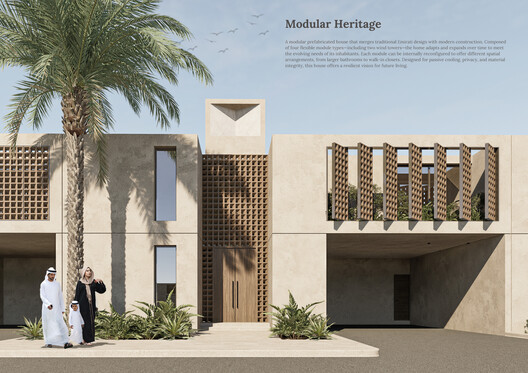
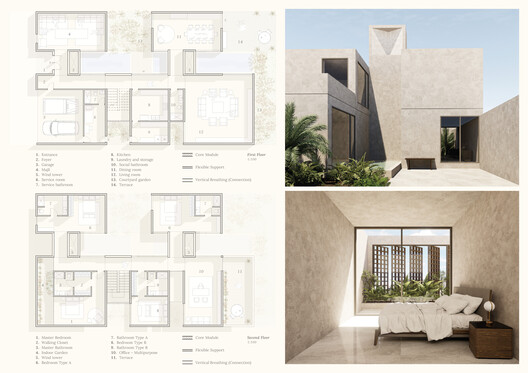
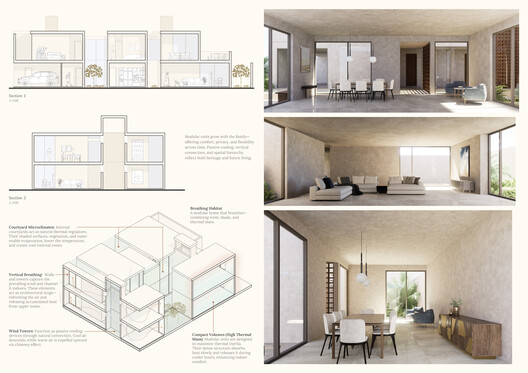
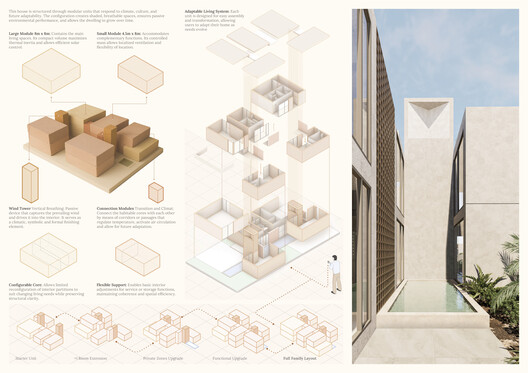
This modular prefabricated house merges Emirati architectural heritage with contemporary construction to create a flexible, climate-responsive home. Using four module types—including wind towers, large living spaces, small rooms, and wooden connection modules—the design can expand or reconfigure over time to meet changing needs. Passive strategies such as shaded courtyards, mashrabiya-inspired screens, and cross-ventilation establish comfortable microclimates while preserving privacy. Prefabricated structural elements and lime plaster walls reduce construction time and environmental impact, ensuring cultural continuity while offering a scalable, adaptable model for resilient future housing.
Project title: Breeze
Authors: Jurij Čerňak, Lukáš Chudík, Sofia Čerňaková, Michal Urban – Apex A s.r.o., Slovakia
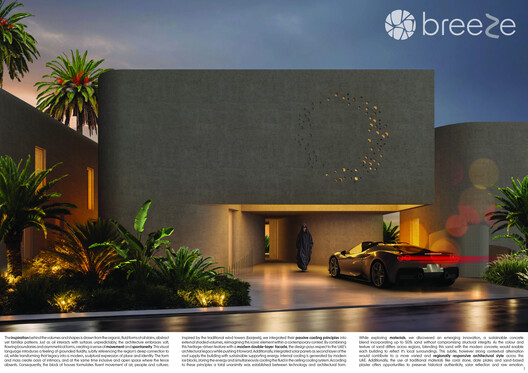
Breeze draws its formal language from the fluid and unpredictable patterns of oil stains, translating them into soft, asymmetrical volumes that evoke movement, spontaneity, and openness. The design merges Emirati heritage with forward-looking innovation, reinterpreting traditional wind towers (barjeels) as shaded exterior volumes and pairing them with a modern double-layer façade to enhance passive cooling and airflow. Integrated solar panels and internal ice-block cooling systems support the house's energy performance while creating comfortable interiors adapted to hot climates. Materially, the project advances a sustainable concrete blend incorporating up to 50% local sand alongside traditional elements such as coral stone, date plates, and sand-based plaster. This approach not only preserves a sense of regional authenticity but also produces a varied, responsive architectural identity across the UAE, blending technology, sustainability, and cultural memory into one cohesive system.
Project title: PLOT.TWIST
Authors: Livia-Maria Stanciu, Diana-Cristina Geru, Angelo Antonucci, Mihail Ceban – K2 Design Lab, Romania
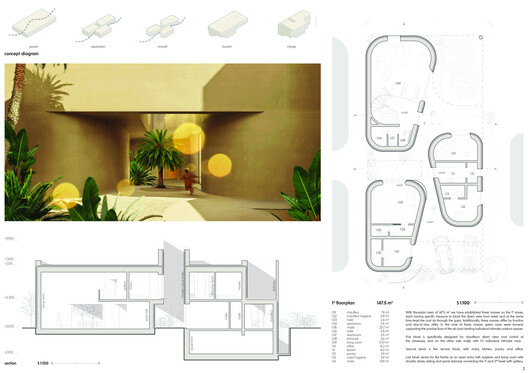
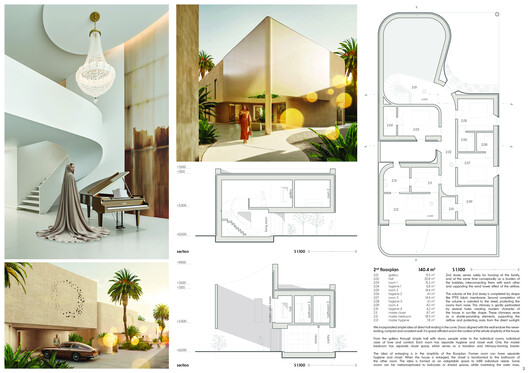
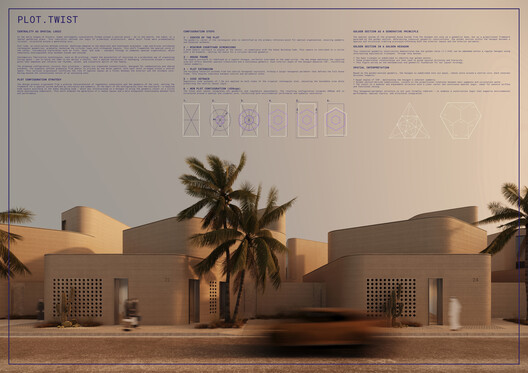
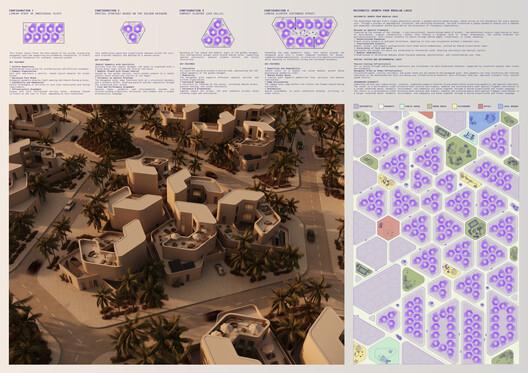
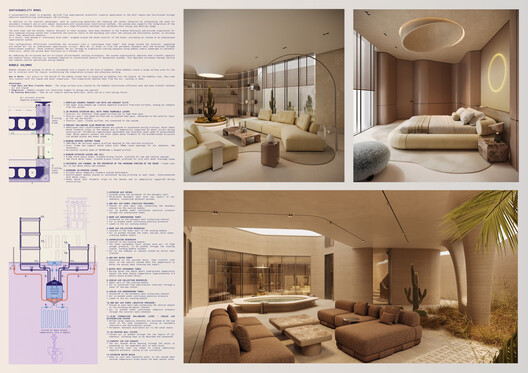
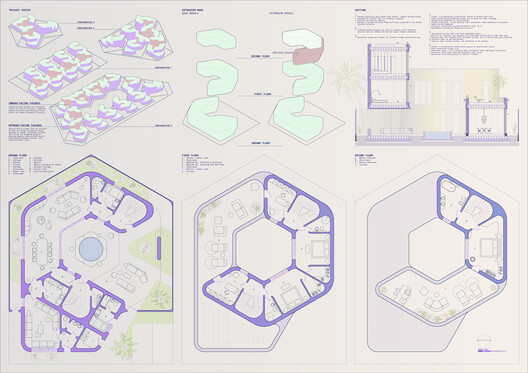
PLOT.TWIST reinterprets the Emirati courtyard house as a radial, modular prototype centered on a hexagonal courtyard derived from the golden section. Using 3D-printed walls with embedded air channels and underground cooling, the dwelling integrates passive environmental control directly into its structure, reducing reliance on mechanical systems. The plan rejects front-back hierarchies in favor of a center-periphery layout that encourages openness, inclusion, and climatic performance. Modular units radiate from the core, enabling flexible aggregation into linear, radial, or compact clusters at the neighborhood scale. Courtyards, micro-nebulization, and thick thermal walls establish shaded, low-energy living environments, while golden-section proportions provide coherence and scalability. This approach unites form, material, and climate strategy into a single system, offering a housing model that bridges tradition and innovation while adapting fluidly to future family structures and urban growth.
Project title: Threads of Heritage
Authors: Anna Zyerova and Alona Fedko – Ukraine
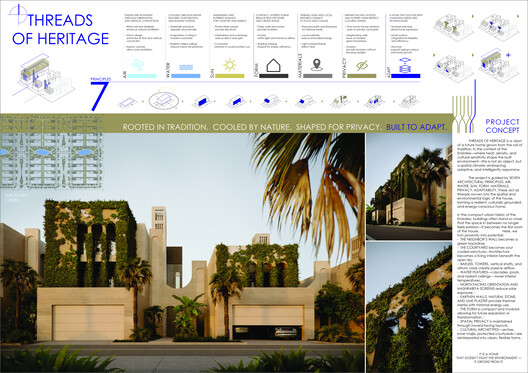
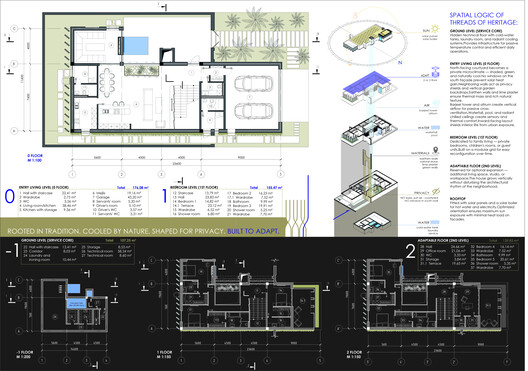
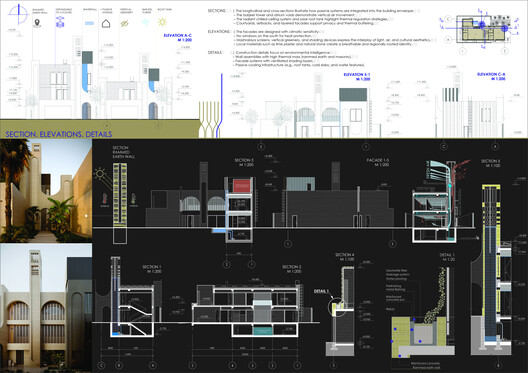
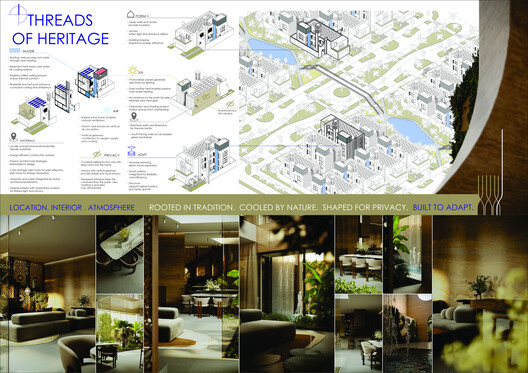
Threads of Heritage envisions a future-ready Emirati home that grows from its environment rather than fighting it. Organized around a shaded, north-facing courtyard, the design transforms dense urban proximity into privacy and microclimatic comfort, using green walls, water features, and layered setbacks to cool and filter the air. Traditional elements such as barjeel towers, atrium voids, arches, and mashrabiya screens are reinterpreted as passive performance systems that enhance airflow, regulate sunlight, and provide seclusion. Built from rammed earth, lime plaster, and limestone, the home's compact massing and deep niches minimize heat exposure while photovoltaic panels, solar boilers, and radiant cooling systems reduce energy demand. A modular grid allows the house to adapt vertically or horizontally over time, supporting future family needs without compromising cultural or climatic responsiveness. By weaving air, water, sun, form, materials, privacy, and adaptability, Threads of Heritage creates a living system rooted in tradition and shaped for resilience.
Project title: Nafas – The Porous Skin House
Authors: BLU by Yasser Kaaki, Saudi Arabia
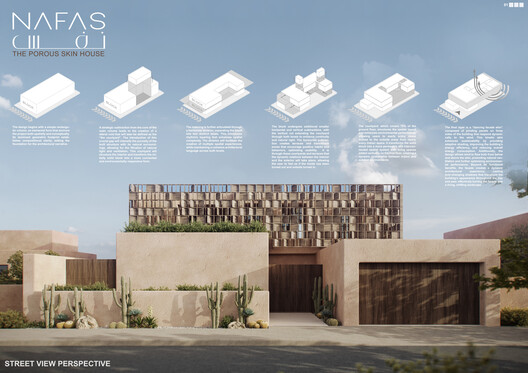
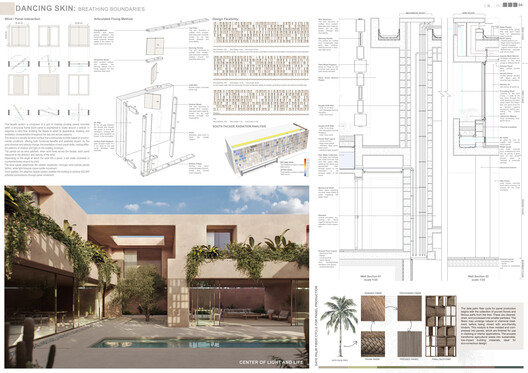
Nafas reinterprets the Emirati courtyard house as a porous, breathing habitat designed to harmonize with the desert climate. At its core lies a central open court that anchors the home's social and thermal life, linking all rooms to a shaded, wind-cooled sanctuary. The defining feature is its "dancing skin" façade — a kinetic lattice of pivoting panels that shift with the breeze to create changing patterns of shade, transparency, and airflow. This dynamic envelope, combined with integrated wind towers, passive cooling systems, and locally sourced low-energy materials, reduces heat gain and energy use while maintaining privacy. The design prioritizes minimal ground coverage and layered massing to improve thermal comfort and daylighting. By merging climate-responsive strategies, flexible spatial organization, and a strong cultural narrative, Nafas offers a living architecture that blurs boundaries between inside and out, transforming environmental forces into an active part of daily life.
Project title: Al Wasl – Interweaving Space, Climate & Wellbeing
Authors: Sumana Hossain, Akm Abul Hossain Bhuiyan – UAE
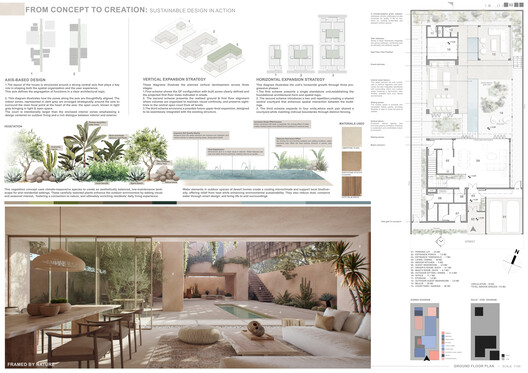
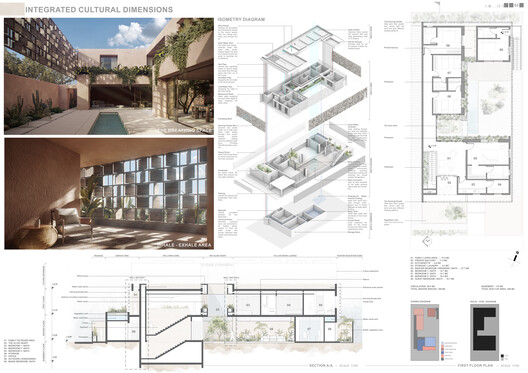
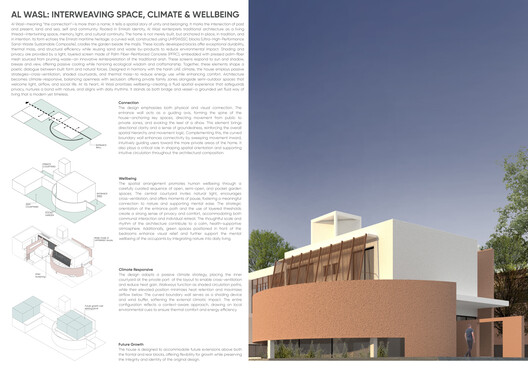
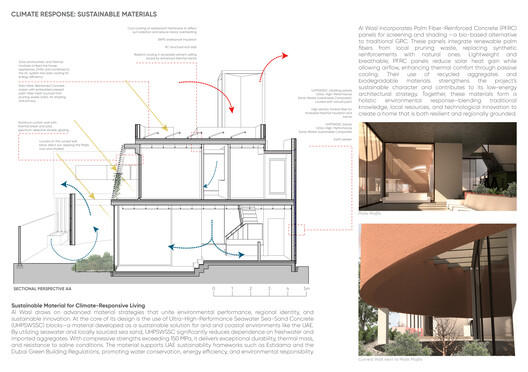
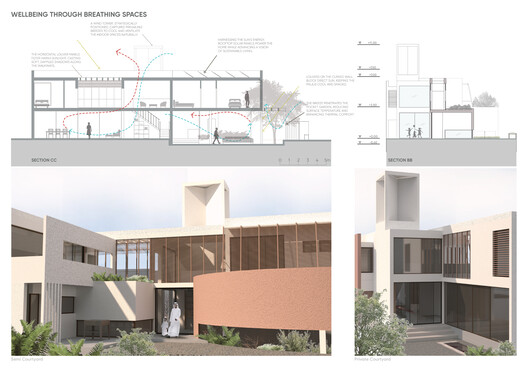
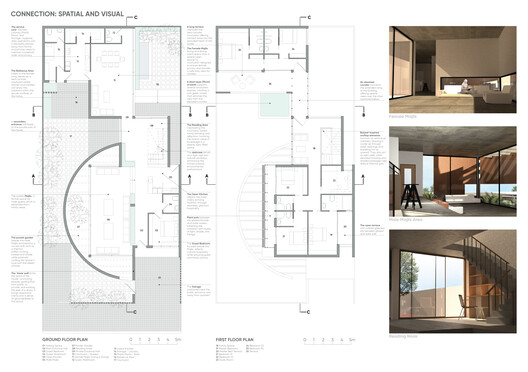
Al Wasl translates as "the connection," reflecting its aim to unite tradition, climate, and contemporary living within a single, flowing architectural language. Drawing from Emirati maritime heritage, the house features a curved garden wall built from Ultra-High-Performance Sand-Waste Sustainable Composite (UHPSWSSC) blocks, combining exceptional durability, thermal mass, and resource efficiency by reusing local sand and waste by-products. Shading and privacy are achieved through Palm Fiber-Reinforced Concrete (PFRC) screens, which reinterpret the traditional arish using renewable palm fibers to provide passive cooling, filtered light, and airflow. Inside, shaded courtyards, cross-ventilation, and layered spatial organization balance openness and seclusion, creating a fluid indoor–outdoor experience. Together, these strategies reduce energy use while enhancing comfort and wellbeing, aligning the home with UAE sustainability frameworks. Al Wasl stands as a resilient, climate-responsive dwelling—anchored in heritage, shaped for privacy, and designed to adapt with its inhabitants over time.
Project title: Sa'af Al Nakheel House
Authors: Amal Mohammed Ahmed Ali, Nihal Saifalislam Saeed A Alsabbagh, Suaad Ahmed Juma Alsuwaidi – UAE
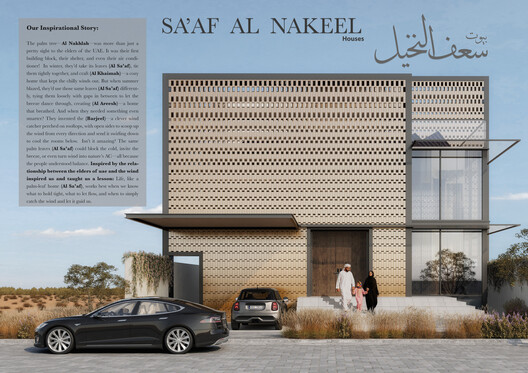
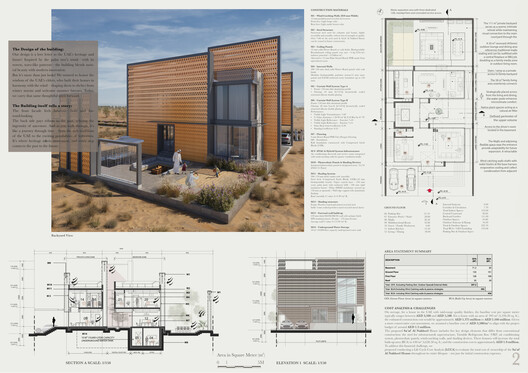
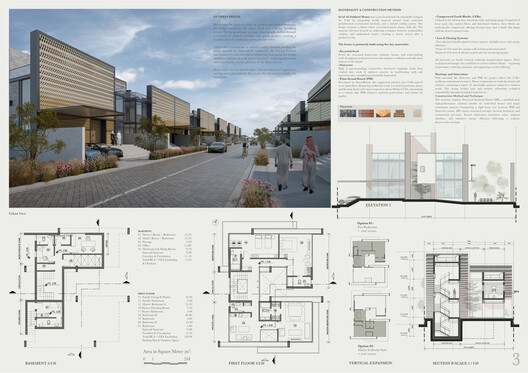
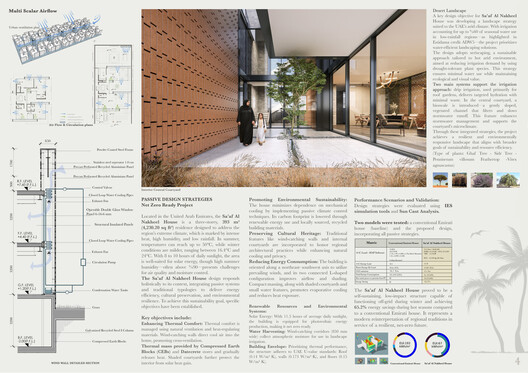
Sa'af Al Nakheel House draws inspiration from the traditional Emirati use of palm leaves—tight for warmth, loose for airflow, and elevated as barjeel wind catchers—to create a home that adapts naturally to climate and culture. Organized around shaded courtyards and cross-ventilated interiors, the design reinterprets these age-old techniques through contemporary materials and construction, balancing enclosure with permeability. Palm-fiber elements and barjeel-inspired towers guide breezes through living spaces, while modular layouts allow the home to shift between privacy and openness as family needs evolve. By merging the wisdom of Al Sa'af with modern passive cooling, renewable materials, and flexible planning, the house becomes both shelter and climate moderator, embodying a living memory of how Emirati communities once built in harmony with the environment and offering a future-ready model that holds, flows, and catches the wind.
Discover more groundbreaking competitions and award-winning entries from Buildner here.