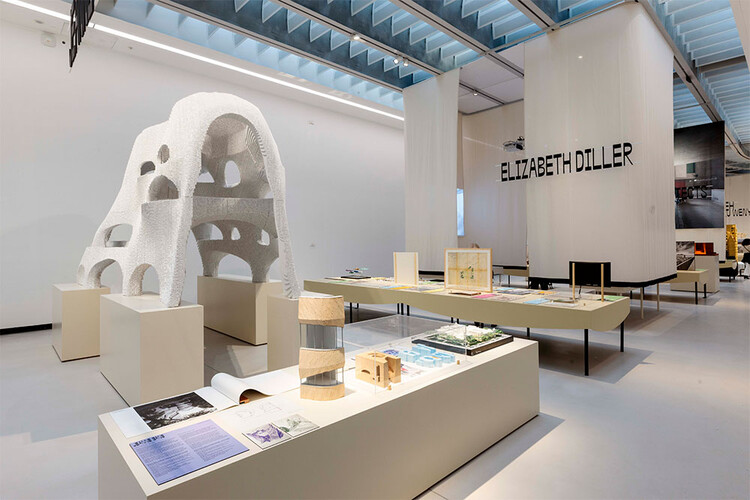
The Fujimoto Experiment: Five Students, Five Days, One Model

Last week an online call was put out by Rome’s MAXXI museum promising the first five architecture students to respond a chance to travel to Rome and build a model of Sou Fujimoto’s latest project. The five selected entrants started on their work at MAXXI on Monday and their experience is being broadcast over the course of this week in a series of photos and videos detailing the ups, downs, opinions and thoughts of the students as they work.
Read more about the model and exhibition after the break…
Update: Zaha Hadid’s Maxxi Museum faces Closure

Two weeks ago, we reported that Zaha Hadid Architects famed Maxxi Museum may face closure, as the high-profile museum was placed under special administration after the government uncovered a €800,000 hole in Maxxi’s 2011 accounts. With major budget cuts in cultural funding slashing the museum’s €11 million budget to less than €2 million for 2012, the future of the Maxxi remains unknown. However, as reported on BD Online, Maxxi president Pio Baldi has resigned and Italian architect Antonia Pasqua Recchia has been appointed to take his place.
Recchia has announced that she will to do everything possible to keep the Maxxi afloat and preserve the museum’s prestigious reputation on the international stage. She plans seek corporate sponsorship and private funding to make up lost funds and save the museum from closure.
Zaha Hadid’s Maxxi Museum faces Closure

Just two years after its opening, the Maxxi Museum in Rome is threatened with closure. The country’s current economic crisis has resulted in major cuts in cultural funding, causing a great deal of stress on the arts. As BD reports, earlier this month the museum was told that the government’s contribution to its €11 million budget would fall to less than €2 million for 2012. Now, as the museum officials failed to set a budget for 2013, the government has reportedly begun proceedings to put the high-profile museum under special administration.
Designed by Zaha Hadid Architects, the 2010 Stirling Prize winning national art and architecture museum has attracted more than 450,000 visitors per year. Hadid has described the museum’s success as “remarkable”, as it quickly built a prestigious, international reputation within the world of contemporary art.
Update: “WHATAMI” by sTARTT, winner of the 2011 YAP at the MAXXI

As we told you on a previous article, Italian firm sTARTT has been selected as the winner of the YAP summer installation at the MAXXI museum in Rome, as the result of a partnership with the MoMA and the MoMA P.S.1.
sTARTT’s entry WHATAMI is based on the manufacturing of an artificial archipelago-hill, generating smaller green areas in the garden and potentially outside the museum. The hill works as a garden, injecting “green” into the concrete plateau of the museum’s outdoor space, allowing it to serve as a stage and/or parterre for concerts and other events, or as a space to rest and look at the museum itself.
The artificial landscape will be punctuated by large “flowers” providing light, shadow, water, and sound. The materials proposed for the installation involve a two-fold recycling process, the supplying of the materials for the construction (straw, geo-textile, plastic) and the dismantling of the “hill” (turf, lighting).

stARTT is the brainchild of Simone Capra and Claudio Castaldo, a practice with interesting projects that move between landscape, city, infrastructure, and context. On this project they worked with Francesco Colangeli, Andrea Valentini and Massimo Brizzarielli worked as green consultants.
More details after the break.
sTARTT “WHATAMI” winner of the 2011 Young Architects Program at the MAXXI

As we told you weeks ago, the MoMA and PS1 have partnered with the MAXXI (the National Museum of the 21st Century Arts in Rome) on their Young Architects Program. This partnership will result in a summer installation in the exteriors of the italian museum (a Zaha Hadid building completed last year). This installation will happen at the same time as the one at the P.S.1, designed by Interboro Partners.
The winning propostal WHATAMI by Italian architects stARTT is based on the manufacturing of an artificial archipelago-hill, generating smaller green areas in the garden and potentially outside the museum. The hill works as a garden, injecting “green” into the concrete plateau of the museum’s outdoor space, allowing it to serve as a stage and/or parterre for concerts and other events, or as a space to rest and look at the museum itself.
The artificial landscape will be punctuated by large “flowers” providing light, shadow, water, and sound. The materials proposed for the installation involve a two-fold recycling process, the supplying of the materials for the construction (straw, geo-textile, plastic) and the dismantling of the “hill” (turf, lighting).
Video: King Abdullah Petroleum Studies and Research Center (KAPSARC) / Zaha Hadid Architects
Here is a video about one of Zaha Hadid‘s latest project, King Abdullah Petroleum Studies and Research Center (KAPSRC) in Riyadh, Saudi Arabia. This project has a holistic approach unifying architecture and engineering, landscape and building artist expression and environmental responsive design. It is intended to not only be a leading research facility, but also a LEED Platinum certified building upon its completion.
We recently featured Zaha Hadid, as she won this years esteemed RIBA Stirling Prize for the design of the MAXXI National Museum in Rome. Full coverage of the RIBA Stirling Prize along with photographs of the MAXXI can be found here.
Also you can check our previous coverage of Saudi Arabai – in particular last year ArchDaily personally visited Saudi Arabia for the opening of the King Abdullah University of Science and Technology, an international graduate-level research institution. Photographs and a write up on KAUST here.