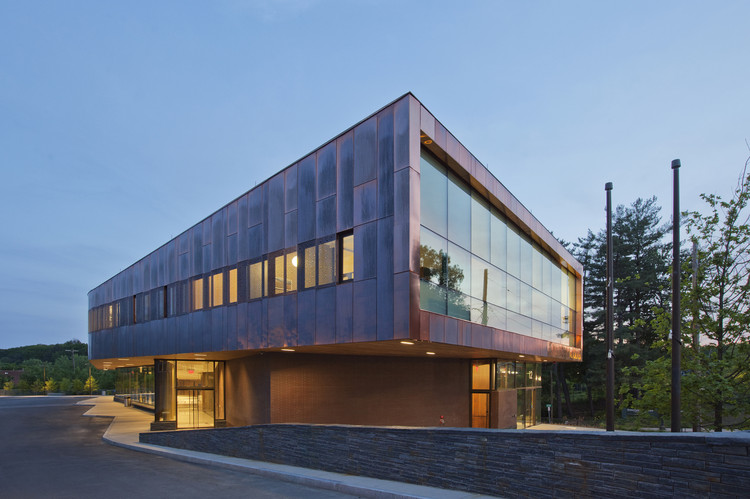
ICEWALL / Yushiro Okamoto

As a part of MIT’s 150th anniversary celebration, a student competition was held for a installation to become part of the festivities. Yushiro Okamoto‘s winning proposal, ICEWALL, has recently been completed and has been submitted to share with us here at ArchDaily. Follow after the break to browse through a large collection of photographs of the project.
Page Road House / Andrew Cohen Architects

Architects: Andrew Cohen Architects
Location: Lincoln, Massachusetts, USA
Landscape Architect: Scott Carman
General Contractor: Jonathan Merz
Structural Engineer: Richmond So Engineers, Inc.
Civil Engineer: Dave Crispin
Photographs: Greg Premru Photography
BSA Headquarters / Höweler + Yoon Architecture

The Boston Society of Architects plans to move from its current location on 52 Broad Street to a new space at Atlantic Wharf, as part of a major transformation of the 1867 institution. As part of an open design competition, the BSA selected Höweler + Yoon Architecture’s proposal entitled: Slipstream Public Exchange. Images of the proposal, a fly through video and an architects description after the break.
Smith College Campus Center / Weiss Manfredi

Students at Smith College—the largest liberal arts institution for women in the country—are assigned to houses, many of them Victorian-era structures complete with living rooms. Meant to foster a collegial environment, while successful, they also create isolated communities. Broadening the opportunity for social interaction, the Smith College Campus Center serves as a mediating body, the only building at Smith available to all students, faculty, and staff.
Follow the break for more photographs and drawings of this Weiss/Manfredi project.
Architects: Weiss/Manfredi
Location: Smith College Campus, Northampton, Massachusetts, USA
Design Partners: Marion Weiss and Michael A. Manfredi
Project Manager: Tae-Young Yoon
Project Architects: Armando Petruccelli and Kian Goh
Project Team: Michael Blasberg, Lauren Crahan, Stephanie Maignan, Chris Payne, Jason Ro, and Yehre Suh
Structural Engineering Consultant: Weidlinger Associates Consulting Engineers
MEPFP Engineering Consultant: Jaros, Baum, and Bolles Consulting Engineers
Landscape Architecture Consultant: Towers|Golde Landscape Architects and Site Planners
Lighting Design Consultant: Renfro Design Group, Inc.
Civil Engineering Consultant: Fuss & O’Neill
Curtain Wall Consultant: R. A. Heintges Architects Consultants
AV/Acoustics/IT Consultant: Shen Milsom & Wilke
Food Service Consultant: Cini-Little International
Cost Estimator: AMIS Inc.
Waterproofing Consultant: James Gainfort
Construction Manager: Daniel O’Connell’s Sons, Inc.
Client: Smith College
Project Area: 60,000 sqf
Photographs: Jeff Goldberg
Firestone Pavilion / Newick Architects

Located in Longmeadow, Massachusetts, the site for this project is an existing 1960’s modern house with a 1980’s complementary addition, including a pool at the outset. Designed by Newick Architects, the design for the Firestone Pavilion needed to serve multiple functions as a car port and pool enclosure fence. The architecture pre-dated the current owner, who asked the architects to reinvent these spaces from the English trellis and dovecotes that originally maintained these spaces.
A 2010 AIA Connecticut Design Award recipient for Architecture: The Encompassing Art, the jury praised the Firestone Pavilion, “The sensitive handling of intersecting walls, beams and planes and the abstract sculptural quality of enclosures, such that it reminded us of a composition by the sculptor Donald Judd.”
Follow the break for more photographs and drawings of the pavilion.
Architects: Newick Architects
Location: Longmeadow, Massachusetts, USA
Structural Engineer: Michael Horton and Associates
Base Structure Contractor: Pearson Systems
Architectural Metals Fabricator: Lift Design and Fabrication
Glazing Contractor: Town & Country Glass
Project Year: 2010
Photographs: Courtesy of Craig Newick
Art of Americas Wing at the Museum of Fine Arts, Boston / Foster + Partners

The Museum of Fine Arts, Boston (MFA) recently unveiled their new Art of Americas Wing designed by Foster + Partners in collaboration with CBT/Childs Bertman Tseckares of Boston. The carefully designed wing, contributed to the restored and augmented visitors experience, that reinstates the original formal axis of the Musuem and its relationship to the linear Back Bay Fens park designed by Frederick Law Olmsted in 1877. The new wing hosts 53 new galleries including the Art of the Americas collections, and consolidates the Museum’s five great collections into a more cohesive and understandable whole.
Norman Foster commented that, “The MFA is more than a great cultural institution – it is the catalyst for the rejuvenation of an entire neighbourhood in Boston. Over time the Museum had lost its connection to the Back Bay Fens and the beautiful landscape of Frederick Law Olmsted’s ‘Emerald Necklace’. In restoring Lowell’s original plan and in opening up and reasserting the grand Fenway entrance, we have rediscovered this link. At the same time, we have drawn the landscape deep into the heart of the building and along Huntington Avenue. The result is a more legible museum that will create new connections between the park, the Museum and the local community.”
More details about the new Art of Americas Wing after the break.
Architects: Foster + Partners
Location: Boston, Massachusetts, USA
Foster + Partners Project Team: Norman Foster, Spencer de Grey, Michael Jones, Kate Murphy, John Small, William Castagna, Benedicte Artault, Robin Blanchard, Jan Coghlan, Chris Connell, Aaron Davis, Gennaro di Dato, James Edwards, Dagmar Eisenach, Morgan Fleming, Kristin Fox, Herbert Gsottbauer, Anthony Guma, Sean Hanna, Rie Haslov, Judith Kernt, Ismael Juan Khan, Kohelika Kohli, Abel Maciel, Peter Matcham, Pablo Menendez Paz, Aidan Monaghan, Yat Lun Ng, Mathis Osterhage, Silvia Paredes, Carol Patterson, Michael Pelken, Michael Richter, Katherine Ridley, Il Hoon Roh, Ingrid Sölken, Kinna Stallard, Matthew Stokes, Diego Suarez, Jane Tiley, Alexis Williams, Oliver Wong, Richard Yates
Architect of Record: CBT/Childs Bertman Tseckares Inc
Design Structural Engineers: Buro Happold
Structural Engineers of Record: Weidlinger Associates
Design MEP Engineers: Buro Happold
MEP Engineers of Record: WSP Flack + Kurtz
Landscape Architect: Gustafson Guthrie Nichol Ltd.
Civil Engineers: Nitsch Engineering Inc
Construction Management: George B.H. Macomber Company (Pre-Construction Services), Skanska USA Building Inc (Enabling Contractor), John Moriarty & Associates (General Contractor)
Client: Museum of Fine Arts, Boston
Project Area: 193,325 sqf (new construction)
Project Year: 2010
Photographs: Nigel Young, Foster + Parners
Boston Fusion / Bay Arch

The ambitious and successful award-winning architect, MAA Christian Bay-Jorgensen, from the architectural firm, Bay Arch, shared with us this unique and sustainable building at the harbour in Boston, Massachusetts. With affiliates in Ringkobing and Copenhagen and with creativity and energy in the blood, Boston Fusion will contain apartments and offices to create a new, green design in every sense with the help of eco-friendly materials from Icopal. This project also forms part of the plans for a new, green quarter called South Boston. More images and architect’s description after the break.
Lechmere Public Library / Alan Lu

At a time when the economic state of the United States is at a point where it is impacting the way students and current architects are going about designing certain building types, Alan Lu, who is currently the Presidential Fellow at MIT is deeply engrained within the realm of form, fabrication and the endless pursuit of luxury through space. His studies and research is demonstrated in his Lechmere Public Library design in Boston, Massachusetts where his hybrid form of institutional and private space combines to exist as a single entity. More images and description after the break.
Preservation Achievement Award Winners

The Boston Society of Architects shared with us their publication where members were given honorable recognition for receiving the Preservation Achievement Award by the Boston Preservation Alliance. While, undoubtedly, these iconic buildings have been highlights to the city of Boston, they are now being acclaimed for being buildings of historic preservation while creating a resounding impact for society and beyond. Flip through the Boston Society of Architects’ images to view stunning work by architects after the break.
Kripalu Center for Yoga & Health / Peter Rose + Partners

Massachusetts-based Peter Rose + Partners had a simple strategy for designing the Kripalu Annex, part of the largest and most established yoga retreat in North America. Rose wanted his architecture to speak to the spiritual and natural essence of yoga by creating elegant material relationships and crisp aesthetics.
More images and more about the yoga center after the break.
Simmons Hall at MIT/ Steven Holl

When Massachusetts Institute of Technology commissioned Steven Holl in 1999 to design a new a dormitory for the school they had one goal in sight: that the spaces around and within the building would stir up interaction among students. While MIT focused on the building’s use and function, Holl aimed to create a memorable building. With MIT’s vision in mind along with Holl’s artistic architectural ideas, the ten-story undergraduate dormitory became a small city in itself with balancing opposing architectural elements, such as solids and voids and opaqueness and transparency.
More on Simmons Hall after the break.
Pitch House / Carl Hampson & Eunike Design

Carl Hampson and Eunike Design recently designed the Pitch House for Belmont, Massachusetts. The home is the reinterpretation for the ideals of early European modernism as it “evolves the universal machine for living concept into a site-specific contemporary dwelling shaped by the local forces of climate, culture, and sustainability.” The main living spaces sit under a pivoting roof that responds to the changing seasons by providing the correct amount of sunlight and shade to the interior throughout the year. The constantly changing roof “provides a centerpiece for year round outdoor activities.” An open ended site strategy responds “to the transformation of suburban ideals facilitated by the influx of information technology” while the home’s orientation, active and passive solar strategies, thermal mass, and earthen berms collectively reduce year round energy loads.
More images after the break.