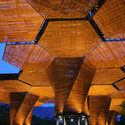
Orquideorama / Plan B Architects + JPRCR Architects

Uploaded by — Filed under: Infrastructure ,Selected ,Structures , , , ,
 

Architects: Plan BFelipe Mesa, Alejandro Bernal + JPRCR – Camilo Restrepo, J. Paul Restrepo
Collaborators: Viviana Peña, Catalina Patiño, Carolina Gutiérrez, Lina Gil, Jorge Buitrago
Location: Botanical Garden, Medellín,
Client: Medellin Botanical Garden
Builder: Ménsula S.A.
Project start: 2005
Completion: 2006
Budget: 523 US$ / m2
Constructed Area: 4.200 sqm
Materials: Wood,
Photographers: Sergio Gómez (SG), Camilo Orozco (CO), Felipe Mesa (FM), Izaskun Chinchilla (IC), Carlos Mario Rodriguez (CMR)

a. Architecture and organisms

The Construction of a Orchideorama should come up of the relation between architecture and the living organisms. It should not make any distinction between natural and artificial, on the contrary, it should accept them as a unity that allows architecture to be conceived as a material, spatial, environmental organization that is deeply related to the processes of life.

b. Two scales of the organic

panal scheme

The organic is understood in two different scales, and each of them allows us to understand different aspects of the project:
Micro scale: A scale that holds the principles of material organization, defines geometrical patterns, it is nature living structures configuration.
Visual – external scale: It allows us to relate phenomenologically and environmentally to the world, and perceive, notice the world.

c. The “organic” as material organization

The microscale of the organic, such as its capacity to be organized in precise laws of geometry patterns (Direct example: Honeycomb structure), allows us to build a single module (we call it Flower – tree, which mean a flower form figure with the size and properties of a tree), that when it becomes systematically repeated, it allows us to define growing properties, its evolution and its adaptability. Its geometry.

d.The “organic” as environmental phenomena

The big scale of biomorphic structures, and in this case specifically: Flowers or/and tress allows us to define perception as a situation where visitors can feel the extension of a forest, a shadow garden. In the other hand it allows us display a set of technical facilities such as collecting water and to structure the modules as hollow trunks.

e. Doing architecture as sowing flowers

We propose the Orchideorama to be built as sowing flowers: One flower – tree grows, and just beside it, another will appear, until the complete system of Flower – tree structures is defined. They can grow or be sow where is possible, adapting its system structure to the field where it is intended or needed.

f. An Orchideorama is not a storage facility structure

patios plan

Industrial architecture is not the response to develop an Orchideorama. The Orchideorama is composed of 10 Flower – tree structures, that can be built individually, and allow the system grow or response to any uncertainties, such as budget, construction inconvenients or political decisions.

g. Three species of Flower – Tree structures. Lively Patios

The Flower – tree structure has three different contents according to is location and its definitions. Each Flower – tree is “hollow” in the center and each of them configure a small hexagonal patio.
The patios have three different characters:

1. Flower – tree – Light (Small temporary gardens)
2. Flower – tree – plants (Orchids, exotic and tropical flowers)
3. Flower – tree – animals (Feeding birds facilities – butterfly breeding place)


Thumb up Thumb down 0

4:45 AM Sep 17th

Bia

Orquideorama / Plan B Architects + JPRCR Architects | ArchDaily http://t.co/6B3NOaV via @archdaily

Thumb up Thumb down 0

10:30 AM Mar 17th

Keenelandpicks.com

Another ominous sign for Keeneland undercard-Turfway closing for off-season stabling another sign Kentucky is in trouble http://shar.es/3QHP

Thumb up Thumb down 0

10:30 AM Mar 17th

Another ominous sign for Keeneland undercard-Turfway closing for off-season stabling another sign Kentucky is in trouble http://shar.es/3QHP

Thumb up Thumb down 0

11:43 PM Mar 31st

Orquideorama / Plan B Architects + JPRCR Architects | ArchDaily http://t.co/vqp1rnw

Thumb up Thumb down 0

1:05 PM Nov 10th

Orquideorama / Plan B Architects + JPRCR Architects | ArchDaily http://t.co/8sX9Omtg via @archdaily

Thumb up Thumb down 0

11:30 PM Feb 4th

@fredherba Então eu vou lá novamente, o cara é FERA: http://t.co/z0Esevat

Thumb up Thumb down 0

11:36 PM Feb 4th

@fredherba os caras são feras > http://t.co/z0Esevat

Latest Comments »

Why not try and improve the existing...[+]
What even is that lake room oval thing!!?? I still don’t know…[+]
why is there noone with the necessary NO !! don’t...[+]
Simplicity and complexity in the same place: composite functionality...[+]
why shall this happen again? the 70′ are back in town (do we...[+]

Upcoming Architecture Events »

got events? invite us! click here

Architecture Books & Magazines »

Volume 27: Aging

Volume 27: Aging

I never can get enough of Volume. This issue is loaded with provocative articles that stimulate discussion about a pressing reality, the dramatic demographic shift in the age of human populations. Throughout this issue there are articles like Martti…


Passive Solar Architecture / David A. Bainbridge and Ken Haggard

Passive Solar Architecture / David A. Bainbridge and Ken Haggard

David Bainbridge, founder of the Passive Solar Institute, recently sent us his book Passive Solar Architecture. The book is a great introduction for anyone interested in passive solar architecture. The content is kept simple and straightforward. It allows any…


Volume # 28: Internet of Things

Volume # 28: Internet of Things

This issue of Volume explores architects’ roles in the age of the internet. For us at ArchDaily, this is a topic we find very interesting. We ask all the architects we interview how the internet has changed their practice;…


Our partners »

AD on iPad via Pulse

Browse by date »

Browse by category »

Friends »