Barreiro College of Technology / ARX

Uploaded by — Filed under: Educational ,Selected , , , , ,
 

Architects: ARX PORTUGAL - José Mateus y Nuno Mateus
Location: Barreiro,
Project team: Paulo Rocha, Stefano Riva, Andreia Tomé, Clara Martins, Marco Roque Antunes, Nuno Grancho, Pedro Alves, Pedro Dourado, Pedro Sousa, Tânia Pedro, Francisco Marques, Sónia Luz
Client: Instituto Politécnico de Setúbal
Project year: 2001- 2003
Construction year: 2005- 2007
Constructed area: 10,500 sqm
Landscape: GLOBAL, Arquitectura Paisagista Lda.
Structure: TAL PROJECTO, Projectos, Estudos e Projectos de Engenharia Lda.
Photographs: FG + SG - , Sergio Guerra


The building site assigned for the School is located in the outskirts of the city of Barreiro. These are rural territories which were invaded by recent constructions intersecting green-gardens and reed plots.

Residence houses are predominant and other functions were not predicted for this area and so this neighbourhood is now just a suburb with little urban life. The soil, however, is quite interesting: broad, softly inclined and well-related with its shape – unevenness of 13,12 feet in perimeter to north and south – having at one end a dense forest of cork and large pine trees.

There are some projects that cause a public reaction even before its existence, and there one can find a great deal of important matters to consider. This school is such an example. The inhabitants of this “neighbourhood” protested against its existence because they wanted a primary school instead – which was transferred elsewhere -, but also because they feared the impact a building of large proportions would have, both visually and ecologically. Fearing that the trees would be cut down, they counted and marked every single one.

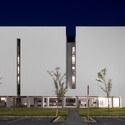
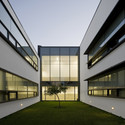
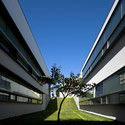
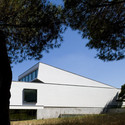
We aimed at imprinting to the building a somewhat ambiguous character. On one hand it “dissipates” and accepts the prevalence of the natural elements, on the other hand it deals with their presence as an artificial element of abstract origin. This principle is highlighted by the constructive choices: big coal-grey block that, when sectioned, reveals a white interior.

The architecture becomes more topographic in one of the extremities of the building, where there is no way to tell where the surrounding starts or ends, and in the opposite side, with its more present limits, defined by the alignment of the tops of the different bodies of the building.

The structure is placed in the middle of the lot, saving the third part to the north for parking and main entrance, whilst to the south the woods stop being a localized strip and now stretch around and over the building. From the set, one of the bodies of the building – the faculty area – rises in height, thus marking its presence within larger distances and configuring a new urban landmark.


Thumb up Thumb down 0
Eddie says:

Excelent work!

 
# October 8, 2008 at 18:01
Thumb up Thumb down 0
raúl says:

it looks very fun

 
# October 9, 2008 at 07:39
Thumb up Thumb down 0
2MACoff says:

ЛАДНО…

 
# May 28, 2009 at 14:11
Thumb up Thumb down 0
Goldschmidt R says:

i realy like it!

 
# November 30, 2009 at 01:28
Thumb up Thumb down 0

NICE & PURE FORMS¡¡¡ CONGRATULATIONS ARCHITECT ¡¡

 
# August 30, 2011 at 17:58

Leave a Reply »


Latest Comments »

“ditto”[+]
Architecture has been and always...[+]
I think the idea of the whole project...[+]
Another useless piece of junk from him – except this time it is dangerous!...[+]
Coffee with an Architect has got to stop; it’s pathetic.[+]

Upcoming Architecture Events »

got events? invite us! click here

Architecture Books & Magazines »

Architectural Lighting: Designing with Light and Space / Hervé Descottes with Cecilia E. Ramos

Architectural Lighting: Designing with Light and Space / Hervé Descottes with Cecilia E. Ramos

As part of Architecture Briefs series, produced by The Foundations of Architecture, this short book on lighting gives a very good introduction into architectural lighting. The authors start by explaining the six visual principles of light; illuminance, luminance,…


Thermally Active Surfaces in Architecture / Kiel Moe

Thermally Active Surfaces in Architecture / Kiel Moe

Departing from the simple question Why do we heat and cool buildings with air?, this book focuses on the technique of thermally active surfaces. This technique uses water in building surfaces to heat and cool bodies – a method


Cebra Files 02

Cebra Files 02

We recently received a monograph of Cebra’s work. This young firm is energetic, pushes the boundaries, goes after competitions, and has been successful in pushing many projects into reality. We are fan their work and have featured Cebra 16…


Our partners »

AD on iPad via Pulse

Browse by date »

Browse by category »

Friends »