
AD Classics: Vanna Venturi House / Robert Venturi

By — Filed under: AD Architecture Classics ,Houses ,Residential , , , , , , ,
 

© Maria Buszek

Most critics usually regard consistency in architecture an important aspect of the design. However in the Vanna Venturi House took the road less travelled and tested complexity and contradiction in architecture, going against the norm. Located in Chestnut Hill, Pennsylvania on a flat site isolated by surrounding trees, Venturi designed and built the house for his mother between 1962 and 1964. In testing his beliefts on complexity and contradition (for which he also wrote the book Complexity and Contradiction in Architecture), Venturi went through six fully worked-out versions of the house which slowly became known as the first example of Postmodern architecture.

More on the Vanna Venturi House after the break.

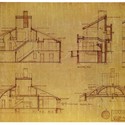
Approaching the Vanna Venturi house, one can detect the symbolic imagery of shelter through its exterior with its wide symmetrical gable like a classical pediment, which in this case is split, and the chimney poking out in an exaggerated manner from the back. The main entrance is in the center, creating a sense of symmetry that both is and is not there due to the placement of the windows. These windows are located based on function in the interior. For instance, there is a Modernist ribbon window for the kitchen and square windows serving the bedroom and bathroom on the other side of the front facade.

© UPenn

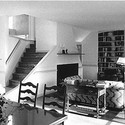
The interior is centered around the fireplace, the hearth of the home, but still Venturi’s design is a “generic” house with unusual twists. The plan contains only five functional rooms, and on the outside it relates to public scale, seeming much larger than it actually is. The “generic” fireplace is actually placed next to a stair that competes with the fireplace to be the core of the house. The fireplace is void, the stair is solid and both vertical elements contort in shape to make room for the other.

© Flickr - User: eloisemoorehead

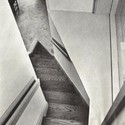
Upon entering there is the main living space. Also located on the first floor due to a request from Venturi’s mother are the kitchen and the bedroom. The second floor contains another bedroom, storage space, and a terrace. A “nowhere stair” on the second floor also integrates itself into the core space. It rises up at an awkward angle, and its function on one level is completely useless due to its steep slope, while on the other level it serves as a ladder to clean the high window on the second level.

© storiesofhouses.com

In order to create more contradiction and complexity, Venturi experimented with scale. Inside the house certain elements are “too big,” such as the size of the fireplace and the height of the mantel compared to the size of the room. Doors are wide and low in height, especially in contrast to the grandness of the entrance space. In the rear elevation of the house is an oversized lunette window, which follows the main elements of the exterior that are exaggerated in size. Venturi also minimized circulation space in the design of the house, so that it consisted of large distinct rooms with minimum subdivisions between them.

© storiesofhouses.com

Venturi referred to the exterior as a layering system. The effect intended was to make the exterior walls both walls and screens. For example, the east glass wall is recessed in order to form a covered yard screened by the back wall. This same idea is used on a smaller scale for the bedroom on the other side of the house.

A manifesto for Postmodern architecture, the Vanna Venturi house is a composition of rectangular, curvilinear, and diagonal elements coming together (or sometimes juxtaposing each other) in a way that inarguably creates complexity and contradiction.

Architect: Robert Venturi
Location: Chestnut Hill, Philadelphia, Pennsylvania,
Project Year: 1962-1964
Photographs: Depending on the photographs: On Flickr: eloisemoorehead, eamesd, and Maria Buszek, UPenn, storiesofhouses.com, and Venturi, Scott Brown & Associates Inc.
References: Venturi, Scott Brown, & Associates Inc., and
Davies, Colin. Key houses of the twentieth century. W W Norton & Co Inc, 2006. Print.

* Location to be used only as a reference. It could indicate city/country but not exact address.
 
 
Thumb up Thumb down 0

【archi info】 AD Classics: Vanna Venturi House / Robert Venturi http://dlvr.it/1Nn3K #AD_Classics (archdaily) #rental_archiinfo

 
# June 2, 2010 at 15:44
Thumb up Thumb down 0

AD Classics: Vanna Venturi House / Robert Venturi http://bit.ly/cde8DL

 
# June 2, 2010 at 15:44
Thumb up Thumb down 0

AD Classics: Vanna Venturi House / Robert Venturi via ArchDaily – © Maria Buszek Most critics usually … http://tinyurl.com/24ssqze

 
# June 2, 2010 at 16:20
Thumb up Thumb down 0

Vanna Venturi House on @archdaily http://ow.ly/1TsBF #architecture

 
# June 3, 2010 at 06:50
Thumb up Thumb down 0

@shotakeo 雑誌ちゃうで。分かるわー、忘れたくても忘れられんじゃろーて、この顔は。。http://www.archdaily.com/62743/ad-classics-vanna-venturi-house-robert-venturi/

 
# June 3, 2010 at 06:58
Thumb up Thumb down 0

AD Classics: Vanna Venturi House / Robert Venturi | http://vil.ag/9RpXgQ

 
# June 3, 2010 at 08:46
Thumb up Thumb down 0
Mark Gardner says:

AD Classics: Vanna Venturi House / Robert Venturi | ArchDaily http://bit.ly/bfglnY

 
# June 3, 2010 at 12:15
Thumb up Thumb down 0
Remkool says:

” going against the norms “…?
ah ah !
All in America is so…naive !
Culture, politic, architecture….
Susan Sontag where are you ?

 
# June 3, 2010 at 12:42
    Thumb up Thumb down 0
    plots says:

    I’ll take naivety over ignorant umbrella statements about other countries and cultures. Irrespective of the general feelings as regards post-modernism Venturi was an important player in developing architectural ideas as we apply them today, to simply give this building the brush off because you don’t like its aesthetics is as telling of your approach as your ignorance about America.

     
    # June 3, 2010 at 21:21
      Thumb up Thumb down 0
      H. Roark says:

      Well said Plots.

       
      # June 4, 2010 at 06:39
    Thumb up Thumb down 0
    jlbr says:

    How is it that all in America (I supppose you mean the USA), is all naive? How is Venturi’s work less or more naive than the work of Bofill, Botta, or Rossi to name some European PoMo architects (I am going to guess you are European), and how were they not sharing similar ideas to those of Venturi? I don’t get your comment at all.

     
    # June 4, 2010 at 19:40
Thumb up Thumb down 0
vw says:

AD Classics? …so guess by the inclusion of this heap of POMO that AD has dried up their reserves of “classics”?

 
# June 3, 2010 at 13:18
    Thumb up Thumb down 0
    PatrickLBC says:

    I’m not a big fan of pomo either, but…… This building has stood for over 40 years as THE prime example of the postmodern style. It is also one of the most famous buildings by Venturi, a giant in 20th century architecture. How is it NOT a classic?

     
    # June 3, 2010 at 13:48
Thumb up Thumb down 0
Jonas Abreu says:

Reading: "AD Classics: Vanna Venturi House / Robert Venturi | ArchDaily"( http://twitthis.com/fpcbnp )

 
# June 3, 2010 at 15:04
Thumb up Thumb down 0
jlbr says:

Yes, Venturi wrote better than he designed. He had quite interesting ideas and arguments to make against Modernism, he challenged the comfortable and dead-end position Modernism had come to in the 70s and came up with some interesting ideas about Post-modernism and architecture. Now, as for this building, it is pretty God-awful if you ask me, but IT IS A CLASSIC. If only for the ideas it represents. Thank God we have moved on though. NEXT!

 
# June 4, 2010 at 19:30
Thumb up Thumb down 0
JNK says:

whether you like or don´t like POMO, you have to admit it was really influential and has it place in history. it might be naive in details, but that movement had really good points about modernistic urban planning. For me: modernism: beautiful architecture, horrible urban plannuig . pomo: horrible architecture, but down-to-earth (man) urban planning

 
# June 5, 2010 at 07:48

Leave a Reply »


Latest Comments »

Molt interesant. La llastima es que per fer aquesta casa van destruir totes les...[+]
its a waste of material. bad stuff :|[+]
Tsvetan Sirakov on Gas Station / Atelier SAD
Nice one :) Reminds me of Wright’s Johnson Wax building… Well...[+]
Looks like it has a ton of potential. A largely walkable city with good...[+]
wow![+]

Upcoming Architecture Events »

got events? invite us! click here

Architecture Books & Magazines »

Chase for Space: An Architecture Challenge for the Future / Nejc Trošt

Chase for Space: An Architecture Challenge for the Future / Nejc Trošt

                          Open publication – Free publishing – More book

“Chase for Space: an architecture challenge for the future is an transdisciplinary book with wide overview of future space…


Log 23

Log 23

Log 23, like the other Log issues, gathered together a great collection of essays about architecture and the city. This issues features essays from notable people such as, Greg Lynn, Pier Vittorio Aureli, Joseph Clarke, and more. Also there is…


Sustainable Design: A Critical Guide / David Bergman

Sustainable Design: A Critical Guide / David Bergman

Written for students and practitioners in the fields of architecture and interior design, our new Architecture Brief Sustainable Design… provides a concise overview of all the techniques available for reducing the energy footprint of structures and spaces. With clear, simple


Our partners »

AD on iPad via Pulse

Browse by date »

Browse by category »

Friends »