
Architects: Martín Fernández de Lema, Nicolás F. Moreno Deutsch
Location: Mar Azul, Buenos Aires, Argentina
Contruction company: Héctor Ferraro
Structural Engineer: Julio Zapico, ing.
Furniture: Manifesto
Project Area: 134 sqm
Project Year: 2006-2007
Photographs: Gustavo Sosa Pinilla
The landscape of Mar Azul, a seaside resort near Villa Gesell and 400 km from Buenos Aires, is full of thick forest of different kinds of pine trees, acacias and black poplars as well as wide areas of dunes and virgin beaches.

The local construction code demands free space at both sides and limits the extraction of trees. The future owners –a couple that will change their boat for a house in the forest- requested that great care should be taken to preserve the natural conditions of the plot of land and to profit as much as possible from the natural qualities.

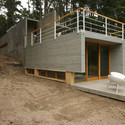
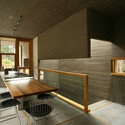
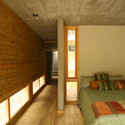
So, the house turned into a habitable dock, which emerges from the ground to see the landscape surrounding. It takes place on two levels, a level which emerges from the earth serves as a plinth for private use, which organizes the rooms and defines a horizontal plane on which rests a pavilion on the upper level, which includes the social program with the living, dining room, grill and terrace, organized in a central area of use, with sides of circulation and services. Upstairs, one of these bands open circulation defines an access path between trees, from the street. A piece of concrete L-shaped opens this central area to the north, opening the forest view with large windows, and close to the southeast, with smaller windows, willing to visual height of a seated person.

The vertical support of this L is a wall of concrete formwork tables arranged horizontally to accentuate the dominant direction of the house, which is taking thickness and defines the circulation, support functions, linking both levels. The horizontal plane of the L is drilled, in the range of external access circulation, and traversed by trees, which seem to spring from the way of wooden boards treated pine.
- © Gustavo Sosa Pinilla
- lower floor plan
- upper floor plan
- elevation 01
- elevation 02
- elevation 03
- elevation 04
- section


wow.
like the integration between the built environement and nature, feel though that the relationship between man and the external is a bit more distant; even though the wooden vertical elements (especially on the shorter side) do well to mimc the vertically of the woods outisde.
overall brilliant.
Great house !!! Perfect size and proportion. Very human.
great architecture, great use of concrete and wood, one of the best projects i’ve seen on this site, bravo
wow. this one is my favorite. can’t get enough of this design – been scrolling through the pics over and over. bravo.
FAN
TAS
TIC
!!!
small, smart, genius loci. its not only modern, its cosy, too! the materials/colors match perfectly into the woods :)
what else can you want?! i like it a lot…
Mies Van der Rohe en el siglo XXI.
Terribles dificultades culturales para abandonar el ángulo recto, y degjar de refugiarse en la mas que previsible poesía Rietveld…. de 1930 !
Sigan intentándolo pero con algo menos de solemnidad y algo
mas de frescura.
qe bueno ver cosas asi en nuestro pais, felicitaciones
I'd Live Here: House Among Trees. http://bit.ly/cyleFu
.
Coincido con Zamba, una estética que no aporta demasiado
en cuanto a innovación y a cierta sensualidad que puede
tener la arquitectura. Prácticamente monocromática, me
recuerda a la estética del museo Xul Solar, en Bs Aires, pero … se trata de una casa de veraneo.
Hay que arriesgar mas. Experimentar en los temas que lo
permiten.
Creo que Mies tiene mucho que decir en el siglo XXI, y quien piensa que mies es solo angulo recto y neoplasticismo, no entendio nada de nada. Me da la impresion que esta casa es mas que lenguaje y hormigon. Esta obra me hace acordar al auditorio de Clorindo, Testa, que es una excusa para hacer una montaña. Es una excusa para traer algo de un afuera, afuera de la arq y del programa espeficico encargado, una montaña y un mirador. Leyendo la memoria de los autores entiendo que la mirada esta puesta en hacer un muelle, otro mirador, al cual se accede no por una rampa sino por un camino entre arboles. Casi que la funciòn de casa, asi como la de auditorio en el caso de Clorindo, estan muy bien resultos, de manera simple y poco pretenciosa, ya que el sentido esta puesto en otro lado.
Desde ese lado entiendo la relacion con los arboles, la casa se dispone todo el tiempo en funcion de ellos. No creo que le importe a los autores demasiado si el detalle de los aujeros esta visto, o si bak ya trabajo con hormigon. Y eso es muy miesiano, crear todo el tiempo cortinas de humo.
I just love this! What a restrained, tasteful, lovely, beautiful place! What more could be said? Kudos! Thanks for sharing it!
very nice indeed.
BRAVO!!
I am always amazed to see a building with trees integrated into the building like this… contractors in the USA can’t seam to build within 25′-0″ of a tree without killing it.
um espectaculo na natureza
Great, great, great….
too similar to BAK Arquitectos
indeed
Ha ha ha, I wasn’t read who made this building, until you said it. Those two houses are like twins. But this one is better then BAK. But anyway even sience people are thinking in the same way, with 100 of km distance. :))
I like the fact that they manage to keep the trees intact, but it feels as if the architects designed the model in the office and then went to site and realised there’s a couple of trees in the way. ‘Oh s#@*, what do we do now? Ahh don’t worry, we’ll just cut some holes in the roof!’
I just feel that they could have designed around the trees instead of through them.
I think the issue of the trees in this project is much more than 4 holes in a roof, I understand this project as the creation of a dock to watch other trees, the curtain of trees in the background of the land. It seems very wise use of trees to generate an access path including them. I think the holes in the ceiling are a consequence of that, not the main idea. For the trees position in plant, I gather that the house is modulated from the position of them.
The trees not only bore a roof, but they give meaning to the house, apart from measuring it.
very cool, like a house by lacaton and vassal
Why am I always such a sucker for these kinds of houses?? http://bit.ly/ajDc7P
Oh my. Want. http://www.archdaily.com/49336/house-among-trees-marti%CC%81n-ferna%CC%81ndez-de-lema-nicola%CC%81s-moreno-deutsch/
RT @kristoffbertram: Want: http://bit.ly/ajDc7P
Well, hello there my little dream house http://tinyurl.com/y9p3n44 Combination of wood, concrete and trees is absolutely lovely
¿Qué opinan de tener una casa en medio de los árboles? A mí me gusta la idea. http://ping.fm/dRc9p
Lovely bit of architecture – House Among Trees – http://bit.ly/9TNyMk #Architecture
RT @ChairmanCorti: Lovely bit of architecture – House Among Trees – http://bit.ly/9TNyMk #Architecture
House Among Trees / Martín Fernández de Lema, Nicolás Moreno Deutsch | ArchDaily http://bit.ly/abTzn2