Architects: Zaha Hadid Architects
Location: Soho, Beijing, China
Architects In Charge: Zaha Hadid & Patrik Schumacher
Project Director: Satoshi Ohashi
Associate: Cristiano Ceccato
Project Architect: Yoshi Uchiyama
Project Team: Stephan Wurster, Michael Hill, Samer Chamoun, Eugene Leung, Rita Lee, Lillie Liu, Rolando Rodriguez-Leal, Wen Tao, Tom Wuenschmann, Seung-ho Yeo, Shuojiong Zhang, Michael Grau, Shu Hashimoto, Shao-Wei Huang, Chikara Inamura, Lydia Kim, Yasuko Kobayashi, Wang Lin, Yereem Park
Local Design Institute: BIAD Beijing Institute of Architecture & Design
Area: 332857.0 sqm
Year: 2012
Photographs: Iwan Baan, Courtesy of Zaha Hadid Architects

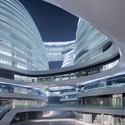
The Galaxy SOHO project in central Beijing for SOHO China is a 330 000m2 office, retail and entertainment complex that will become an integral part of the living city, inspired by the grand scale of Beijing. Its architecture is a composition of five continuous, flowing volumes that are set apart, fused or linked by stretched bridges. These volumes adapt to each other in all directions, generating a panoramic architecture without corners or abrupt transitions that break the fluidity of its formal composition.

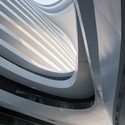
The great interior courts of the project are a reflection of traditional Chinese architecture where courtyards create an internal world of continuous open spaces. Here, the architecture is no longer composed of rigid blocks, but instead comprised of volumes which coalesce to create a world of continuous mutual adaptation and fluid movement between each building. Shifting plateaus within the design impact upon each other to generate a deep sense of immersion and envelopment. As users enter deeper into the building, they discover intimate spaces that follow the same coherent formal logic of continuous curvelinearity.

The lower three levels of Galaxy SOHO house public facilities for retail and entertainment. The levels immediately above provide work spaces for clusters of innovative businesses. The top of the building is dedicated to bars, restaurants and cafés that offer views along one of the greatest avenues of the city. These different functions are interconnected through intimate interiors that are always linked with the city, helping to establish Galaxy SOHO as a major urban landmark for Beijing.

- © Iwan Baan
- © Iwan Baan
- © Iwan Baan
- © Iwan Baan
- © Iwan Baan
- © Iwan Baan
- © Iwan Baan
- © Iwan Baan
- © Iwan Baan
- © Iwan Baan
- © Iwan Baan
- © Iwan Baan
- © Iwan Baan
- Courtesy of Zaha Hadid Architects
- © Iwan Baan
- © Iwan Baan
- © Iwan Baan
- General Plan


Hidden due to low comment rating. Click here to see.
I was there on saturday for the opening. Great design, Great visual impact, poor construction details.
Hidden due to low comment rating. Click here to see.
hi, im curious about the ‘poor construction’ as you said? do you mean it’s terrible to look closer?
All around the building the finishes, materials, technical details are poorly executed. Everything looks great in the pictures but to be honest once you put a step on it you can find quality issues in every corner (floor, windows, stairs, structure, frames).
it was constructed at the baan-scale of perception
poor construction detail means ? finshes is not done properly ?
this is more like it, Zaha! beautiful
No interior pictures besides the big crowd!?
This is great. There is definitely a common thread throughout Zaha’s big body (of work), but I love the fact that she explores a different aesthetic, a different way to articulate space in every project. There is a freshness, uniqueness, and inventiveness with every new creation. Now if only she were more likeable…
خیلی خوب طراحی کرید.imIRIRAN
A Zaha Hadid version of “Sanlitun Soho” complex…
Wonderful, I agree with Jaime that architectural details are poor but this is one of the characteristics of this “brand”. However what I see here is an interesting similarity with the MVRDV Kwanggyo power centre in Korea of 2008(to be realized in 2011): http://www.designboom.com/weblog/cat/9/view/4748/mvrdv-architects-wins-gwanggyo-power-centre-competition-in-south-korea.html
You didn’t realize it is end of 2012 and you are quoting a construction to be realized in 2011. This project was obviously never constructed
scrolled down to see a “project status”, to determine wether i’m looking at renderings or not. no project status. still not sure.
Wonderful, I agree that architectural details are poor but this is one of the characteristics of this “brand”. However what I see here is an interesting similarity with the MVRDV Kwanggyo power centre in Korea of 2008, to be realized in 2011.
Hidden due to low comment rating. Click here to see.
Dear SchizoBuddy, I just would like quote that Soho Galaxy has strange similarity with the MVRDV competition project conceived 4 years before and should be realized in 2011. Unfortunately many very original and ambitious competition projects are note realized.
Except for the color and the heights of the buildings, you’re absolutely right–a very strong similarity between the two projects.