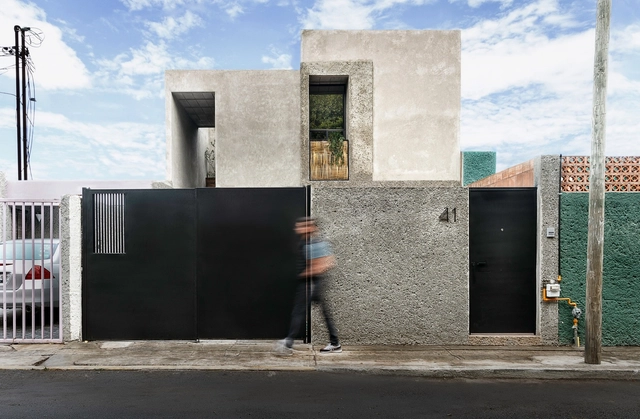
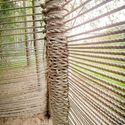
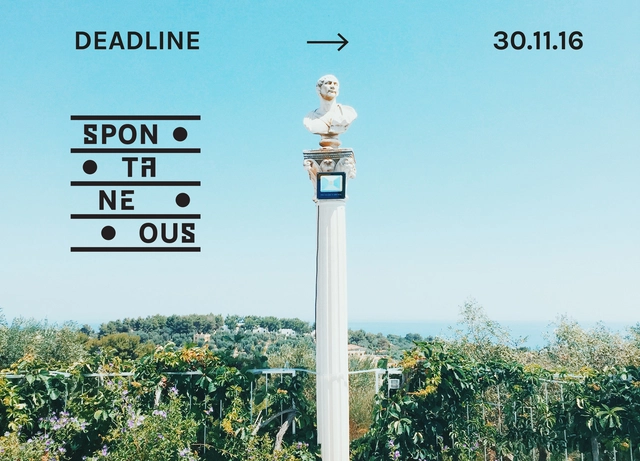
In those areas in which spontaneous and unauthorized construction is widespread, overwhelming good architecture, one should consider that informal phenomena are a tangible manifestation of the social relationship with built environment. Structural or decorative elements are figured out and crafted to quickly respond to two important needs: spatial appropriation and self-representation of the builder. Often lying in the grey area of building regulations.
Asia’s leading annual event on design, innovation and brands, Business of Design Week 2016, will commence on 30 November 2016 and end on 3 December 2016 at the Hong Kong Convention and Exhibition Centre. This year, the Business of Design Week brings to Hong Kong the distinctive minds in the profession of architecture to share their views on development of a future city. This is the first year BODW is partnering with a U.S. city – Chicago.
Completed in January 1977, Richard Rogers’s and Renzo Piano’s Centre Georges Pompidou was initially received skeptically by critics, but the public soon embraced Beaubourg as an essential—and well loved—Paris institution. Francesco Dal Co’s lively intellectual biography, Centre Pompidou: Renzo Piano, Richard Rogers, and the Making of a Modern Monument (Nov. 29, Yale University Press) explores the Pompidou’s history and the reasons for its success, from its genesis as a politically calculated response to the turbulent 1968 student protests to the role played by architects in its construction, as well as the historical influences and the engineering solutions that inform its design.
Contemporary Aerial View of Oficina Maria Elena. Chile. Photo by Ignacio Infante.
Transnational projects for resource extraction have motivated the development of massive infrastructural corridors. The strategic siting of mining towns, petrochemical encampments, and industrial developments aims to integrate vast geographical and political entities. These experiments promise to advance economic development on a national scale, but their influence on regional and urban constructs tests the agency of architecture and planning at smaller scales.
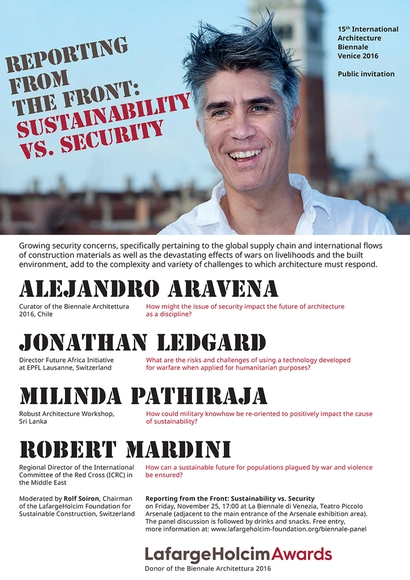
Based on his experience in curating the 15th International Architecture Exhibition of La Biennale di Venezia 2016 in Venice, the Chilean architect Alejandro Aravena inspired the LafargeHolcim Foundation for Sustainable Construction to organize a debate on sustainability and security. Framed as one of this year Architecture Biennale’s discussions, the event will foreground topics that were raised in the context of the exhibition “Reporting from the Front” and expose them to “real life reports” from the forefront of architecture and related disciplines.
Growing security concerns, specifically pertaining to the world supply chain and global flows of construction materials as well as the