1. ArchDaily
  2. Urbanus

Urbanus: The Latest Architecture and News

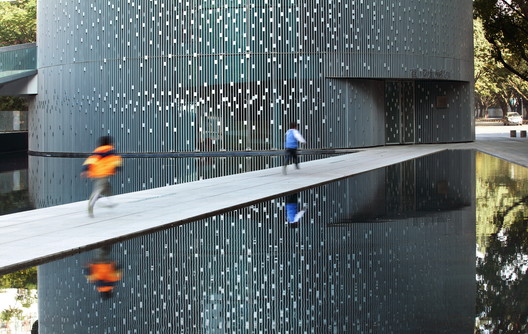
An Interview with Liu Xiaodu, Urbanus

“If you don’t know or really didn’t study the local culture, do universal design. That’ll keep the quality. If you want to do something that you don’t know, there is a big chance that it’s going to fail and have a bad impact on the city and the people here. Do it in your own way. If you do something good and beautiful back home, you should do exactly the same type and put it here. That’s also a good contribution because you show good architecture quality… Do something universal!” - Liu Xiaodu, Shenzhen, 2013

Founded in 1999, Urbanus is led by its trio of partners Meng Yan, Wang Hui and Liu Xiaodu, all of whom studied first in China and then abroad in the USA before returning to their native country at the very beginning of its construction boom. In this interview Liu Xiaodu discusses the changing realities of Chinese architecture education, the beginnings of their firm and the positive side to the “chaos” of the country's current urban expansion.

An Interview with Liu Xiaodu, Urbanus - Image 1 of 4An Interview with Liu Xiaodu, Urbanus - Image 2 of 4An Interview with Liu Xiaodu, Urbanus - Image 3 of 4An Interview with Liu Xiaodu, Urbanus - Image 4 of 4An Interview with Liu Xiaodu, Urbanus - More Images+ 7

Barcelona Commemorates 300 Years of Catalan Spirit With 7 Public Installations

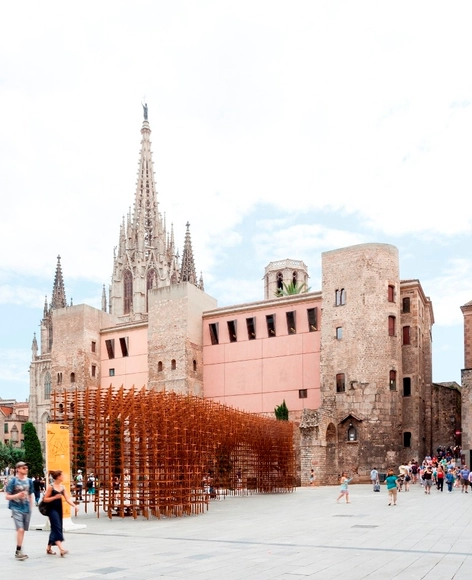
Every year, citizens of Catalonia commemorate the events of September 11th 1714, a key date in the War of the Spanish Succession that has come to symbolize what Voltaire called "the Barcelonans' extreme love of freedom." With this year marking the 300th anniversary of these events, Barcelona Cultura enlisted the Fundació Enric Miralles to curate 7 public installations around the city as part of its Tricentenari BCN program.

The result is BCN RE.SET, organized by Benedetta Tagliabue of the Fundació Enric Miralles and stage director Àlex Ollé, which invited guest architects from countries all over the world to colloborate with local universities and create installations symbolizing 6 political and ideological concepts: identity, freedom, Europe, diversity, democracy and memory. These installations will be in place until September 11th. Read on after the break for descriptions of all 6 installations.

Barcelona Commemorates 300 Years of Catalan Spirit With 7 Public Installations - Image 1 of 4Barcelona Commemorates 300 Years of Catalan Spirit With 7 Public Installations - Image 2 of 4Barcelona Commemorates 300 Years of Catalan Spirit With 7 Public Installations - Image 3 of 4Barcelona Commemorates 300 Years of Catalan Spirit With 7 Public Installations - Image 4 of 4Barcelona Commemorates 300 Years of Catalan Spirit With 7 Public Installations - More Images+ 10

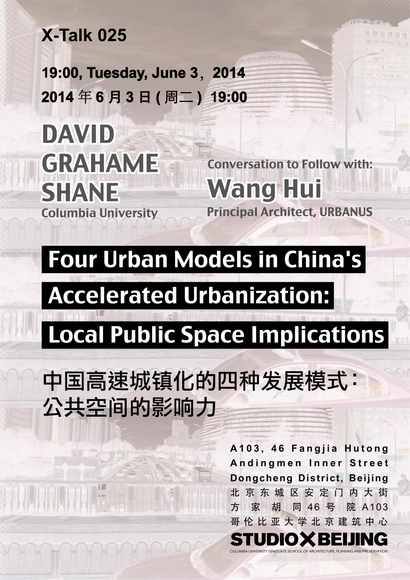
Lecture / Four Urban Models in China's Accelerated Urbanization: Local Public Space Implications

China's accelerated urbanization juxtaposes many local and global urban models in the contemporary urban space of the mega-city/metacity region. Since 1945 the global and local discourse on urban design and development has been dominated by four conceptual models. These four models, the metropolis, the megalopolis, the fragmented metropolis and the megacity/metacity have appeared in Asia with local characteristics and with special, hybrid characteristics. China's rapid urbanization has been based on an equally rapid industrialization that has telescoped the historical development pattern of western nations into 60 years. 

Venice Biennale 2014: Full List of National Participants Revealed

A few hours ago in Venice, Rem Koolhaas presented his curatorial vision for "Fundamentals" in a live-streamed opening press conference. As we reported last year, "Fundamentals" will focus on architecture rather than architects and history rather than contemporaneity. Koolhaas will not just curate an exhibition of his own, but will be coordinating the "collective effort of all national pavilions."

This year's exhibition features the participation of 65 countries--including 11 first-time participants (Azerbaijan, Côte d'Ivoire, Costa Rica, Dominican Republic, United Arab Emirates, Indonesia, Kenya, Morocco, Mozambique, New Zealand and Turkey). See the complete list of national participants--which includes collaborations with Jacques Tati, Hans Ulrich Obrist, FAT, Iñaki Ábalos and others--after the break.

Click here to see all of ArchDaily's previous coverage of the 2014 Venice Biennale. And stay tuned... we'll be bringing you on-the-ground reports from Venice when the Biennale launches in the first week of June!

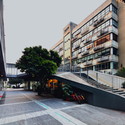
Tulou Housing Guangzhou / URBANUS Architects by Iwan Baan

Subscriber Access | 
Tulou Housing Guangzhou / URBANUS Architects by Iwan Baan - Image 2 of 4
Urbanus' project

Architecture photographer Iwan Baan once again shared with us an impressive photo set on a social housing project by Chinese architects Urbanus.

The commission was to design a 220 apartment housing complex for people for low income families in Guangzhou. Urbanus decided to give the complex a nice and intimate atmosphere, by reinterpreting the traditional Hakka Houses. This housing typology correspond to 300 year old houses in the south of China, and as you can see on some pictures after the jump, they are basically a large housing project where complete families live as a community (aunts, nieces, nephews, etc.)

You can take a look at the Urbanus’ complete photo set over here, and the Hakka Houses photos over here.