1. ArchDaily
  2. textile architecture

textile architecture: The Latest Architecture and News

What Textiles and Translucency Bring to Public Space: 5 Lightweight Interventions

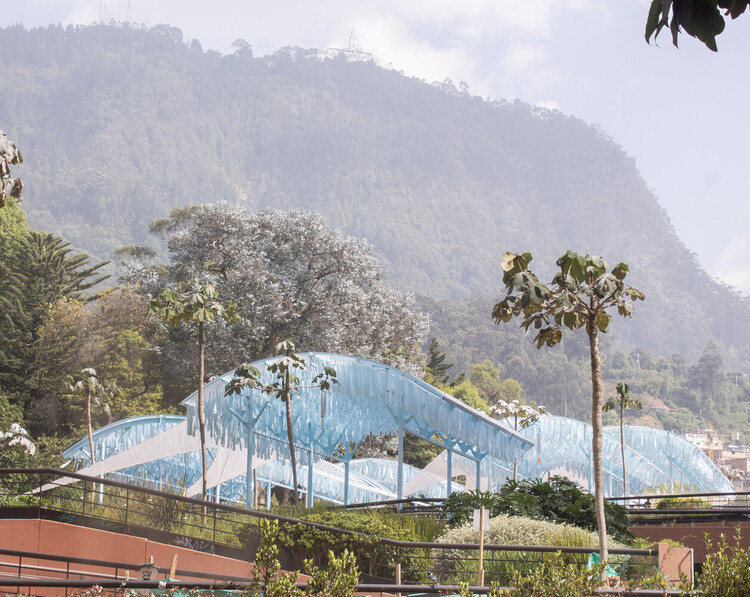
What do lightweight materials bring to public space with an ethical, ecological, and non-extractive design principle? Various textile textures offer a point of entry, being closer to the body than heavy conventional structural materials. Through its flexibility and responsiveness, it enables a form of soft enclosure rather than a fixed boundary in architectural space. Responding to minimal environmental stimuli, the fabric brings continuous movements into space. When layered or assembled, it produces gradations of density, depth, and enclosure, while recent innovative fabrication technologies extend the possibilities of its form and structural durability.

Semi-transparent materials further mediate the conditions of visual permeability and bodily experience of the space. By transmitting and filtering light, they blur clear separations between interior and exterior, solid and void, creating thresholds that are neither fully open nor fully enclosed, but constantly in negotiation. Reinterpreting structure in urban space through lightweight, translucency, and softness opens up alternative modes of spatial perception and bodily engagement.
What Textiles and Translucency Bring to Public Space: 5 Lightweight Interventions - Image 1 of 4What Textiles and Translucency Bring to Public Space: 5 Lightweight Interventions - Image 2 of 4What Textiles and Translucency Bring to Public Space: 5 Lightweight Interventions - Image 3 of 4What Textiles and Translucency Bring to Public Space: 5 Lightweight Interventions - Image 4 of 4What Textiles and Translucency Bring to Public Space: 5 Lightweight Interventions - More Images+ 15

Serbia’s Wool Installation Explores Circular Design at Venice Architecture Biennale 2025

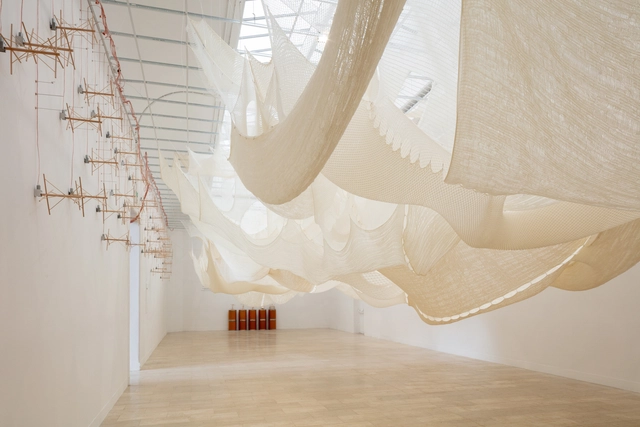
The Serbian Pavilion at the 19th Venice Architecture Biennale consists of an immersive installation made of wool. The exhibition, titled Unraveling: New Spaces, was curated by architect Slobodan Jović and designed by an interdisciplinary team composed of Davor Ereš, Jelena Mitrović, Igor Pantić, Sonja Krstić, Ivana Najdanović, and Petar Laušević. The interior space of the Pavilion, located in the Biennale's Giardini, is occupied by an ephemeral installation that follows the principles of circular design, effectively producing no waste. The installation consists of a broad woven wool fabric that gradually unknits according to a guided choreography of algorithmic precision, completely disassembling by the end of the Biennale's exhibition.

Serbia’s Wool Installation Explores Circular Design at Venice Architecture Biennale 2025 - Image 1 of 4Serbia’s Wool Installation Explores Circular Design at Venice Architecture Biennale 2025 - Image 2 of 4Serbia’s Wool Installation Explores Circular Design at Venice Architecture Biennale 2025 - Image 3 of 4Serbia’s Wool Installation Explores Circular Design at Venice Architecture Biennale 2025 - Image 4 of 4Serbia’s Wool Installation Explores Circular Design at Venice Architecture Biennale 2025 - More Images+ 64

Nomadic Architecture: Why Tomorrow's Buildings Might Need to Move

Subscriber Access | 

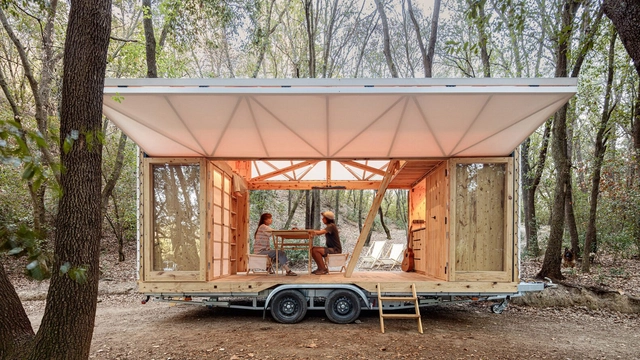
In early Mongolia, herders dismantle their yurt - a portable round tent made of felt or animal skin - in pursuit of new lands where they can raise their livestock. Not much further away is a digital nomad in Bali, preparing their next move into a co-living space in Ho Chi Minh City. Though separated by vast distances and cultural divides, these individuals are united by a timeless human desire - a quest mobility and adaptable living spaces. In light of geopolitical changes and emerging lifestyles, the demand for flexible residential architecture intensifies. In this era of increased mobility, is it enough for people alone to move, or will the buildings of tomorrow need to follow suit?

Nomadic Architecture: Why Tomorrow's Buildings Might Need to Move - Image 1 of 4Nomadic Architecture: Why Tomorrow's Buildings Might Need to Move - Image 2 of 4Nomadic Architecture: Why Tomorrow's Buildings Might Need to Move - Image 3 of 4Nomadic Architecture: Why Tomorrow's Buildings Might Need to Move - Image 4 of 4Nomadic Architecture: Why Tomorrow's Buildings Might Need to Move - More Images+ 2