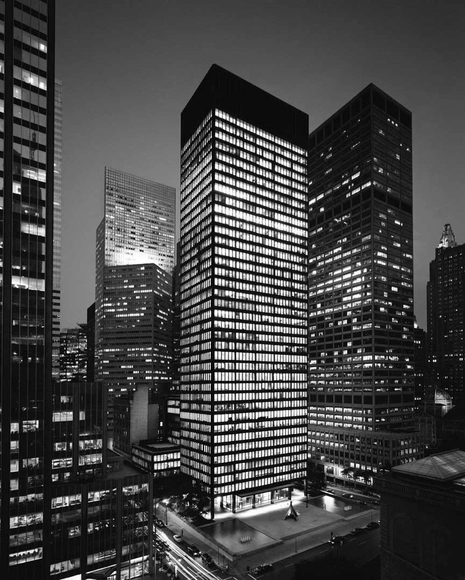
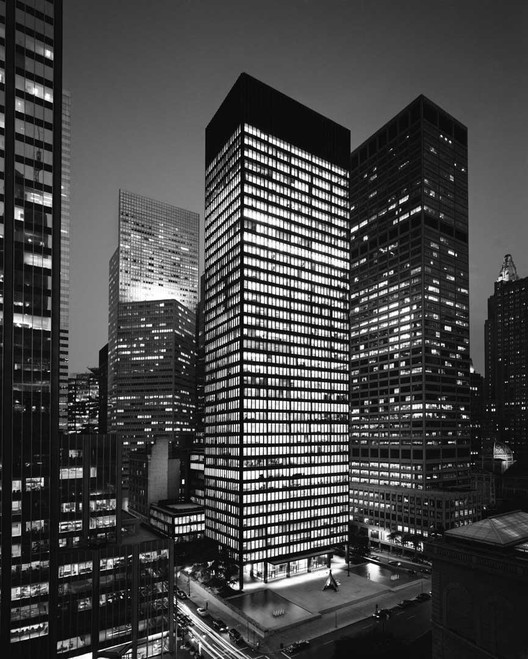
Text description provided by the architects. Located in the heart of New York City, the Seagram Building designed by Mies van der Rohe epitomizes elegance and the principles of modernism. The 38-story building on Park Avenue was Mies' first attempt at tall office building construction.
The tallest building in the world will be opened in just a few more days. This 2.3 gigapixel photo, composed of 381 images taken with a Canon 5D Mk II with a 400mm lens by bristolg, who posted a video to show the high level of detail of the image.
SOM recently unveiled the design for the Digital Media City Landmark Tower in Seoul, Korea. The 2,100 foot (640m) tall tower will be the tallest tower in East Asia when completed in 2014.
The iconic building is located in the north of the Han River, which crosses the city, and will dominate the skyline becoming a important icon for Seoul… which is what you will expect if you commission a tower this tall.
Taipei 101, famous for being one of the world’s tallest buildings, is set to get some major eco-upgrades in an effort to save money, reduce its impact, and gain the much coveted title of “World’s Tallest Green Building.” In 2007, the Burj Dubai surpassed Taipei 101 in terms of height, but the Taiwanese building won’t give up the fight, throwing down $1.8 million in energy efficiency upgrades, which are expected to yield $20 million annually in savings and make it the Earth’s greenest and tallest building.
Over the next 18 months, the skyscraper will undergo significant energy efficiency upgrades and will also seek LEED Gold certification for existing buildings. The certification will largely depend on the building performance after the upgrades and renovations take place. The owners of Taipei 101 are teaming up with SL+A International Asia Inc., Siemens and EcoTech International Inc. to complete the eco-upgrades. Seen at Inhabitat. More images after the break.
Spanish architect Francisco Mangado is currently working on the design of a tower in the capital city of Argentina. The 200m tall building will be the tallest tower in Buenos Aires.
The project, located in the Puerto Madero area, includes over 68.000sqm, for housing, an hotel, restaurants, commercial space and parking.
The big dilema of this kind of project in the city is the public space, most of the times only approached at ground level. Francisco Mangado’s strategy includes public program along the tower, as a vertical boulevard.
After the residences on the first levels, we find a public lobby on floor 27th, with public services and restaurants, where the tower varies in section as you can see on the drawings below. We find more public facilities at the top, continuing with this openness of the program as the tower develops.
Kohn Pedersen Fox Associates, the international architecture firm headquartered in New York, announced it has completed the conceptual design for Lotte Super Tower 123 in Seoul, South Korea. The 555-meter (1,821 feet), 123-story tower, when completed in 2014, will be the tallest building in Asia and the world’s second tallest after the Burj Dubai.
Kohn Pedersen Fox (KPF) was selected earlier this year after an international design competition by owner/developer Lotte Group, one of South Korea’s largest conglomerates. This long anticipated project has now earned all major zoning approvals, and excavation is nearly complete. The building will serve as Lotte’s new corporate headquarters and will be built by Lotte Construction, a subsidiary of the group. Architect’s description after the break.
Renzo Piano‘s latest project, the Shard, has recently moved to the construction phase. The 1,016 ft high skyscraper will be the tallest building in Western Europe and will provide amazing views of London. The mixed use tower, complete with offices, apartments, a hotel and spa, retail areas, restaurants and a 15-storey public viewing gallery, will sit adjacent to London Bridge station as part of a new development called London Bridge Quarter. Replacing the 1970′s Southwark Tower on Bridge Street, the Shard is a welcomed addition to the London skyline, and its central location near major transportation nodes will play a key role in allowing London to expand.
With the countless number of ridiculously tall skyscrapers planned for around the world, it is remarkable the controversy an 82-story skyscraper for Midtown Manhattan can create. Three years ago, MoMa completed an $858 million expansion, yet the museum is still in need of additional room to house its growing collections. The Modern sold their Midtown lot to Hines, an international real estate developer, for$125 million. Hines, in turn, asked Pritzker Prize Laureate French architect Jean Nouvel to design two possible solutions for the site. “A decade ago anyone who was about to invest hundreds of millions on a building would inevitably have chosen the more conservative of the two. But times have changed. Architecture is a form of marketing now, and Hines made the bolder choice,” reported Nicolai Ouroussoff for The New York Times.
“Bolder” is certainly fitting to describe Nouvel’s Torre de Verre which is planned for 53 West 53rd Street. The 1,250 foot tower will offer approximately 40,000 sq feet of new gallery space for the MoMa, in addition to 150 residential apartments and 100 hotels rooms. The tower’s unique silhouette will dominate the Midtown block, rising higher than the iconic Chrysler Building. Its irregular structural pattern has been called “out of scale” on numerous occasions by opponents of the project. Some complain that the tower will “violate the area’s integrity” noting that its height will obscure views and light. Shadow studies show that the building may plunge apartments in the area and the ice-skating rink at Central Park into darkness.
The aesthetic is definitely foreign to Midtown and, yet, while most are quick to reject change, the tower will sit in an area surrounded by highly revolutionary buildings. Its new neighbors include Philip Johnson’s “Lipstick Building” at Third Avenue; Hugh Stubbins’ Citicorp Building at Lexington Avenue, Mies van der Rohe’s Seagram Building and SOM’s Lever House at Park Avenue. At some point in time, each of those buildings exemplified a change in style, and yet now, they are staples in the area’s heritage.
With controversy still surrounding Nouvel’s design as it moves through the city’s review process (ULURP), John Beckmann and his firm, Axis Mundi decided to do something about it. A few short days ago, Axis Mundi unveiled a conceptual alternative design for 53 West 53rd Street. The alternative features a 600 foot, 50 story mixed use building that ”rethinks the tall buildings that have become synonymous with New York City’s identity.” Beckmann explained, ”Historically, the skyscraper was a unitary, homogeneous form that reflected the generic, flexible office space it contained…The Vertical Neighborhood is more organic and more flexible–an assemblage of disparate architectural languages. It reflects an emerging reality for tall buildings as collections of domestic elements: dwellings, neighborhoods, streets.”
More images and more about Axis Mundi’s alternative after the break.
After several years of organizing the annual Skyscraper Competition it has become a renowned architectural prize around the world. The best projects of each competition are widely published from architecture, design, and fashion publications to technology, business, and entertainment magazines. The winning projects are also featured in websites, television documentaries, and galleries.
Meir Lobaton + Kristjan Donaldson recently shared their design for a 36 story residential tower in Mexico City, Mexico. The project addressed the balance between the desire of living in a single-family residence with the cost of the land.
More images and more about the project after the break.
Amidst financial buildings and high-rise apartments, Belgian architect Vincent Callebaut has redefined the conventional skyscraper. His 132 story complex for the south edge of Roosevelt Island addresses the pressing need for environmental and ecological sustainability. This conceptual design focuses on creating a completely self-sustaining organism that not only utilizes solar, wind, and water energies, but also addresses the pending food shortage problem.
Probably the most impressive thing for someone who visits for the first time cities like New York, Shanghai or Dubai is the ridiculous size of it’s buildings. So to finish this week of Round Up, we bring you previously featured skyscraper on ArchDaily.
The “Spire”, the skyscraper designed by Spanish architect Santiago Calatrava, was going to be the tallest building in the United States. That title will have to wait, at least until the economic crisis affecting construction all over the world starts having better days.
UPDATE: We wrongly credited the whole project to AS+GG, but they were only comissioned to design the three main towers, on a master plan designed by SOM Chicago.
It seems no one told Dubai about the financial crisis, as new projects keep being unveiled. This time, our green friends over Inhabitat tipped us on a mega development, owned by Maraas Holding: The Jumeirah Gardens. The master plan for this project was designed by SOM Chicago, and consists of a mixed-use development that incorporates low, medium, and high-density zones for business, residences, retail, leisure, and recreation – a city within a city, with an estimated cost of US$95 billion.
The three main towers were comissioned to Chicago based architects AS+GG (Adrian Smith + Gordon Gill), The most impressive one -and the third tallest tower in the UAE- is 1 Dubai, pictured above. The tri-partite skyscraper will be 3218 ft (981m) tall, and the towers will be connected by a series of glass suspension sky-bridges. This bridges are so big, they even grow palms on them as you can see on the further renderings. At the base of the buildings, grand arched entrances allow boats to travel underneath the building and into a central atrium space. The mixed-use development includes a hotel, residential, commercial retail and entertainment space totaling 800,000-900,000 square meters.