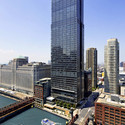
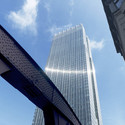
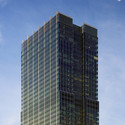
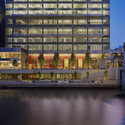
Construction of Schweger Associated Architects‘ Dubai Pearl is continuing. The groundwork, foundations, basements and lower grounds floors of the four towers which form the central section of Phase 1 of the development is now complete. A total of 3.5 million man hours have so far been spent since work started on site and over 60,000 cubic meter of concrete has been poured on one of the largest construction projects still being developed in the UAE.
This project comes from architectural and urban planning firm, solus4 who has devised a set of principles that guided the design of the Sustainable Vertical Neighborhood. This “neighborhood” takes its form in an iconic 950 foot tall residential tower in New York City. Applying these principles to a vertical neighborhood requires the full engagement of the design team, the building team, the financing team and the owners.
The Nunavut Tower by rzlbd is a structure that aims to fulfill the human desire to conquer gravity, while challenging the modern notion of skyscrapers as vertical extrusions of a two-dimensional layout on the ground. The desire is to design a skyscraper in which each space is tailored to the inhabitant.
D+R Dipiuerre Architettura has just recently presented their proposal for a project being developed on the island of Kish, Iran and has shared their fresh work with ArchDaily’s readers. Additional images and brief description after the break.
In recent years, UNStudio – which has been internationally recognized for its approach to developing dynamic forms – has also grown to focus on sustainability with the intent to decrease C02 emissions. With this in mind, the firm, with consortium DUO², has realized one of the most sustainable large office buildings in Europe for two governmental offices, the Education Executive Agency and the Tax Offices. “The design contains numerous new innovations related to the reduction of materials, lower energy costs and more sustainable working environments. It presents a fully integrated, intelligent design approach towards sustainability,” explained Ben van Berkel.
More images and more about the project after the break.
Designed by Team CLS, headed by award winning UK Architect Darren Chan, other members including Emily Lau (Architecture Graduate) and Jonas Sin (Netherlands Architect), their project, Helios Rehab Sanctuary, innovates in the application of sustainable technologies to create a new and exciting typology. More on this project after the break.
Songdo International Business District (IBD) occupies over 1,500 acres of reclaimed land on the West Coast of Incheon, Korea. This waterfront master plan includes a diverse array of programmatic elements and is designed to be a pedestrian friendly city with walkable streets and an urban density that allows for an active street life. Signature features include, the New Songdo City First World Towers, Northeast Asia Trade Tower, the 100-arce Songdo Central Park, and the Songdo City International School.
For WORKac’s skyscraper design for the Shenzhen Metro Tower, the architects created a new a new kind of mixed density to promote a sustainable and a diverse stacked city. This vertical city holds places places of intense urban interchange that combine infrastructure, mixed uses, and public space. Located at an intersection with a horizontal crossroads of major boulevards, this vertical interchange between the underground metro, ground-level bus station, shopping podium and the offices and hotel above will essentially be linking the metro with the sky. ”We call this tower the Interchange – a vertical city that twists together natural green space with ecological systems, structural and functional efficiency with dramatic new forms and technology, while linking the underground to the sky,” added the architects.
eVolo Magazine is pleased to announce the winners of the 2011 Skyscraper Competition. Established in 2006, the annual Skyscraper Competition recognizes outstanding ideas that redefine skyscraper design through the use of new technologies, materials, programs, aesthetics, and spatial organizations, along with studies on globalization, flexibility, adaptability, and the digital revolution. This is also an investigation on the public and private space and the role of the individual and the collective in the creation of a dynamic and adaptive vertical community. The award seeks to discover young talent, whose ideas will change the way we understand architecture and its relationship with the natural and built environments.
The first place was awarded to Atelier CMJN (Julien Combes, Gaël Brulé) from France for their ‘LO2P Recycling Skyscraper’ in New Delhi, India. The project is designed as a large-scale wind turbine that filters polluted air with a series of particle collector membranes, elevated greenhouses, and mineralization baths. More images and descriptions of winning entries after the break
The following projects were selected by insulation specialist Saint-Gobain Isover as the eight shortlisted projects for the UK final of the Multi-Comfort House Competition. The competition produced many interesting solutions to the problem of urban development and energy efficient construction for high rise buildings.
Read on for more informations and images from the shortlisted projects.