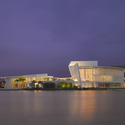
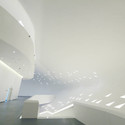
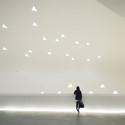
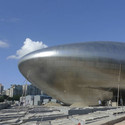
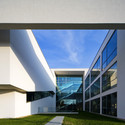
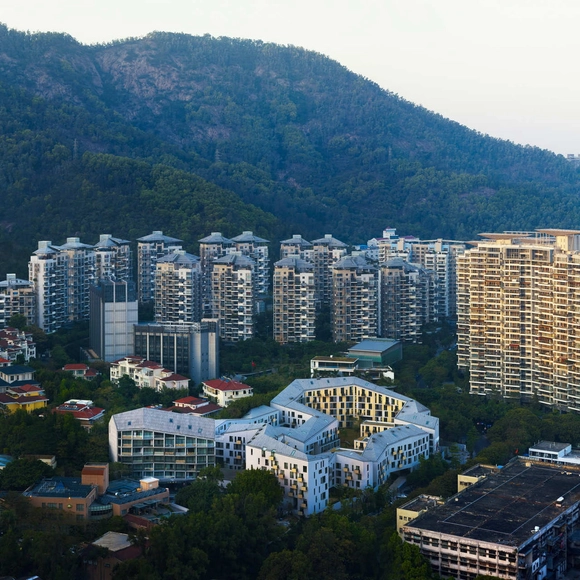
A unique ecological resource for an otherwise densely-populated urban region, the Xiasha district is a rural, coastal setting outside of Shenzhen. FCHA‘s second prize winning proposal for the masterplan project of Xiasha Wander Bay seeks to strike a balance between the preservation of the site’s pristine ecology and the needs of a four-season tourist town. More images and architects’ description after the break.
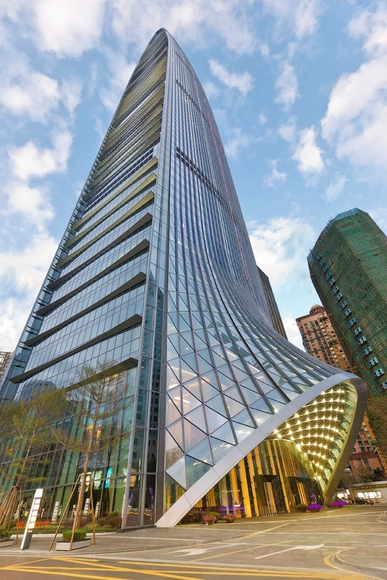
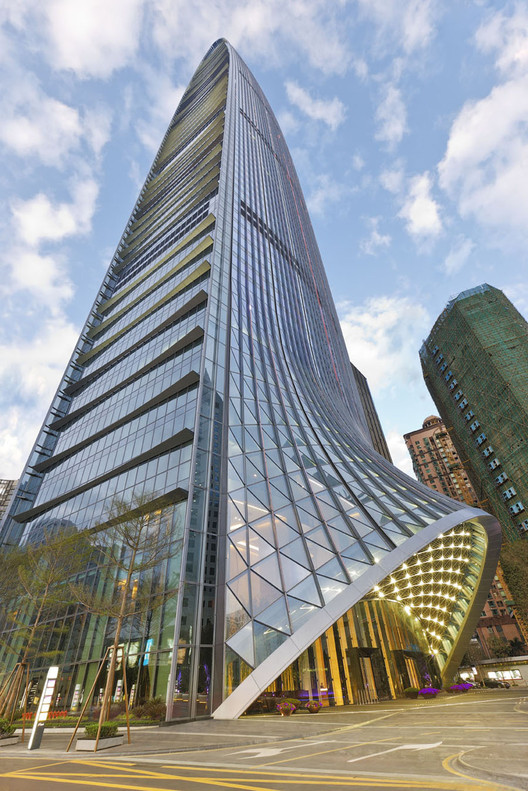
OMA has won the design competition for the Essence Financial Building in Shenzhen, China. Led by OMA Partners David Gianotten and Rem Koolhaas, the design beat out four other entries by international and Chinese practices.
The skyscraper will be OMA’s second in Shenzhen (the first being the Shenzhen Stock Exchange, which will be completed in April this year). By challenging many typical office tower conventions (such as a central core plan and curtain wall systems), OMA hopes their buildings will help lead the way for a “new generation” of office towers in the city.
As David Gianotten commented in the Press Release: "OMA is very excited about its continuous and deepening participation in Shenzhen's development, especially as the city makes its latest evolution: from a manufacturing city into a services hub. This next generation of urbanism calls for a new generation of office towers of which the Essence Financial Building could be one."
More on the Essence Financial Building, after the break...
With Shenzhen’s Bao’an District an emerging incubator for entrepreneurs and rapidly growing new businesses, FCHA’s second prize winning proposal for the Headquarters Building for Small and Medium Enterprises seeks to establish an inclusive hub for start-up enterprises. This building hopes to maximize the exchange of resources and ideas with the aim of sparking new innovation and collaboration. More images and architects’ description after the break.
Soon to be Shenzhen’s tallest tower at 660 meters, the Ping An Finance Center by KPF will anchor the city’s new Central Business District. Positioned at the southwest corner of the intersection of Yi Tian Road and Fu Hua Road in the Futian District, the tower will connect with neighboring properties in addition to Shenzhen Line 1 Gou Wu Gong Yuan metro station. More details after the break.
Commissioned by the Golden Harbor Group, the design for the masterplan for the Honghe project by AECOM is aimed to help Longgang, an emerging area of Shenzhen, to function positively on the city’s renovation and upgrading. Located in a new rising area, the project covers the south area of the main venue for last year’s University Games. Their design will not only become the complex of services in east Shenzhen, but will lead the development of sports and mice industries, which will also be important for Shenzhen to become the base radiation to the development of east Guangdong Province. More images and architects’ description after the break.
A complementary and mutual beneficial partnership, Hong Kong and Shenzhen will join the globalization as an integrated image and get benefit. With intimate collaboration, the proposal for the Hong Kong-Shenzhen boundary control point by WAU Design will serve as a symbol of close communication. The scheme concept comes from “link”: many single units can be twisted into a solid and integrated form. This scheme, a twisted link, indicates multi-level and deep cooperation between Hong Kong and Shenzhen on economic, cultural, and multi-faceted levels. More images and architects’ description after the break.
LYCS Architecture won an invited competition for a 32,000 sqm testing and assessment research center in the city of Shenzhen. It is a mixed-use building including offices, residential and commercial. The project conceptually begins with the traditional Chinese urban design idea of a ‘miniature city’ and divides the site into 10 equal volumes. Then, the volumes are aligned corresponding to the scattered programs across the landscape. More images and architects’ description after the break.
YanPaiXi Village, designed by Regional Construction Studio, is located in Guzhang County, Western Hunan. The houses in the village are surrounded by terraces which were built along the mountain and are divided into a number of large and small blocks by channels which are generated by nature. The society is steady and the residents are sincere and honest. Inspired by this village, the device attempts to explore an inter-growth prototype by implanting this “light” model in an urban and rural space. More images and architects’ description after the break.
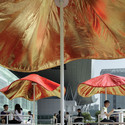
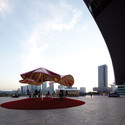
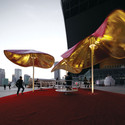
‘And then it became a city…’ is a film series featured at the 2011 Shenzhen & Hong Kong Biennale of Urbanism\Architecture. The Biennale is curated by Terence Riley and just opened last week – on view in Shenzhen through February 18, 2012. And then it became a city… shows the everyday life and activity of six planned cities under sixty years old. The cities featured include Gabarone, Chandigarh, Shenzhen, Almere, Las Vegas, and Brasilia. More trailers on the films about their corresponding cities can be viewed after the break.