Residential: The Latest Architecture and News
Zagrad Center / Randić & Turato
Apartment Fandl / Schlosser + Partner

-
Architects: Schlosser + Partner
- Area: 109 m²
- Year: 2009
DK2 / ICE

ICE – Ideas for Contemporary Environments, became our first AD Futures ever. They have just shared with us DK2, a luxury service apartments project in Hanoi, Vietnam for which they won 3rd prize in an invited competition.
The project is located next to the West Lake in Hanoi. The competition was requesting to create a residential iconic tower of 65 floors. As the project would be naturally dominant in a city of rather low scale, it focussed less on the design of the form of the building, but rather on the quality of the units within to create a user based experience.
More images and architect’s description after the break.
Aqua Tower / Studio Gang

-
Architects: Studio Gang
- Year: 2009
Konya Residence / Superpool

A few weeks ago Superpool surprised me with one of the best library designs I have seen in a while: the Open Library in Istanbul. A small area, a rich public space.
But the office has also been working on two large scale residential projects in Turkey: Konya Residence and Dagos Tower (will be featured on a future article). Both projects propose innovative strategies in terms of dense housing. I´m eager to see how this projects develop and materialize in the future.
About the Konya Residence:
Conesa 4560 Building / Adamo-Faiden
Slit House / EASTERN Design Office

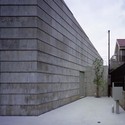
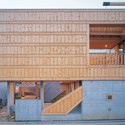
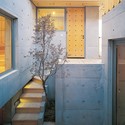
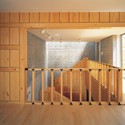
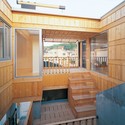
Designed for an 80 year old woman, EASTERN Design Office’s Slit House, a reinforced concrete residential project, “presents her both a life space with a soft light and an interesting experience of scale unlikely in a house.” Situated in an old Japanese city on a site 50 meters by 7.5 meters, the home has long slits that run along a 22 centimeter thick wall, making the interior space open, while providing enough privacy.
More about the home and more images after the break.
The Interlace / OMA

A year and a half ago, OMA unveiled the first images for a residential project in Singapore, on schematic design phase. Basically it was a set of stacked low-rise blocks.
Today OMA sent us an update on this project, The Interlace, and more details appear.
The project is located on a green belt outside the capital city, and consists on 31 stacked apartment blocks, each six-stories tall and identical in length, resulting in 170,000sqm of gross floor area for 1,040 apartments.
What is interesting about the project is how these stacked volumes achieve a high density, while still maintaining privacy and long-range views as you can see on the renderings.
The second result of this “stacked” strategy, are the common spaces filled with tropical green. By looking at the plan view of the complex, a series of inner courtyards appear on the empty spaces between the blocks. The project turns then into a rich vertical community, apart from the single tower projects seen in the area. Extensive residential amenities and facilities are interwoven into the lush vegetation and offer opportunities for social interaction, leisure, and recreation.
Waterpod Project

The Waterpod ProjectTM has been floating around the New York area for the past few months gaining a lot of attention. Beginning in Newtown Creek, between Brooklyn and Queens, the Pod is moving down the East River and Hudson River. As reported by Melena Ryzik for The New York Times (view her articles here) this experimental project investigates the blend of community living and artistry. Showcasing artworks, performances and such, the WaterpodTM, is an eco-conscious environment that was designed “In preparation for our coming world with an increase in population, a decrease in usable land, and a greater flux in environmental conditions, people will need to rely closely on immediate communities and look for alternative living models; the Waterpod is about cooperation, collaboration, augmentation, and metamorphosis,” explained Mary Mattingly, a photographer who thought of the Waterpod idea.
More about the WaterpodTM after the break.
House in Mukouyama / TSC Architects
Revolutionary Development for Turkey / RMJM

Internationally recognized practice RMJM Architects have recently announced their groundbreaking $1 billon mixed-use complex for the Atasehir district, the growing residential and business area of Istanbul, Turkey. RMJM’s complex will allow the new business center to flourish by serving 20,000 people and providing for a variety of their needs. The project will be revolutionary for Turkey as it will become the country’s first LEED-certified mixed-use development upon its 2011 completion date.
More images and more about the complex after the break.
Bluepoint Sales Pavilion / Paul Raff Studio

Located in Phuket, Thailand, Paul Studio Architects‘ Bluepoint Sales Pavilion provides a space for potential clients to enjoy the surrounding views. The elegant wooden structure gracefully compliments the landscape by “responding to the powerful contextual site conditions.”
More about the residence after the break.
Studio 2 in 1 / TWS & Partners

TWS & Partners named their latest work Studio 2 in 1, as it accommodates the function of a home and a studio within one place. The studio is located in the urban setting of Jakarta, amidst the semi-detached housing units that are typical of the area. With a small site measuring 10 meter by 20 meter, the project aims to “elaborate the tropical, shaded, natural illuminated, and cross ventilation, breathing space regardless all the limitation of space.”
More images and further project description after the break.
Alternative for 53 West 53rd Street / Axis Mundi

With the countless number of ridiculously tall skyscrapers planned for around the world, it is remarkable the controversy an 82-story skyscraper for Midtown Manhattan can create. Three years ago, MoMa completed an $858 million expansion, yet the museum is still in need of additional room to house its growing collections. The Modern sold their Midtown lot to Hines, an international real estate developer, for$125 million. Hines, in turn, asked Pritzker Prize Laureate French architect Jean Nouvel to design two possible solutions for the site. “A decade ago anyone who was about to invest hundreds of millions on a building would inevitably have chosen the more conservative of the two. But times have changed. Architecture is a form of marketing now, and Hines made the bolder choice,” reported Nicolai Ouroussoff for The New York Times.
“Bolder” is certainly fitting to describe Nouvel’s Torre de Verre which is planned for 53 West 53rd Street. The 1,250 foot tower will offer approximately 40,000 sq feet of new gallery space for the MoMa, in addition to 150 residential apartments and 100 hotels rooms. The tower’s unique silhouette will dominate the Midtown block, rising higher than the iconic Chrysler Building. Its irregular structural pattern has been called “out of scale” on numerous occasions by opponents of the project. Some complain that the tower will “violate the area’s integrity” noting that its height will obscure views and light. Shadow studies show that the building may plunge apartments in the area and the ice-skating rink at Central Park into darkness.
The aesthetic is definitely foreign to Midtown and, yet, while most are quick to reject change, the tower will sit in an area surrounded by highly revolutionary buildings. Its new neighbors include Philip Johnson’s “Lipstick Building” at Third Avenue; Hugh Stubbins’ Citicorp Building at Lexington Avenue, Mies van der Rohe’s Seagram Building and SOM’s Lever House at Park Avenue. At some point in time, each of those buildings exemplified a change in style, and yet now, they are staples in the area’s heritage.

With controversy still surrounding Nouvel’s design as it moves through the city’s review process (ULURP), John Beckmann and his firm, Axis Mundi decided to do something about it. A few short days ago, Axis Mundi unveiled a conceptual alternative design for 53 West 53rd Street. The alternative features a 600 foot, 50 story mixed use building that ”rethinks the tall buildings that have become synonymous with New York City’s identity.” Beckmann explained, ”Historically, the skyscraper was a unitary, homogeneous form that reflected the generic, flexible office space it contained…The Vertical Neighborhood is more organic and more flexible–an assemblage of disparate architectural languages. It reflects an emerging reality for tall buildings as collections of domestic elements: dwellings, neighborhoods, streets.”
More images and more about Axis Mundi’s alternative after the break.
Residential Tower / Meir Lobaton + Kristjan Donaldson

Meir Lobaton + Kristjan Donaldson recently shared their design for a 36 story residential tower in Mexico City, Mexico. The project addressed the balance between the desire of living in a single-family residence with the cost of the land.
More images and more about the project after the break.