Can current design and manufacturing technologies be incorporated into vernacular and traditional construction techniques? On the IE University campus in Segovia, a group of researchers from IE University, Princeton University, and the University of Bergamo built an unreinforced masonry structure called innixAR that demonstrates how digital technologies can enhance craftsmanship. This pavilion explores the intersection between the latest augmented reality (AR) innovations and 4D funicular design to allow vault craftsmen to build masonry structures without the need for physical guides and costly temporary molds.
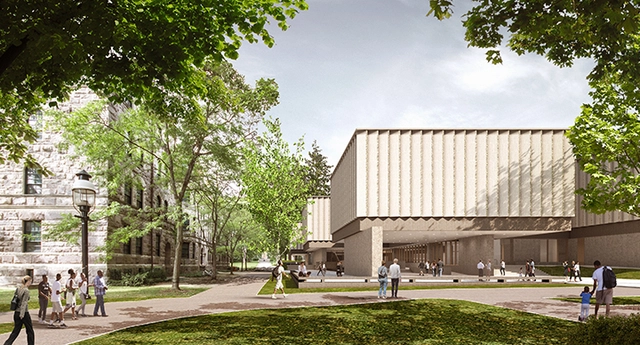
Sir David Adjaye has created an inclusive new vision for Princeton University Art Museum’s new building. Located at the heart of the campus, the project will replace and roughly double the square footage of the existing facility. Construction is scheduled to begin in 2021 with an anticipated opening in late 2024.
Videos
Courtesy of Denise Applewhite, Office of Communications
Architecture theorist, historian, and curator Beatriz Colomina has been awarded the 2020 Ada Louise Huxtable Prize for Contribution to Architecture from the W Awards. As the Howard Crosby Butler Professor of the History of Architecture and co-director of the Program in Media and Modernity at Princeton, Colomina is an internationally renowned architectural historian and theorist who has written extensively on questions of architecture, art, technology, sexuality and media.
The resignation itself was demanded* by Princeton University President Christopher Eisgruber after Zaera-Polo was accused of plagiarizing parts of a text he produced for the “Elements of Architecture” exhibition curated by Rem Koolhaas at the 2014 Venice Biennale. From the start, Zaera-Polo has denied that his texts violate Princeton’s academic code of conduct, but nevertheless agreed to Eisgruber’s demand. In the documents leaked Tuesday, Zaera-Polo criticizes the actions taken by Princeton both before and since his resignation, arguing that they have damaged his reputation. He is thus suing them on four charges: “breach of contract,” “breach of the implied covenant of good faith and fair dealing,” “tortious interference with contract and prospective economic advantage,” and finally “trade libel.”
The story will undoubtedly receive a lot of attention, given that it involves a controversial dispute between an internationally renowned architect and a university with an international stature. But the real story behind the dispute is not about Alejandro Zaera-Polo’s academic conduct or Princeton’s handling of its staff contracts; instead, it has everything to do with our expected standards for architectural research.