Last September, we shared the news of Louis Kahn’s memorial park for the southernmost tip of Roosevelt Island. Kahn had designed the park in the 70s, but after his sudden death, the plan was forgotten until 1992 when the MoMA featured the scheme in an exhibition. Upon learning of Kahn’s thoughtful and architecturally compelling ideas to commemorate FDR and his Four Freedoms speech, the public quickly advocated its completion. As we reported earlier, at the end of Kahn’s axial tree-lined triangular “Garden”, a 72 sqf “Room” will contain excerpts from the text of President Roosevelt’s Four Freedoms speech. This room, contained by 12 foot high granite columns, is meant for contemplation and remembrance as Kahn’s stoic material palette, clear formal attitude, and forced perspective of the skyline will create, what we imagine will be, a quiet and peaceful atmosphere. With Kahn’s simple gestures, the memorial will preserve a time in American history where FDR’s leadership inspired hope to endure the Great Depression and the second World War. We’re excited for the memorial to be completed and we’ll keep you up to date with its progress.
A great sample of construction photos and renderings after the break.
Gia Wolff’s latest architectural installation features a 25 ft diameter portal suspended above 2 Avenue between 36 and 35 Street in Industry City, Brooklyn. As part of Superfront Public Summer, the site specific piece is a reaction to the existing typological conditions and explores potential scenarios for the future of Industry City. Finnish for ‘portal’, Portaali refers to the Scandinavian dock workers who used to occupy the buildings in the late 1900s.
More about the installation, including a video, after the break.
In the wake of Hurricane Irene it only seemed appropriate to take a second look at Rising Current, an exhibit that was featured at the MoMA just last year. To give you a refresher, the exhibit was a cohesive showcase of five projects tackling the lingering truth that within a few years, the waterfront of the New York harbor will drastically change.
Team Zero, comprised of ARO and dlandstudio, specifically took a look at the lower Manhattan landscape, proposing to develop a new soft and hard infrastructure solution paved with a mesh of cast concrete and engineered soil and salt tolerant plants. This would create greenways that act as absorptive sponges for rainwater. The porous green streets address daily tidal flows and storm surges with 3 interrelated high performance systems (network of parks, wetlands and tidal salt marshes). These systems stop sewage overflow, block higher sea levels and mitigate storm surge.
Rising Current provided an emphasis on how to re-think the city, relevant before, and even more pressing now after the flooding from the hurricane. Let’s hope that the ideas for solutions that were generated from the exhibit can now be considered for implementation. More about Rising Currents and Team Zero’s solution following the break.
Local New York architect Gregg Pasquarelli of SHoP Architects recently gave a speech at the Association of Collegiate Schools of Architecture’s Teachers Seminar 2011. He addresses numerous issues that are currently being debated within the profession where the theme of the three-day seminar was “Performative Practices.” The roles of the architect and builder, the architect and engineer, etc. The roles of architects as instruction makers who outsource to specialists in façade or fabrication may not be as clear as in previous generations. His own firm is prime example of the shifting of roles. SHoP has branched off with its own SHoP Construction subsidiary that is managing the fabrication of their design for the new Barclays Center rusted steel skin. More details after the break.
To say New York’s High Line is a successful project is putting it very lightly. From the moment the overgrown landscape opened, thousands have flocked to experience the amazing public space and dozens have been inspired to incorporate similar urban reuse attitudes in their cities. Ruth Samuelson sharedMexico City’s inspired project which seeks to apply the New York High Line’s sense of serenity to a busy intersection by mid-2012. “The High Line in New York seemed to me a fresh breath of air, completely. Mexico City just needs – within so many streets, so many avenues – respite like this,” explained Daniel Escotto Sánchez, the general coordinator for the city’s Public Space Authority.
Boffo is a New York City non-profit organization focused on culture and the arts. Through events and exhibitions Boffo draws attention to artists and designers while often giving them an opportunity to display their work. Boffo recently announced the winners of their Boffo Building Fashion competition, an open competition that called for architects to pair with fashion designers to build temporary spaces displaying both talents. Find out who the architects and designers are after the break.
As part of an upcoming exhibition, they are developing a New York Archive of Sacred Spaces in Profane Buildings and they need your help. This is an open call for contributions that explain either a story or the memory of a visit, a sketch of a known space, a photograph of a street sign, a location in a map, anything that might help us construct the most comprehensive guide to the sacred unknown of New York. To participate, you are encouraged to submit any material at their website.
More information on the exhibition after the break.
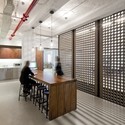
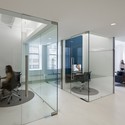
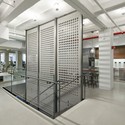
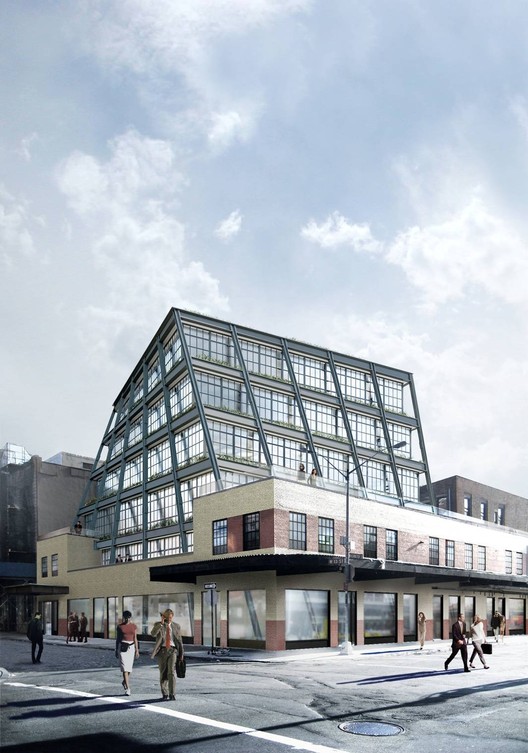
After patiently evolving the design of 837 Washington Street, the Meatpacking District’s newest addition, New York-based Morris Adjmi Architects are happy to announce the project’s recent approval from the Landmarks Preservation Commission. The new office and retail building, which will rise from a 1930s warehouse, will be Adjmi’s fourth building in the Meatpacking District. The project has been struggling to gain approval, primarily due to its height, as the building was originally conceived to stand 100 feet tall; however, the most recent design scheme shows the building measuring just below 80 feet, allowing it to blend more graciously with its surroundings.
Studio Mode/modeLab is pleased to announce the upcoming modeLab Parametric Design Workshop in New York City over the weekend of August 20/21, 2011. In response to the overwhelming interest and success of last month’s workshop, modeLab will conduct one last Parametric Design Workshop this summer. The workshop will include a newly redeveloped curriculum and series of supporting lectures as a means to engage both the conceptual, as well as technical domains of applied parametric design.
The Internet is now the library of the past. Where the public library has historically served as the primary source of information gathering and dissemination, we now look to this new virtual, infinitely large library that can be accessed anywhere at any time as the Library of the present.
As a result, the primary roles of today’s physical libraries have shifted. Libraries of the past focused primarily on individualized information consumption. Communal aspects of interaction and information dissemination now represent the core mission of the library when information is more easily accessible. The silent grand beaux-arts reading rooms of New York or Boston have of the past been transformed into flexible communal “living rooms” in Seattle.
The Association for Computer Aided Design in Architecture (ACADIA), in collaboration with Brooklyn-based fabrication house FLATCUT_ recently announced the winners of this year’s ACADIA 2011 Design + Fabrication Competition. The competition challenged designers to create new forms in the categories of furniture, partition and lighting using innovative materials and digital fabrications applications. The winners brought not only ingenuity to their designs, but a sense of beauty and functionality that excited the jury. More images and information on the competition winners after the break.
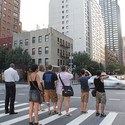
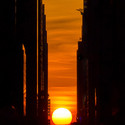
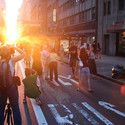
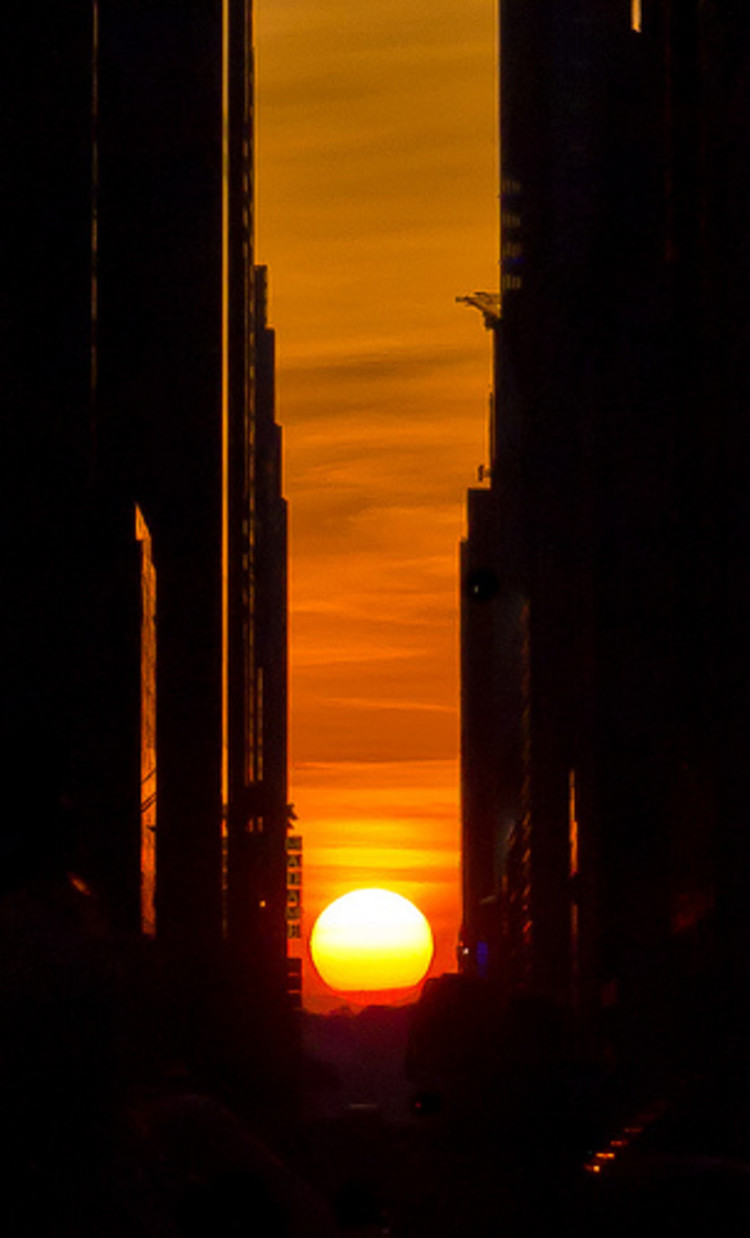
Manhattanhenge, is the term used to describe a biannual occurrence in New York City when the sun aligns with the east-west streets of Manhattan’s main grid. Adopted in 1811 the famous street grid of Manhattan, the Commissioners’ Plan, was the original design plan for the streets in which the grid plan is offset at 29.0 degrees from true east-west. Twice a year photographers gather to witness this urban solar phenomenon, when the sun sets perfectly between the skyscraper corridors and illuminates the north-south facades of the streets. Tripods and pedestrians filled the crosswalks this past Wednesday to catch a glimpse of this moment.
One of the New York City’s most forgettable buildings has been transformed into a model of modern technology. The Port Authority Bus Terminal (PABT), located in midtown Manhattan between 40th and 42nd street, now boasts the world’s largest transparent media façade completed by GKD Metal Fabrics which effectively covers the building’s outdated steel façade. More images and project description after the break.