Created and conceived by Patrick Duffy, the creative director of the OUT NYC, and designed by award-winning Italian designer and architect Antonio Pio Saracino, the Arches of Hope installation will be launched at its opening reception on Thursday, January 17, from 6:30pm-8:30pm at the OUT NYC and be on display until January 24. In collaboration with Lifebeat: Music Fights HIV/AIDS and the MTV Staying Alive Foundation, the stunning and inspiring interactive art installation will be unveiled on the eve of President Obama’s second inauguration as part of a multi-faceted campaign aimed at raising awareness of the rise of HIV and AIDS in young people. More images and information after the break.
New York’s Garment District, consisting of 18 blocks in the west side of midtown, was the city’s most well known industries in the boom of the 1920s through the early 50s. The influx of immigrants and the geography of New York City made it a natural hub for manufacturing and trading activity. The work began in small workshops and at home in crowded tenements and eventually grew out of these crammed space into factories and warehouses. The industry inadvertently transformed Seventh Avenue into rows of skyscraper factories that faithfully abided to New York City’s zoning regulations. The 125 loft buildings all shared the pyramidal forms due to step-back laws governing design.
Now, The Skyscraper Museum in New York City is celebrating this neighborhood and its influential development of business, industry and architecture and the mark that it left on the city with an exhibition called URBAN FABRIC. It is curated by Andrew S Dolkart, the Director of the Historic Preservation Program, and will be running through February 17th.
Learn more and watch the curator’s lecture after the break.
When plans for the High Line were first revealed it made quite an impression on the design community. The converted elevated rail line, long abandoned by New York City, was threatened by demolition until a group of activists fought for its revival and helped transform it into one of the most renowned public spaces in Manhattan. Now Queens, a borough with its own abandoned infrastructure is on its way to redeveloping the land for its own version of the High Line, to be known as the Queensway Cultural Gateway.
In late December, the Trust for Public Land announced that New York Governor Andrew Cuomo has awarded a $467,000 grant to the organization to begin a feasibility study on the 3.5 mile Long Island rail line. Early proposals reveal a new pedestrian and bike path, public green space and a cultural gateway that will celebrate Queens’ diversity in art, sculpture and food, serving the 250,000 residents that live in the neighborhoods along the route, which include Rego Park, Forest Hills, Richmond Hill, Ozone Park and Forest Park.
Designed by architecture students, Ian M. Ellis and Frances Peterson, their proposal for the North Brother Island School for Autistic Children in New York City aims to provide a necessary resource for the Bronx, which is heavily underserved in terms of school for children with Autism Spectrum Disorder. The project is also designed with the intention that it will dissolve the negative stigma of the island, stabilize its naturalized growth as habitat for the birds, and introduce research and education programs to provide a cutting edge learning environment for the public, parents, and children. More images and architects’ description after the break.
The Principles just recently completed an interactive project, titled the “Workshop”, for the clothing brand Everlane in the Meatpacking district of New York. As part of the Everlane’s “Not-a-Shop” series, which focuses on selling only online, “the space was a physical manifestation of their primarily digital presence; replacing coded interaction with physical interaction,” described The Principals co-founder Drew Seskunas.
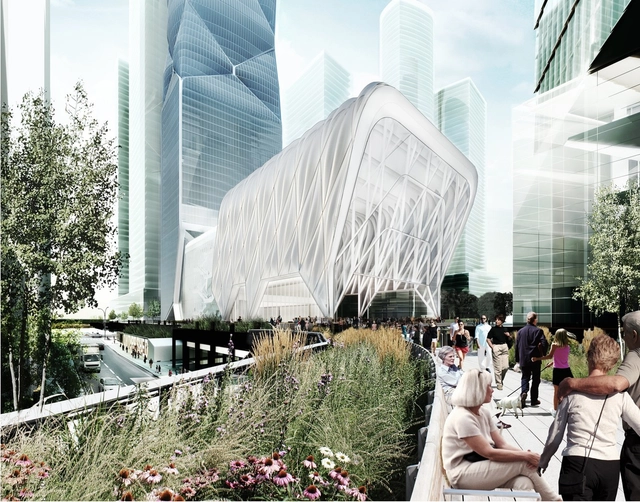
Construction has exploded along the High Line ever since it opened: condos hover over the rehabilitated track and look out onto the Hudson, while the new location of the Whitney Museum is making headway on the southern end of the park as Google moves into its NYC headquarters to a building just a few short blows away. Now, the historic Chelsea Market may be looking at a facelift following approval from the New York City Council for increasing density in the building by developers, Jamestown Properties. The proposed vertical extension, which has made a brief appearance on a few architecture blogs, will provide the additional in demand office and retail space in the Chelsea neighborhood.
This week we’re going to spotlight one of our greatest contemporary filmmakers, Tim Burton. In the 1989 film Batman, Burton generates a whole gothic environment, full of art deco and art nouveau buildings within Gotham City. Locations were inspired by urban spaces from New York City, Los Angeles, West London, Chicago, Pittsburgh, Tokyo, to Hong Kong (even though Gotham City was a well-known nickname for New York City, before Batman was ever written).
If you didn’t check out our article on Architecture & Batman, do so now – and let us know which Director you think does Gotham best in the comments below…
Shipping container architecture has gained a lot of ground over the past few years for its simplicity, affordability and flexibility. Yes the very same containers that make transatlantic voyages and are carted around hitched to trucks have become a tool for architects to design restaurants, to serve as retail or pavilions and even homes. According to an article by Matt Chaban on the New York Observer, NYC plans to prepare for the next disaster with apartments built out of shipping containers to be used as disaster relief shelters.
Hosted by the Architectural League and co-sponsored by The Irwin S. Chanin School of Architecture of The Cooper Union, Steven Holl will lecture in the Great Hall at The Cooper Union on November 28 at 7:00pm. Holl’s architecture and writing has undergone a shift in emphasis, from his earlier concern with typology to his current interest in phenomenology. This “Time Light” lecture is dedicated to Lebbeus Woods and will show both early and recent works by Steven Holl Architects. Following the lecture, Steven Holl will be joined in conversation by Sanford Kwinter. For more information on the event, please visit here.
The west side of midtown Manhattan is probably one of the more unexplored areas of New York City by residents and tourists alike. Aside from the Jacob Javits Center, and the different programs off of the Hudson River Parkway that runs parallel to the waterfront, there is very little reason to walk through this industry – and infrastructure – dominated expanse of land full of manufacturers, body shops, parking facilities and vacant lots. The NYC government and various agencies, aware of the lost potential of this area, began hatching plans in 2001 to develop this 48-block, 26-acre section, bound by 43rd Street to the North, 8th Ave to the East, 30th Street to the South and the West Side Highway to the West.
The new Hudson Yards, NYC’s largest development, will be a feat of collaboration between many agencies and designers. The result will be 26 million square feet of new office development, 20,000 units of housing, 2 million square feet of retail, and 3 million square feet of hotel space, mixed use development featuring cultural and parking uses, 12 acres of public open space, a new public school and an extension of a subway line the 7 that currently terminates at Times Square-42nd Street, reintroducing the otherwise infrastructurally isolated portion of the city back into the life of midtown Manhattan. All this for $800 million with up to $3 billion in public money.
The Battery Conservancy Americas Design Competition 2012: Draw Up A Chair, which we published a couple months ago here, has received an impressive number of registrations to-date and continue to receive wonderful design submissions. Due to the impact of SuperStorm Sandy on many of their registered and would-be participants, they recently announced that they have extended the competition submission deadline to Monday, November 19. For more information, please visit here.
In the wake of Hurricane Sandy, as communities band together to clean up the devastation and utility companies work tirelessly to restore the infrastructure that keeps New York City running, planners and policy makers are debating the next steps to making the city as resilient to natural disaster as we once thought it was. We have at our hands a range of options to debate and design and the political leverage to make some of these solutions a reality. The question now is, which option or combination of options is most suitable for protecting New York City and its boroughs? Follow us after the break for more.
Designed for the Land Art Generator Initiative competition, the ‘NAWT Balloons’ concept, which was recently shortlisted in the competition, aims to couple the image of an oversized helium-filled teardrop with a nuanced application of wind energy technology. While the balloon’s image and subsequent geometry are the primitives to the proposal, the deployment on the Fresh Kills site ignites an interest in the oversized and the attenuated. Designed by Norman Kelley, through its multiplication and reconfiguration, this design may be able to produce new, yet familiar, collections of iconicity. More images and architects’ description after the break.
Designed by Paolo Venturella & MenoMenoPiu Architects, their ‘Solar Loop’ finalist entry for the Land Art Generator Initiative competition aims to expose more surface as possible to the southern solar rays. Sited in FreshKills Park in New York City, the shape comes directly from the solar diagrams, and deals easily with the sun following it with the best angle almost like a frozen artificial sunflower.bThe aesthetic of the sculpture is the result of this dialogue that becomes synthesis between the solar power and the park. More images and architects’ description after the break.
The Museum of Modern Art in NYC is launching an exhibit called Tokyo 1955–1970: A New Avant-Garde, that investigates the transformation of Tokyo from a war-torn nation into an international center for arts, culture and commerce. The exhibition will run from November 18 through February 25, 2012 and includes over 200 works of various media including painting, sculpture, photography, architecture, drawings, graphic design, video and documentary film.
Co-organized, in cooperation with the Architectural League, by Christopher Marcinkoski and Javier Arpa, The City That Never Was symposium is a day-long event that uses the current crisis in Spain as a lens to reconsider patterns of urbanization and development around the world. Taking place November 9th from 9:00am-5:00pm at the Scholastic Building in New York, the event will reconsider how planners, designers, politicians, and financiers conceive of and realize large-scale contemporary urbanization and settlement. This event seeks to better understand the systems that have produced certain imbalances resulting from this urban growth and explore new models and approaches for urbanization and development. For more information, please visit here.
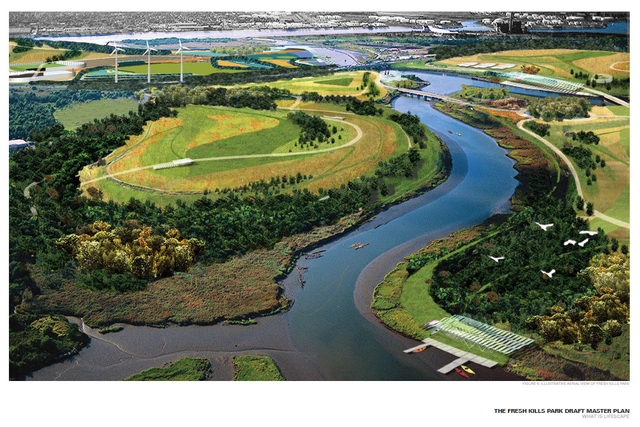
Winners of the 2012 Land Art Generator Initiative Competition for Freshkills Park in Staten Island, NYC are out. With 4 placed winners and a long list of shortlisted projects, the range of ideas shows how designers are exploring many different options for sustainable energy infrastructure.
The Winners:
First: Scene-Sensor // Crossing Social and Ecological Flows byJames Murray and Shota Vashakmadze
Second: Fresh Hills by Matthew Rosenberg, Structural Engineering Consultant: Matt Melnyk, Production Assistants: Emmy Maruta, Robbie Eleazer
Third: Pivot by Yunxin Hu and Ben Smith
Fourth: 99 Red Balloons by Emeka Nnadi, Scott Rosin, Meaghan Hunter, Danielle Loeb, Kara McDowell, Indrajit Mitra, Narges Ayat and Denis Fleury
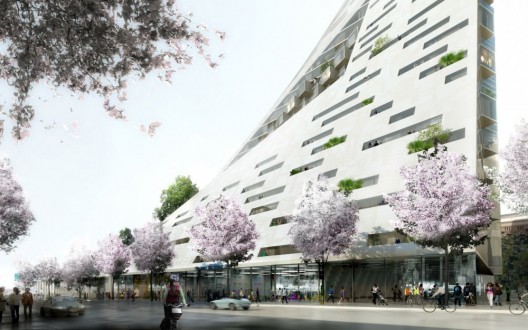
Jeanne Gang is about to make her New York debut, as the Chicago-based architect just unveiled the latest project planned to border New York City’s beloved High Line. The 180,000 square-foot office tower with ground level retail will replace an existing, disused meatpacking plant along 10th Avenue between 13th and 14th streets. It will feature a “gem-like”, glass facade that is intelligently shaped to avoid the disruption of light, air and views from the High Line.
Dubbed the Solar Carve Tower, the mid-rise structure is currently pending city approval and is planned for completion in 2015.
Continue after the break for the architects’ description.