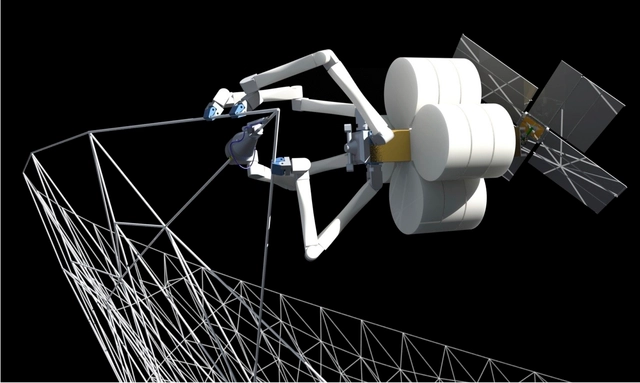
As revealed in an article on Gigaom, NASA has recently added an extra $500,000 into a collaboration with Tethers Unlimited, a company researching ways to 3D print and assemble structures whilst in orbit. Using this technology, their SpiderFab robots reduce the size of the rockets needed to launch materials into space, and also allow for much larger structures to be created than in any previous technique - opening up new possibilities for construction in space. You can read the full article here.
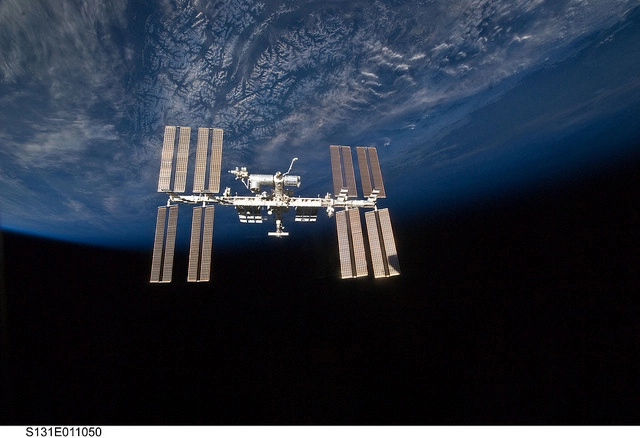
Three months ago, Commander Chris Hadfield captured the attention of millions by recording a cover of David Bowie's Space Oddity - entirely on board the International Space Station. The video was the culmination of five months of social media efforts to raise awareness and interest in current space programs worldwide, and it certainly seems that Hadfield succeeded in piquing the interest of at least a few future astronauts.
But for architects, something else probably stands out in the video: the ISS seems an extremely clinical and uncomfortable environment to live in for five months. The reasons for this are obvious: it is a highly controlled engineered environment; sending luxuries into orbit is expensive; the astronauts are there to work, and after all they are trained to cope in stressful and uncomfortable environments. However, with proposals for longer missions, such as a manned trip to Mars, as well as the continued promise of commercial spaceflight on the horizon, the design of living spaces outside of our own planet may soon become an issue which architects must get involved in.
Read on to find out about the challenges of architecture in space, after the break.
Videos
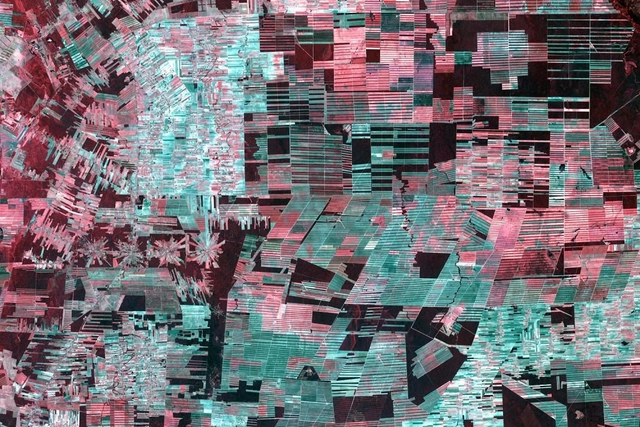
This satellite image of Bolivia shows dramatic deforestation in the Amazon Basin. Courtesy of Google.
NASA, in cooperation with TIME and Google, has unveiled startling timelapse images of Earth from orbit collected by NASA's Landsat program since 1984. This program, created not for spycraft but for monitoring the way in which humans are rapidly altering the surface of the planet, consists of eight satellites that have collected millions of pictures in the course of two generations. When sifted through, cleaned up and stitched together, these pictures come together to create a high-definition slideshow that reveals some of the drastic changes our planet is undergoing - most notably through widespread urbanization.
Currently in the California State Polytechnic University, Pomona, Interim Design Center parking lot, students are constructing a 30 foot experimental structure that expands on the notion of housing astronauts in space. Funded by the National Aeronautics and Space Administration (NASA), the year-long research and experimentation project challenges students to design a vertical habitat capable of housing four astronauts in space for a period of 60 days. Not only is this an extreme case of micro-living, but to design a living quarters with no orientation, where walls, floors and ceilings are non-existent, is unworldly.