Videos
Competition Site facing east, White Bay Power Station in foreground. Image Courtesy of NSW Government
The White Bay Power Station precinct and Glebe Island, two key sites in one of the last major redevelopment sites on Sydney's inner harbour, are the focus of a new international design competition launched by the New South Wales Government. The open, two-stage Bays West International Design Competition seeks a design-led Urban Framework that will guide the transformation of the precinct into a new waterfront neighbourhood.
Pedestrian view of BCIE headquarters in Tegucigalpa. Image Courtesy of Banco Centroamericano de Integración Económica (BCIE)
Central America's nations occupy a narrow land bridge between Mexico and Colombia, but they were not born as separate countries. They emerged from a single entity: the Federal Republic of Central America in 1823. That federation collapsed, yet the ideal of a unified region never fully died. In 1951, the governments signed the Charter of San Salvador, creating ODECA, the Organization of Central American States. Four decades later, the 1991 Protocol of Tegucigalpa replaced it with SICA, the Central American Integration System, the framework guiding regional cooperation today. Within this integration process, the Central American Bank for Economic Integration (BCIE) was founded in 1960 by Guatemala, El Salvador, Honduras, and Nicaragua, establishing its headquarters in Tegucigalpa. On the surface, it is a conventional late-20th-century office complex, but look closer at its façade, and the building becomes an argument about identity. One written in pink quarry stone from the very hills that surround the Honduran capital.
Recorded live at Milan Design Week 2026 in partnership with INDX|GLOBAL, the tenth episode of the Room For Dreams podcast looks at how buildings outgrow their original blueprints. Architects Parvez Alam and Priyanka Arjun, alongside interior designer Aditi Sharma, discuss why the best architecture is never truly finished.
Images of the benches at New York City's High Line Park spread around the world when the project opened in 2009. Emerging diagonally from the same material and modular pattern as the paving, they transition seamlessly from concrete to wood, evoking the railway tracks that once occupied the site. To withstand decades of exposure to the elements, the project required a wood species of exceptional durability, and ipe, harvested from the Brazilian Amazon, was selected. Its slow growth produces a dense, low-porosity hardwood that is naturally resistant to wear, moisture, and biological decay. The choice, however, sparked controversy at the time amid concerns over the certification of the timber's forest management. This broader view changes how we think about materials. Their origin still matters, but so does what happens after the building's life comes to an end.
What defines the quality of a bathroom beyond its basic functions? As one of the most private spaces within the home, the bathroom is closely connected to everyday rituals and moments of pause. While fixtures, circulation, and technical requirements establish the practical foundation, the atmosphere emerges through a combination of spatial decisions: how furniture meets the floor or deliberately avoids it, how materials interact with light, how storage is integrated, and how form and proportion shape perception.
MTM—Made to Measure designed by Herzog & de Meuron for UniFor, Creative Direction by Studio Klass . Image Courtesy of UniFor
What allows a single architectural principle to generate many different outcomes? The answer lies in the systems that organize architecture: geometry, proportion, structure, and construction. Together, these can establish a set of rules that can accommodate different programs, contexts, and spatial conditions while maintaining a coherent identity. A structural grid, for example, can organize a variety of uses, just as a single construction detail can be repeated throughout an entire building without producing identical spaces. Can the same way of thinking be translated into furniture design without losing its identity? MTM—Made to Measure, developed by Herzog & de Meuron for UniFor, explores this question. Instead of designing each piece independently, the collection grows from a single structural principle that can be extended, adapted, and repeated across different functions while maintaining its internal coherence.
What does luxury mean when products are designed for quick obsolescence? Recorded live at Milan Design Week 2026 in cooperation with INDX|GLOBAL, the eighth episode of the Room For Dreams podcast brings together architects Priyanka Mehra, Simran Boparai, Ashmit Singh Alag, and Adreesh Chakraborty to dissect the evolving, often contradictory relationship between exclusivity, sustainability, and purposeful craftsmanship.
Every building begins somewhere else. The sand in its concrete, the stone on its façade, the lithium that may one day power its systems. It arrives, already stripped from a mountain, a riverbed, or a salt flat thousands of kilometers away, having passed through a chain of trucks, ships, and customs declarations that erase almost everything about where it came from. Architecture tends to treat material as a starting condition, something simply available, but extraction is where construction actually begins.
Ellisse, location: Armando Cose, Designer: Philippe Malouin
Communicating an idea using only the essentials is a far greater challenge than it often appears. From Japanese haikus to the refined sculptures of Constantin Brâncuși, many artistic expressions have sought to condense the maximum meaning with the minimum of elements. This economy of form is not a sign of scarcity, but of intensity: every stroke, every word, every silence gains weight. There is something intrinsically appealing in what presents itself as simple and well-resolved, whether it is a text that wastes no words, a tennis player who moves with purposeful gestures, or a melody that is both direct yet unexpectedly profound.
What will the future of steel be?How can this material build the foundation for sustainable economic development and the transition to a low-carbon society?
There is a big difference between looking at an image of a building and experiencing the space it represents. The atmosphere of a place, shaped by its light, sounds, materiality, and relationship with the surrounding landscape, has long belonged to the realm of physical experience. Today, real-time rendering technologies are beginning to narrow that gap, allowing projects to be explored and experienced before they are ever built.
In the twenty-first century agenda, adaptive reuse is understood as a creative and meaningful approach to the development of the built environment. In the face of an era marked by adaptation and transformation, the shaping of human experiences aligns with the principle of "reuse, reduce, recycle." From the authenticity of place to the inherent value of materials, working in dialogue with the past makes it possible to envision new futures that engage with the uses, traditions, and beliefs of earlier eras. By considering each building as a collection of tangible and intangible elements that shape its identity, adaptive reuse interventions require a deep understanding not only of construction methods, structural systems, and spatial rhythms, but also of the cultures that built, inhabited, and will one day occupy these places.
The accelerating rise of a homogenized, worldwide aesthetic is forcing creators to confront a critical reality: design trends are effortlessly transcending geography, but local identity is paying the price. The fifth episode of the Room For Dreams podcast tackles a head-on investigation into whether a boundaryless market is quietly erasing design diversity. Recorded live at Milan Design Week 2026 in cooperation with INDX|GLOBAL, host Claire Broadka of designboom sits down with Sachi Gupta, Shilpi Sonar, Krithika Subrahmanian, and Sumit Dhawan to map out the reality of the borderless creator.
Many factors influence people's well-being, but few have power as great as the quality of sleep. Adults spend, on average, a third of their day (and their life) sleeping. In the case of young children, this proportion is even higher. According to a study published by the WHO in 2019, babies (4 to 11 months) should sleep between 12 and 16 hours/day; and children up to 4 years old should sleep between 10 and 13 hours/day.
Videos
Casa Piedra Blanca / Pablo Lobos Pedrals, Angelo Petrucelli. Image Cortesia de Pablo Lobos Pedrals, Angelo Petrucelli
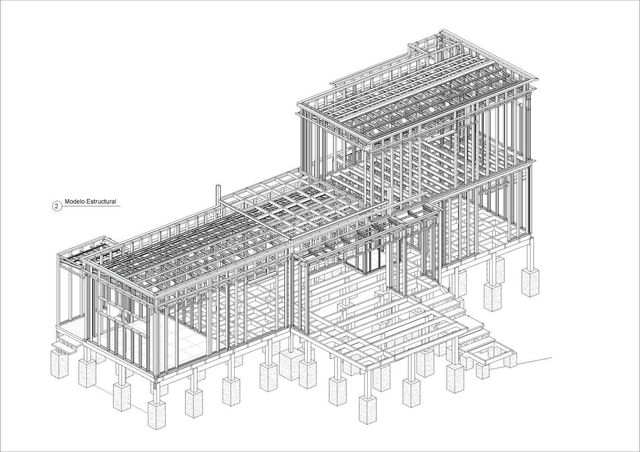
Steel frame is a system composed of galvanized steel profiles, with a thickness between 0.80 mm and 3 mm, cold bent, and assembled as structural frames, with vertical and horizontal studs. To wrap the structural profiles, OSB, cementitious or plasterboard sheets are used, which can be finished and painted internally and externally. Inside the walls, insulating materials can be included, such as mineral, glass wool, or others, to increase the thermal acoustic insulation. In the steel frame system, all the electrical and hydraulic parts are installed before closing the panels, making the process more efficient and without breakage and material waste. Cleanliness of the work, efficiency and speed are key points in this constructive system that is widely spread around the world.
An experiential rebellion takes center stage in the fourth episode of the Room For Dreams podcast, hitting directly at the heart of today's screen-deep, image-obsessed design culture. Recorded live at Milan Design Week 2026 in cooperation with INDX|GLOBAL, host Claire Broadka sits down with four Indian architectural voices — Indrajit Kembhavi, Manish Gulati, Sanjay Singh, and Sidhartha Talwar — to explore a critical question: have we sacrificed the soul of architecture for the sake of a picture-perfect Instagram post?
One of the defining qualities of contemporary interiors is flexibility. Offices, education facilities, hotels, and cultural venues need to be adaptable. They require spaces that can expand, divide, open, and close according to different activities, without sacrificing comfort, or accoustics. How a space is subdivided, then, is no longer a secondary decision, but a central component of architectural performance.
A building material rarely begins where architecture encounters it. By the time concrete reaches a construction site, its limestone has already been quarried, processed, and transformed. Timber arrives long after the forest. Glass appears detached from the sand from which it was made. By the time materials enter construction, much of the landscape and industry that produced them has already disappeared from view.