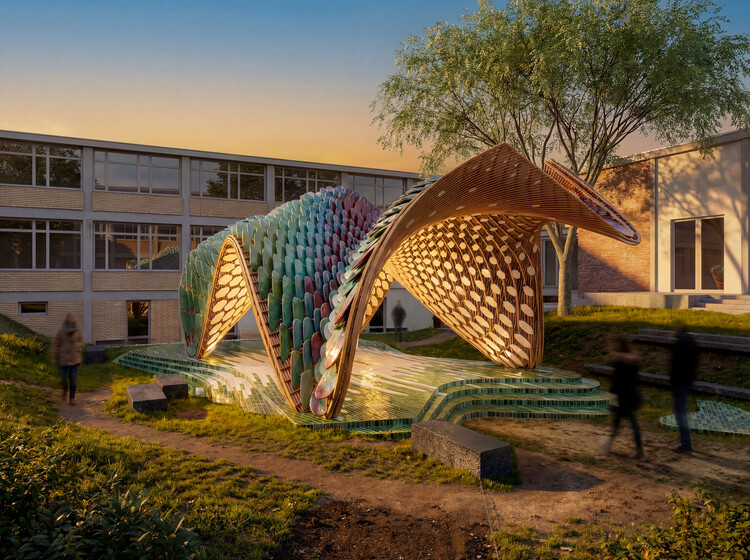
How does an architectural installation express the identity of a region? How can a building material connect with the essence of a nation? Throughout its history, Spain has been shaped by a wide range of cultures and civilizations, including Muslim, Phoenician, Roman, Greek, Carthaginian, and Visigothic influences. From flamenco to ceramic tiles adorning façades and historic monuments, each region of Spain embraces its own customs and traditions, reflected in its architecture, history, art, and design. During Milan Design Week 2026, Tile of Spain presents Spanish Design as a Souvenir at the Fuorisalone—an installation that transforms ceramic tile into a narrative medium through a series of sculptural objects reinterpreting everyday icons of Spanish life.
Anan Alsama designed by Fatimah Alabid, Masud Alzunaifer, and Maha Alesawi. Image Courtesy of Mujassam Watan
In the city, aesthetics are not measured by the height of towers or the width of roads, but by their ability to evoke meaning within space. From this perspective, the Mujassam Watan initiative emerges as more than a mere artistic endeavor. It involves a deliberate attempt to redefine the relationship between people and place, between material memory and imagined identity. In the city of Khobar, in the Kingdom of Saudi Arabia—where urban modernity intersects with rapid social transformation—this initiative raises the question: How can a sculpture become an open text, one that is both visually read and experientially felt?
At a moment when architecture is being pushed to respond more directly to environmental and social pressures, Spain's pavilion for World Design CapitalFrankfurt Rhein-Main 2026 positions itself as more than a temporary installation. While materiality is at the center of its design, the project explores how a reversible cultural infrastructure can activate public space without permanent construction. Discussions about material use, circularity and reutilization in architecture are closely tied to cultural contexts, environmental conditions, and historical influences that reveal how time shapes the built environment. Beyond its construction, Spain's pavilion expresses identity by reinterpreting the architectural method of Antoni Gaudí, the creator of the Sagrada Familia and Park Güell. It also demonstrates how Spain's creative and industrial sectors address current challenges with innovative construction solutions.
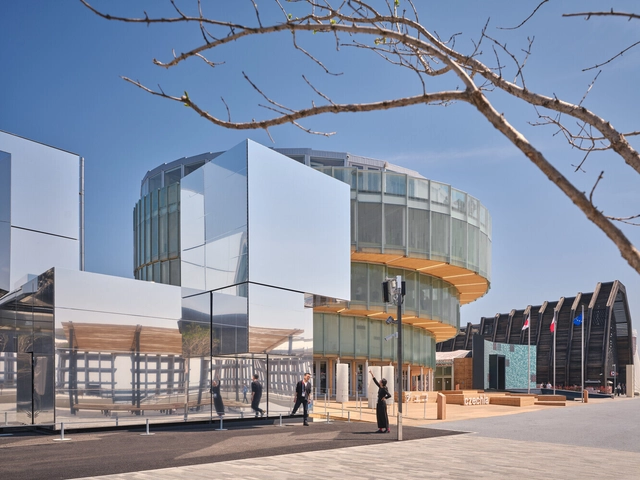
What can a pavilion’s architecture reveal about its country? At major World Expos, national pavilions are designed to answer this question, transforming into spaces laden with symbolism. Though temporary, these structures are rich in meaning, functioning as architectural expressions of political identity. Their forms and materials encapsulate national ambitions. Expo Osaka 2025, the latest chapter in this ongoing narrative, showcases how nations increasingly use built space to construct global images of themselves—sustainable, technological, culturally distinct, and geopolitically relevant.
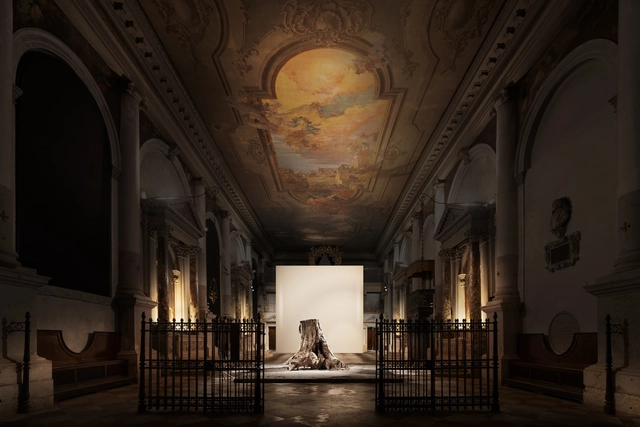
The Lithuanian Pavilion at the 2025 Venice Architecture Biennale presents Archi / Tree / tecture, a project by the National Architects Association. Commissioned by Juratė Tutlyte and curated by architect Gintaras Balčytis, the exhibition invites architects, students, communities, and visitors to reflect on the deep connections between architecture and urban nature. It positions the discipline as an interpretive medium that reveals the layered relationships shaping our cities, which in turn reflect these dynamic interactions. The proposal evokes an urban memory rooted in landscapes where fields and trees once stood, introducing the dimension of time into discussions on city ecosystems, sustainability, and resilience. The exhibition, an indoor installation designed by architects Paulius Vaitiekūnas, Andrius Pukis, and Vika Pranaitytė, will be set within the Church of Santa Maria dei Derelitti. The audiovisual and light installation in the pavilion was designed by the interdisciplinary art duo Lina Pranaitytė and Urtė Pakers, while the sculptural component of the installation was created by Kęstutis Lanauskas.
These days, it is common to hear multiple voices addressing the diverse issues of contemporary architecture. The topics are numerous, ranging from sustainability and inclusion to social justice and the crisis in land use. At first glance, there is no common ground where all these concepts can coexist transversally. However, if we look back, we can see that beyond the formal architectural concepts, the true purpose of architecture (probably) lies in the people and the lives that develop within it.
Thus, many would argue that life is likely more important than architecture, which could open up a broad debate. What is certain is that currently, narratives and voices are emerging and consolidating, aimed at renewing architectural tools and languages. This transformation seeks to turn the built environment into a space that promotes a more equitable and optimistic future for all. One of these voices is that of Tatiana Bilbao, recognized for her process-centered approach where life and human interactions play a crucial role in defining habitats.
https://www.archdaily.com/1018888/life-changes-in-seconds-but-architecture-never-changes-in-conversation-with-tatiana-bilbaoEnrique Tovar
What we build can be metaphoric—often intentionally, sometimes subliminally. But architecture is seldom the intentional commentary of architects, crafting symbolism; more often it is a direct reflection of its time and the culture that made it.
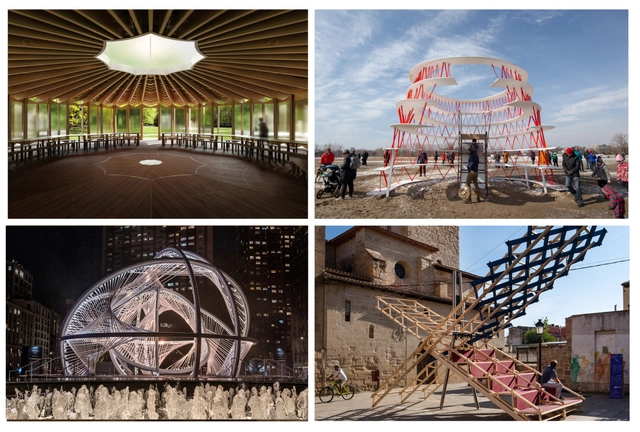
Staged stories on community and identity, ephemeral architecture showed that in 2022 it doesn't have to be permanent to be powerful. A direct and popped-up public installation can shift from preparation to action, reclaiming and defining what makes a community unique. Highlighting installations to acknowledge linguistic diversity in NYC, a giant table to celebrate culinary in Barcelona, and a large-scale net in Dubai to represent the local culture, among others, these initiatives seek to understand ways in which local and regional expressions can help cities to be more equal and diverse.
Globalization has connected the world boundaryless. While it has also made information more accessible, it has led to homogeneity and identity crisis at melding unique societies and cultural expressions. Cultural differences are undeniable as globalization grows. Hence, as architecture produces common living standards, it can also highlight singularities. Festivals, installations, and pavilions, 2022 was the year to express local memories to be recognized and celebrated, setting Community and identity as central topics in ephemeral architecture throughout the year.
With December and January nearly behind us, many of us will have been producing reports. There is an increasing number of tools for reporting PR value sold to companies as ways to justify their worth. There is no doubt that it’s useful to regularly take stock of past and upcoming initiatives and producing a report can even be pleasurable when adding to a sense of accomplishment and direction. The bad thing is that this heavily-report-reliant culture leads to management style PR that focuses more on how something will look on paper as stats, graphs, and pics, than what is actually accomplished.
For instance, The Architecture Foundation in London is highlighting growing Biennale fatigue in its forthcoming “Bored of Biennales” event in March. One can well imagine how all-too-often such events are best experienced not in situ, but instead, through carefully-edited reports or via media coverage as suggested by the Foundation.
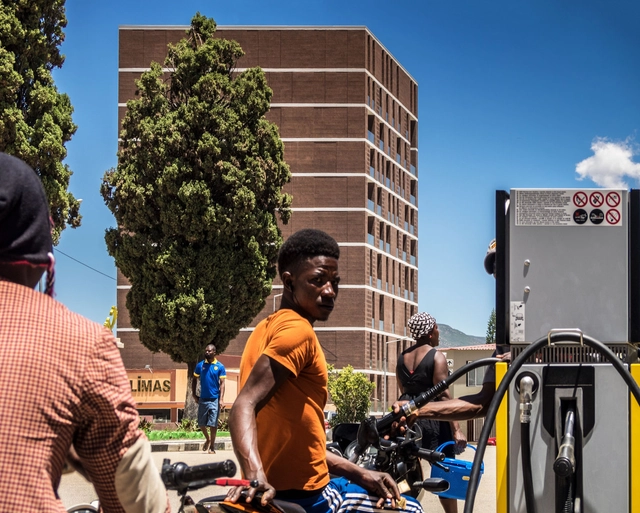
Angola, like many African countries, is experiencing a process of rapid urbanization. For the most part, these changes are happening under little to no regulation, filling cities with spaces that lack the infrastructure to provide a basic quality of life for residents. However, in spite of this unregulated development, it's worth noting the quality of contemporary architecture being produced in the second-largest Portuguese-speaking country, where projects draw inspiration from the strong local identity and blend with modern materials and technology.
In this article, we highlight 4 current projects in Angola. While it is a small sample, not only from the capital city of Luanda, but from smaller cities as well, it showcases the richness of Angola's local architecture--an art form that deserves worldwide recognition.
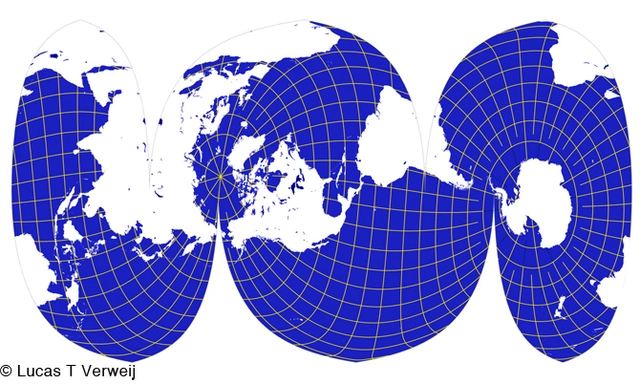
The second symposium in the ANCB programme Borders and Territories: Identity in Place with Nadine Godehardt, Malkit Shoshan, and Lucas Verweij. After the kick-off event in March 2018, this second symposium in the series will deal with Spatial Representations of Connections and Disconnections and the transfer of geopolitical and socio-cultural imaginaries of the world. Each world map reveals a particular worldview with its deposited moral, political, or economical convictions. But maps can also be instruments to analyse contested political situations. Our speakers will bring together artistic, planning, and political persepectives: Lucas Verweij will look into how maps construct our worldview and
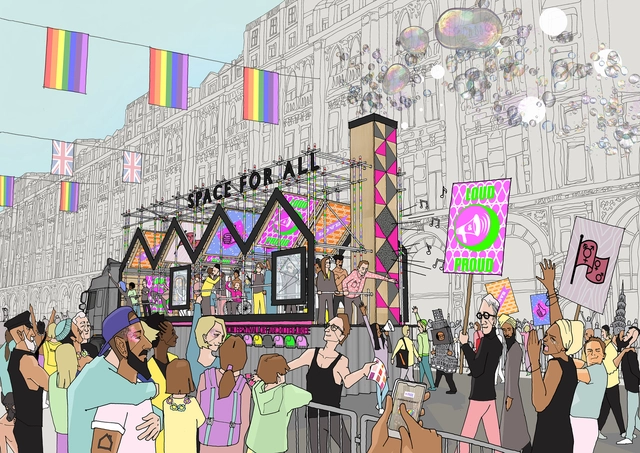
‘A Space For All’ by Hawkins\Brown has been announced as the winner of London Festival of Architecture (LFA) and Architects LGBT+’s Pride Float Competition, the design representing architecture in Pride London 2018. Forming a crucial part of the LFA’s 2018 program, the competition was open to students, graduates, emerging practices and established offices alike, with 'exploring identity' being the brief's core theme. The winning float advocates for increased LGBT+ acceptance and presence within the construction industry, combining “the dual identities of LGBT+ and being an architect.”