Dubai based X-Architects recently unveiled the Urban Oasis, their latest sustainable master plan for Al Ain. The 12-hectare urban development was conceived as a “micro-specific, compact, and passive sustainable urban oasis.” Inspired by the existing natural environment and the traditional dense urban fabric of Islamic cities, the master plan develops an “environmental synergy between landscape and urbanity.” More about the master plan after the break.
Greeen! Architects shared their competition proposal for a new library and office building for the University Duisburg-Essen, in Germany. The young architectural practice specifically focuses on ecological and sustainable design approaches. For their proposal, a large ecological complex intends to “create a place where city and university are woven together.”
We have shared architects’ different approaches to addressing the pressing food issue, from the highly conceptual designs to the more classical ideas. It seems that more competitions and clients require architects to implement gardens for harvesting food, or create an available food solution to accompany the structure. Statistics estimate that more than 80% of the population will live in cities by 2050 and the oil transportation needed to ship food from rural areas will only become more expensive. Soon, adding alternative farming methods won’t be an option; it will be a necessity if food for cities is to remain cost-efficient.
Plantagon, a Swedish-American company, has recently created their take on the vertical farm idea: a geodesic dome containing an urban Plantagon® greenhouse. The farm “will dramatically change the way we produce organic and functional food. It allows us to produce ecological with clean air and water inside urban environments, even major cities, cutting costs and environmental damage by eliminating transportation and deliver directly to consumers,” explained Plantagon.
HyBrid Architecture + Assembly‘s building system, coined “Cargotecture”, offers a sustainable, modular and affordable alternative to traditional construction methods. The Seattle-based architecture and general contracting firm recently created the first cargo container buildings for Seattle in the design district of the Georgetown area.
More images and more about the cargo buildings after the break.
A few weeks ago we were in LA for Postopolis!, and we toured around the city visiting interesting practices. One of our biggest surprises was Yazdani Studio. We started to see this firm because of their buildings for the Ordos project, so we decided to visit their offices and interview the principal, Mehrdad Yazdani.
Mehrdad Yazdani (BA Arch U Texas at Austin, M Arch at Harvard GSD) is a principal at Cannon Design, an international firm with several offices in the US and abroad. A big corporate office, with all the pros and cons it has. Given this, Mehrdad started Yazdani Studio as a small laboratory that benefits from the reach and resources of a large international practice, with the flexibility of a smaller design studio. This in-between position has allowed Yazdani Studio to work on several scales. Something I really liked when i visited their office was the large amount of test models I saw laying around for every project, a proof of the amount of experimentation at the practice.
Some of Yazdani Studio projects include the recent renovation of the Museum of Tolerance (and a 2nd phase that will be completed next), the UCSD Price Center, a new campus for Tata Motors and several institutional buildings. Yazdani Studio was also one of the first practices to start working in Ordos -before the Ordos 100 project- with a Villa currently under construction. Also, Yazdani Studio is developing a restaurant and a concert hall, as supporting programs for the cultural district envisioned for this emerging city on the Mongolian desert.
Well, enough with my intro. Just watch the interview.
Some pictures of our visit to the practice after the break.
This is the first interview recorded live at Postopolis! LA at the rooftop of The Standard. This time we present Yo-ichiro Hakomori from whY Architecture.
Amidst financial buildings and high-rise apartments, Belgian architect Vincent Callebaut has redefined the conventional skyscraper. His 132 story complex for the south edge of Roosevelt Island addresses the pressing need for environmental and ecological sustainability. This conceptual design focuses on creating a completely self-sustaining organism that not only utilizes solar, wind, and water energies, but also addresses the pending food shortage problem.
During the AIA Convention 2009 we had the chance to talk to different AEC software companies, to learn how they are helping architects. We decided to keep the conversation on the same interview format we have been using, so you can hear it straight from the developers.
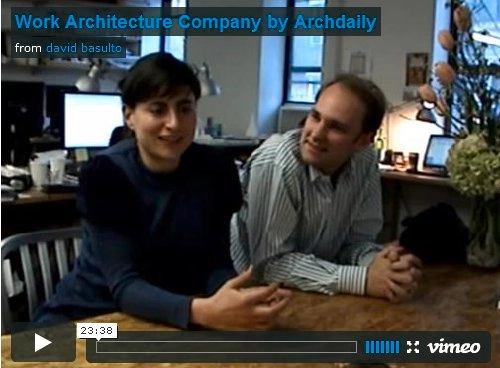
While in LA we had the chance to visit Standard, a small firm doing residential and retail projects. We visited their Tree House, featured earlier on AD, where i was able to see for myself the minimalism found in their works. A simple work, but with lots of well executed details and spaces designed to benefit from the views and the shadow of the tree.
The practice was founded in 1996 by Jeffrey Allsbrook (M Arch USC, studies at the at the Städelschule in Frankurt, Germany and at the Berlage Institute in Amsterdam) and Silvia Kuhle (Architect Technische Universität Darmstadt, Germany, M Arch Columbia University).
Completed projects include residential, retail, educational, office and manufacturing spaces for a diverse clientele of artists, writers, filmmakers, clothing designers, educators and entrepreneurs in California, New York, Las Vegas, Paris and Mexico. While Standard continues to grow, its partners insist upon maintaining a practice that is rigorous and attentive. Direct accessibility and sustained dialogue between clients and the firm’s partners are viewed as essential to project success.
It was a very good talk, and i really liked their point of view on an central aspect of the profession: the clients.
Dutch practice, Sponge Architects sent us their latest residencial project: Villa Panorama, where you can “enjoy the country life in a home where your dream landscape reveals itself before your own eyes”, as they say.
See some more images and drawings after the break.
https://www.archdaily.com/20364/villa-panorama-sponge-architectsAmber P
However, Los Angeles is changing. The city’s Transport Authority has planned in the last years a series of measures aiming to improve quality of life through improving transit and walking and providing alternative to car commuting.
Postopolis! LA has come to an end (at least for 2009). Postopolis! was discussion, debate and reflection around Architecture and a great variety of related topics: Art, City, Technology, Geography, Visualization, etc., which merged into a multidisciplinary conversation broadcasted live by seven different blogs. It’s impossible to resume in a couple of paragraphs what this days in LA were without thinking we suffered a big overdose of information that we need to take the proper time to digest.
Trying to sort out some ideas, I think at least five topics defined these days for us.
The event for itself, that concentrated expositions and discussions about some very interesting and diverse topics. From talks about the city and security with people from the LA Police Department to understand how some cities are reformulating the relation between cities and their citizens through technology, thanks to Ben Cerveny’s exposition. Complete list of everyone who participated can be found here.
Of course, being in LA, we were forced to travel through the city and it’s renowned highways. We realized how hard it is to move without owning a vehicle. But we also got to know a friendly side of the city, with many interesting and different central places to visit.
Finally, a special mention for the place where Postopolis! was carried out: The Standard Hotel in Downtown LA, a great renovation of a 13 floor building by Konig Eizenberg Architecture, where it seems that everything was specially design for the hotel which has one of the most interesting rooftops of LA.
At the same time, Postopolis! was part of the LA Art Week, organized by the For Your Art foundation, so we were immersed in a great cultural environment. Finally, our most sincere thanks to everyone who made Postopolis! possible, specially to everyone who works at The Storefront for Art and Architecture (Joseph, Gaia, Cesar, José, Faris), For Your Art (Bettina, Devin, Julia, Melissa), to the folks at the Standard Hotel, each one of the curators: BLDGBLOG (Geoff), City of Sound (Dan), SubTopia (Bryan), Mudd Up! (Jayce a.k.a. dj/Rupture), We Make Money Not Art (Regina) and of course, every guest who gave life to the event. Thanks to all!
Images that try to resume these 5 days in LA, after the break.
Since we started with ArchDaily, we’ve tried to interview some of the most important and influential architects of the world. It’s really interesting to see what’s on the mind of the architects behind the amazing projects we’ve all seen. So now, we bring you our first Round Up of previously featured interviews. Enjoy!
The success of green roofs has driven Landscape Architects and Architects to explore alternative exterior and interior applications of green planting technology, such as green walls, and green screens. Vertical planting presents challenges to proper irrigation and climate control, requiring innovative solutions. This panel of experts will discuss the relevance of green walls and how can we improve their applications.
New York-based architects Perkins Eastman sent us their new project, 303 East 33rd Street, the first green development in the Murray Hill neighborhood of Manhattan. It’s a 12-story, 165,00 sf building. They worked on the exterior while Studio V Architecture worked on the interior design. They also worked with Archipelago on the landscape of the roof garden.
More images and the architect’s proposal, after the break.
Developed by Toll Brothers, Inc. and The Kibel Companies; 303 East 33rd Street is the first green development in the Murray Hill neighborhood of Manhattan. Designed by top ranked green architecture and design firm Perkins Eastman, the LEED Certified development is a fresh interpretation of the full- and half-block residential complexes built during the last century, and reflects the mix of architectural diversity in the area.