We talk about sustainability, livability, and land use to describe a project, but we often avoid the profitability, capital gains, and externalities that go along with them simply because we don’t know how to use the terms. Architecture doesn’t exist outside of the economy and in fact, how we build each building directly affects the economy of our cities.
As a profession, architecture acts as the mediator between different specialties, and it is very important to speak the official language of each of them. This article will help you easily understand some basic economic concepts that relate to architecture.
AAgora is a debate platform based at the Architectural Association, London, which aims to shed light on relevant architectural topics. These debates take the form of an open-table discussion which encourages the audience to participate at any time. AAgora's third debate will be "Pret A Habiter" - or, Ready to Inhabit - Towards Nomadic Homogeneity, in the city through the sharing economy and Airbnb.
A new study shows that timber buildings can be up to 10-15% cheaper to construct than traditional designs in several different building types. The study, “Commercial Building Costing Case Studies – Traditional Design versus Timber Project,” was led by Andrew Dunn, chief executive of the Timber Development Association (TDA) in Australia. Part of a seminar series touring Australia, the report contains detailed designs of four building types in both timber and conventional construction, with a quantity surveyor comparing cost estimates between them. See how timber compared to conventional methods after the break.
Ever since last year, in response to the publication of Thomas Piketty's Capital in the Twenty-First Century, the hot topic in the field of economics has been inequality. Piketty's book, which argues that if left unchecked wealth will be increasingly concentrated into the already wealthy end of society, many saw the book as evidence for progressive taxes on the wealthiest members of a society. However, according to The Economist a new critique of Piketty's work is making waves among economists. A paper by MIT graduate student Matthew Rognlie argues that, since the 1970s, the only form of capital that has demonstrably increased the wealth of the wealthy is housing. With this in mind, The Economist suggests that, instead of focusing on taxation, "policy-makers should deal with the planning regulations and NIMBYism that inhibit housebuilding." Read more about Rognlie's paper at The Economist, or (for the more adventurous) read the paper for yourself here.
In an effort to combat the economic conditions that have plunged one-fourth of its population into poverty, Egypt's ambitious development plan for a massive new capital city is soon to be underway. Roughly the size of New Cairo, the privately-funded city hopes to become the new administrative center, as well as a bustling metropolis of shopping, housing, and tourist destinations to generate economic activity. Plans were solidified at a foreign investment conference where the official project details were unveiled on March 13 in Sharm el-Sheikh.
Read on after the break for more on the $45 billion plan.
In a recent article for the Financial Times, Edwin Heathcote explores the 'Skyscraper Index', an informal term that suggests a correlation between the construction of a big company's ambitious headquarters and subsequent financial crisis: "Think of the Empire State Building opening into the Wall Street crash of 1929, the Twin Towers being completed as New York City was flirting with bankruptcy or the Petronas Towers in Kuala Lumpur taking the mantle of the world’s tallest building and presaging the Asian financial crisis." Heathcote goes on to describe the latest generation of headquarters being constructed for our current, tech-oriented goliaths - like Apple's monolithic "donut", by Foster + Partners, and Facebook's Gehry-designed Menlo Park campus - and wonders: "if skyscrapers can tell us something about the temperature of an overheating economy, what do these groundscraping new HQs say?" Read the full article here.
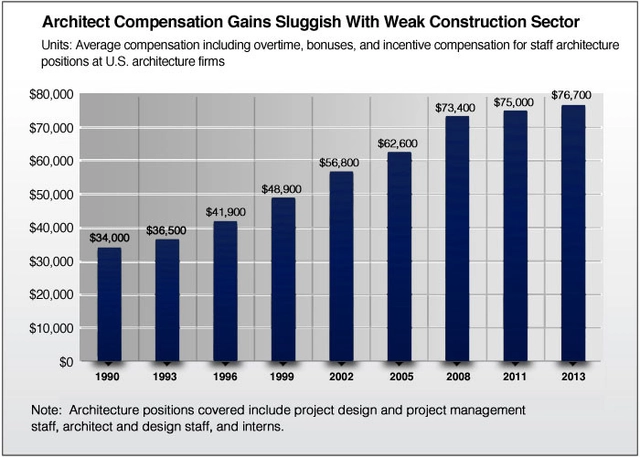
Though most architecture firms have benefited from a steady upturn in the economy over the past few years, architect salaries remain low. According to U.S. Census Bureau, architecture firms have experienced a 11 percent increase in revenue from 2011 to 2012. However, as reported by the American Institute of Architects (AIA), the average total compensation for architecture positions—including base salary, overtime, bonuses, and incentive compensation—has increased only slightly over 1 percent per year between 2011 and 2013. This is barely more than the average increase in compensation between 2008 and 2011 when the construction sector was still in steep decline.
The numbers are in and the American Institute of Architects’ November Architecture Billings Index (ABI) has revealed positive business conditions for all building sectors for the fourth consecutive month.
As a leading economic indicator of construction activity, the ABI reflects the approximate nine to twelve month lag time between architecture billings and construction spending. Understanding this, the AIA is pleased to report that November has reached a five-year high with a score of 53.2, slightly up from 52.8 in October. Since August, the national billings index has continued to increased above 50.0 – the break-even point between contraction and growth – reflecting a steady rise in demand for design services. The West seems to be the only region in contraction, coming in at a score of 49.6.
Additionally, November also sees the Project Inquiry Index at 59.6, marking the 47th straight month in which inquiries into architectural services has been increasing.
“These are the strongest business conditions we have seen since the end of 2007 before the construction market collapse,” said AIA Chief Economist, Kermit Baker, PhD, Hon. AIA. “The real question now is if the federal budget situation gets cleared up which will likely lead to the green lighting of numerous projects currently on hold. If we do end up going off the ‘fiscal cliff’ then we can expect a significant setback for the entire design and construction industry.”
View the ABI highlights in greater detail, after the break…
Many of you may have probably noticed Scott Timberg’s article “The Architecture Meltdown” (Salon, February 4, 2012) circling the internet. The gloomy article discusses the unknowing future and possible demise of the architectural profession – the “glamour profession of the creative class”. Timberg describes struggling professionals that are either unemployed or working full-time at intern wages within a profession that is largely focused on the 1 percent.
There is no doubt that many architects and recent graduates are struggling. Architecture succeeded with the economy and crashed with it as well. With statistics revealing the highest unemployment rates among those with bachelor’s degrees in architecture and articles flooding the internet with titles “Want a Job? Go to College, and Don’t Major in Architecture” (New York Times, January 5th, 2012), there is not doubt that people are scared and unsure of where the profession is heading. Meanwhile, the (AIA) is cheering for a “2.1 percent rise in spending this year for non-residential construction projects”, a bit of optimism many are grasping onto for hope. However, we are headed somewhere. As Timberg states, “People will always need houses, cities and nations will always need schools and libraries and civic buildings, and trendy restaurants will need redesigns. Architecture will never die completely.”
Please continue reading to see Thomas Fisher’s response to Scott Timberg.
BDOnline’s recent report Foster & Partners sees profits soars reveals that the firm has “posted a major rise in profits for the year ended April 30, 2011, with pre-tax profits of £10.9 million, up from £1.6 million.” Most of the firms work is said to come from Asia and China, as turnover at the practice is up to £159 million from £134 million.