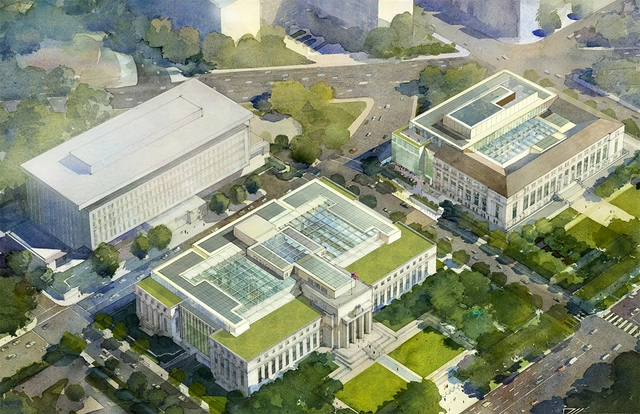
The $42-million project proposes a mixture of glass infill and additions. The courtyards of both the Eccles Building (left) and the FRB-East Building (right) would also be enclosed with glass. In May, Fortus presented certain "refinements" in response to feedback form the Commission of Fine Arts.(Fortus/Public Record)
Paul Philippe Cret’s 1937 building for the Federal Reserve Board (FRB)—the Marriner S. Eccles Building—stands as a prime example of neoclassical civic architecture along Washington D.C.’s Constitution Avenue. But the white marble building may have prompted new proposed guidelines around federal architecture, if conversations swirling in meetings of the Commission of Fine Arts are any indication. Plans to renovate and expand the FRB complex—the Eccles Building is joined by the FRB-East Building, designed in 1933 as the US Public Health Service by Cret’s fellow Frenchman Jules Henri de Sibour—are currently under review at the National Capital Planning Commission (NCPC) and the Commission of Fine Arts (CFA).
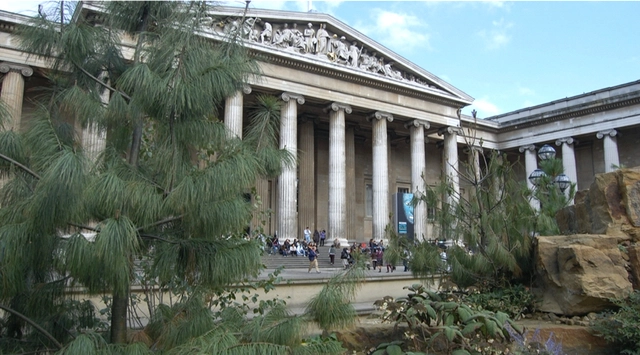
Those who reject Classical and traditional architectures out of hand fail to recognize their important biophilic qualities, emerging from evolution and refinement over centuries to produce some of the most successful, well-loved and enduring places in the world — like the British Museum in London. Photo: Michael Mehaffy
A draft of an executive order titled “Making Federal Buildings Beautiful Again” is moving forward towards possible signing by President Donald J. Trump. The proposed document favors Classical Greco-Roman design typologies for federal buildings in Washington, DC and elsewhere throughout the USA. This order would revise the current rules that regulate the design of federal buildings contracted through the GSA (General Services Administration — a Federal agency managing the construction, administration, and upkeep of US Government buildings and real estate). It was initiated by the National Civic Art Society, a Washington, DC based nonprofit organization that disapproves of what the US government has been building for decades. According to the New York Times, the chairman of the National Civic Art Society, Mr. Marion Smith, stated that: “For too long architectural elites and bureaucrats have derided the idea of beauty, blatantly ignored public opinions on style, and have quietly spent taxpayer money constructing ugly, expensive, and inefficient buildings.”
https://www.archdaily.com/934164/three-comments-on-the-executive-order-making-federal-buildings-beautiful-againMehaffy, Michael W., Nikos A. Salingaros, and Ann Sussman
A new executive order by Donald Trump has the potential to make new federal architecture in the United States follow the classical style. Called "Making Federal Buildings Beautiful Again", the order would require rewriting the Guiding Principles for Federal Architecture, issued in 1962, to ensure that “the classical architectural style shall be the preferred and default style” for new and upgraded federal buildings.
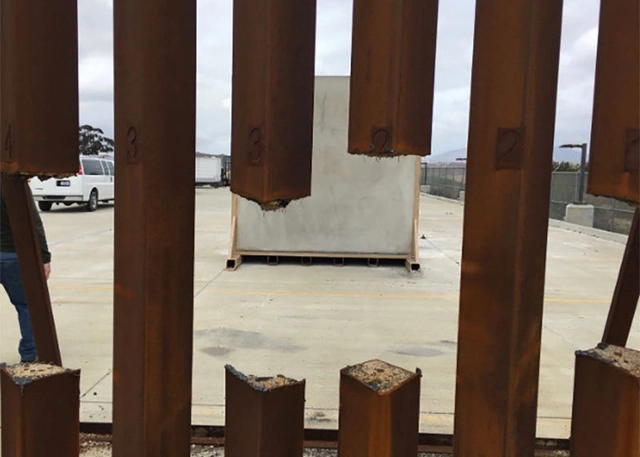
The viability of the Trump administration's border wall has come under fire as all eight prototype structures have failed at least one breach test. The eight border wall prototypes in Otay Mesa, California were assembled in early 2017 after an executive order directed the Department of Homeland Security to build the border wall. The news comes as the administration prepares to potentially declare a national emergency to jumpstart construction of the wall along the U.S.’s southern border.
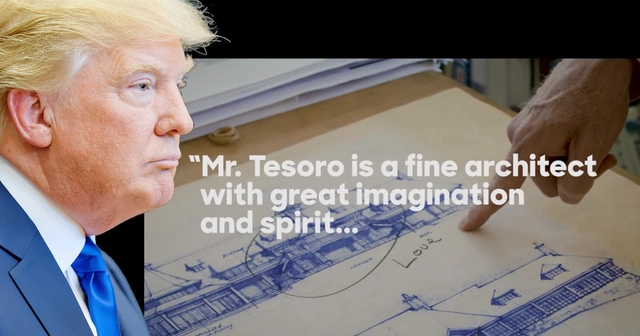
The United States is currently embroiled in what is unquestionably one the most bizarre and unpredictable presidential races in its history. In this strange context, the world of architecture has unexpectedly found itself a hot political topic, with one architect at the center of the controversy: Andrew Tesoro.
Given the nature of the campaign video, which was undoubtedly edited to paint Trump in a negative light, many have understandably questioned whether Tesoro's opinions and story were accurately portrayed. This skepticism was then reinforced by a "condensed and edited interview" published by Forbes, which suggested that Tesoro's opinion of Trump was much more forgiving than the one perpetuated by the Clinton campaign. Given the confusion around Tesoro's true opinions, ArchDaily decided to give the architect a chance to present his message unambiguously. What follows are Andrew Tesoro's responses to three simple questions about Donald Trump. These responses have not been edited by ArchDaily staff.