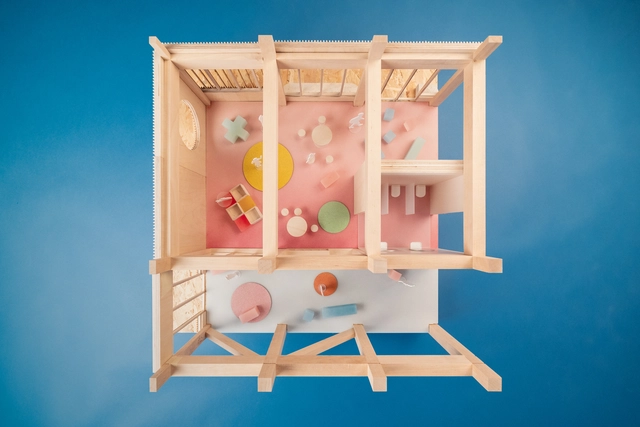
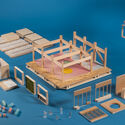
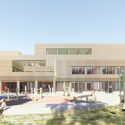
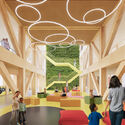
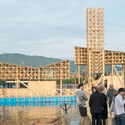
As part of the Circlewood consortium, OMA’s David Gianotten and Michel den Otter have developed a modular system to build schools that can adapt and transform throughout their lifecycle. The system was selected by the City of Amsterdam to be employed to build multiple schools in the coming ten years, as part of the Innovation Partnership School Buildings program. The citywide initiative aims to build nine to thirty “high-quality, flexible, and sustainable” schools as a way to contribute to the city’s goal of becoming fully circular by 2050.
Videos
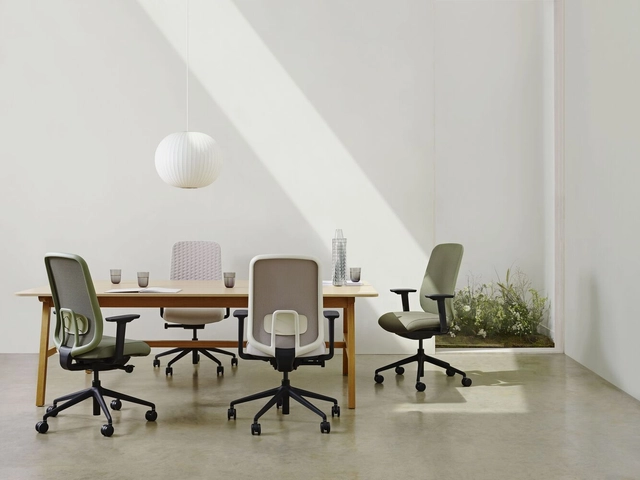
Sia Task Chair. Image Courtesy of Boss Design
Choosing the appropriate working elements –such as furniture, lighting, flooring, and other equipment– is key for creating an optimal workplace environment. With a positive impact on productivity, as well as the comfort and well-being of team members, designing workplace elements that integrate sustainable, wellness and aesthetic qualities implies a deep understanding of the interactions between these three areas. Minimizing the environmental impact and prioritizing well-being throughout the design process, while also considering the resulting aesthetics, Boss Design’s Sia Task Chair defines a new standard for workplace design.
Subscriptions are quickly becoming an integral part of everyday life. For example, streaming platforms have completely replaced the need to own video cassettes, while ride-sharing services partially cover the need to own a private car. Subscriptions have been largely understood as digital services, but a new trend suggests that the same concept could be transferred to physical objects in the near future. Instead of owning a fridge, a washing machine, or even light bulbs, one could acquire a subscription to ensure the freshness of produce, clean clothes, and a well-lit home.
The concept is known as the “subscription-based economy,” a variant of the “circular economy” notion. It postulates that instead of owning some of the objects used every day, one could subscribe to a service to gain access to the same benefits, but without the need to own, maintain or dispose of the object in question. Consumers no longer buy products; they buy access to services. Sometimes, it would mean simply leasing the object instead of purchasing it, but the model goes one step further. It inscribes a shift of responsibility and mentality. Because consumers no longer own the objects, the responsibility to reuse and recycle falls to the producers, who are now in charge of the entire life cycle of the objects they create.
Sustainable cities demand sustainable solutions, which imply the development of a new mindset for the reformulation of conventional creation processes. Within the fight against climate change, the circular economy concept is known as a key factor for the sustainable solutions of the future. Part of this concept is known as circular design, which aims to transform the traditional paradigm of ‘using and throwing away’ into a commitment to reusing existing materials.
Circular design rethinks the creation process of products from the first steps, guiding architects and designers to create products that can be reused, recycled or transformed. Applying circularity in architecture opens the debate of rethinking the life cycle of construction materials. In this manner, fiber cement cladding –a combination of basic earth elements, mineral materials, water, air and fire, in a simple filtration process– proposes a design solution that meets the basic principles of circular construction. In addition to its composition, strength and durability, these products are designed as a system that can outlast a building's lifecycle.
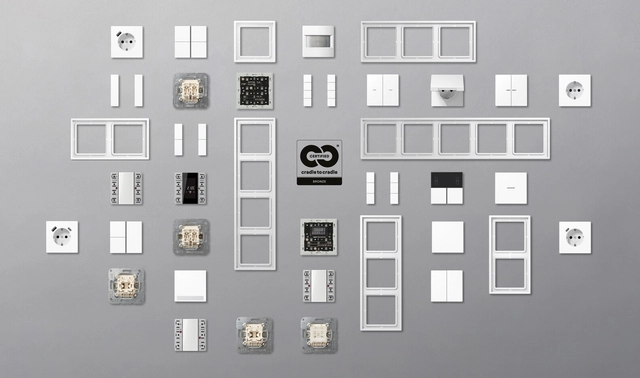
Frames, inserts, modules - hundreds of individual elements from JUNG have successfully gone through the Cradle to Cradle certification process. The LS 990, LS CUBE, AS 500, A 550, A FLOW, A CREATION series from JUNG in white are now Cradle to Cradle certified. Image Courtesy of JUNG
Annually, 13% of the waste generated by humans is recycled, but where does the remaining 87% go? The combination of different types of waste is gradually filling the Earth’s oceans and landfills, leading to a negative impact on wildlife, the natural environment and human health. Within the large amounts of solid waste produced in developed cities, used electronics are a clear example of how materials can be efficiently managed after their life cycle ends. Understanding the behavior of these materials and resources before, during and after their useful life cycle has guided the search for new solutions, such as the Cradle to Cradle (C2C) methodology.
C2C proposes the design of products or processes that function as a healthy ecological system, where resources are efficiently managed in a cyclical way. By applying this methodology to electric appliances, JUNG has developed circular design strategies for their most-used switches and plugs for conventional and smart building technology, allowing them to be dismantled and reused when the product is no longer fit for use.