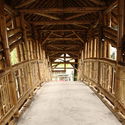
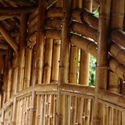
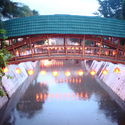
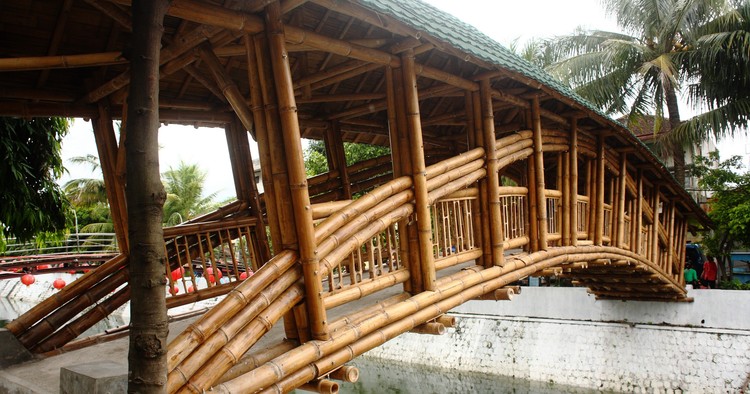
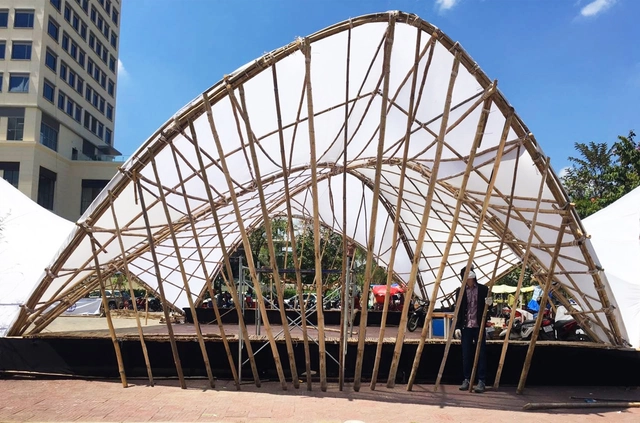
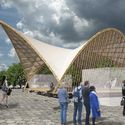
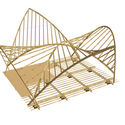
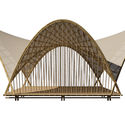
The Architectural Association Myanmar Visiting School aims to provide space and support to invigorate the architectural use of Myanmar's local bamboo resources. The project will revitalize local, traditional bamboo use techniques, and where applicable, combine them with current international best practices in the use of bamboo. It will promote the application of bamboo as an environmentally sound, renewable, and practical means to increasing and sustaining local craftsmanship, sustainable livelihoods, cultural heritage, while supporting carbon sequestering and environmental protection in the region.
BambooU(niversity) was an idea originally conceived to help teach professionals about the potential of bamboo as a green building material. In its current form it is a design and bamboo build workshop in Bali hosted by The Kul Kul Farm at the Green School; facilitated in collaboration with the bamboo design firm, IBUKU.
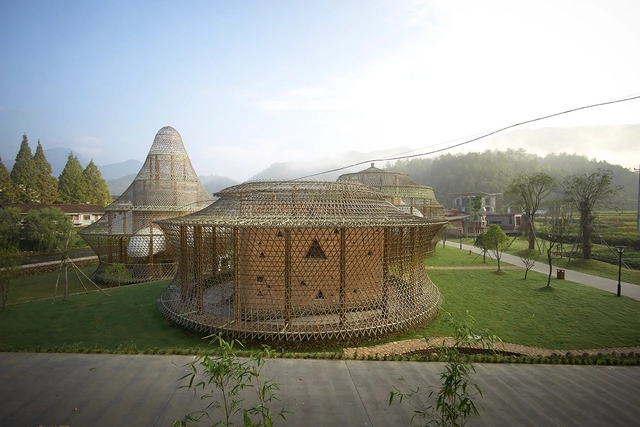
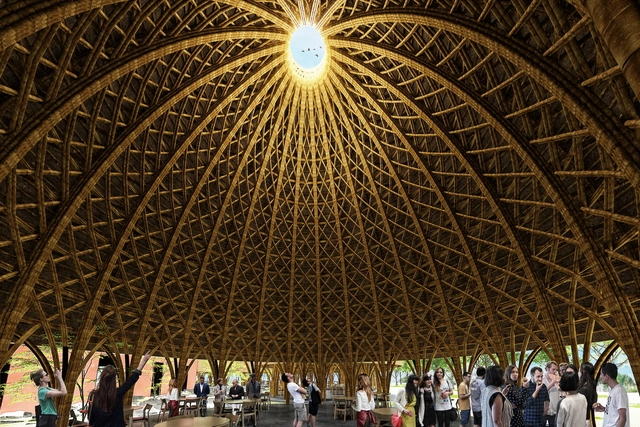
Last september, the first-ever International Bamboo Architecture Biennale was held in the peaceful village of Baoxi in China's Zhejiang province. Curated by local artist Ge Qiantao and architect George Kunihiro, the event saw the construction of 18 bamboo-centered structures designed by 12 architects, including notable names such as Kengo Kuma, Vo Trong Nghia, Anna Herringer, Li Xiaodong and Simon Velez. Aimed at exploring the potential of the sustainable material within contemporary architecture, the structures were built as permanent fixtures that will continue to serve the town after the Biennale’s close.
In this photoset, photographer Julien Lanoo has captured the vibrant results of the inaugural event, exhibiting the structures against the rural mountain landscape.
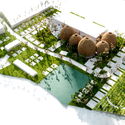
VTN Architects (formerly known as Vo Trong Nghia Architects), has revealed plans for the Son La Ceremonial Domes, a series of of 5 bamboo structures that will provide entry and dining amenities for the larger hospital complex, also designed by VTN.
Building Trust international have announced their 7th international design competition which seeks to find an innovative design proposal for a landmark pavilion structure made from bamboo. The bamboo piece will be the centre of a Bamboo Festival Building Trust are hosting in Phnom Penh, Cambodia this March. The competition challenges architects, designers and engineers to provide a design solution which has the chance to shape the future of building with bamboo globally.
As the common phrase attests, “history is written by the victors.” We therefore know that the story of the West is that of Europe and the United States, while the other actors in world history are minimized or invisible: it happened to the Chinese and Japanese during World War II, to the Ottoman Empire in sixteenth-century Europe, and to racial majorities in the common reading of Latin American independence. The same thing happens in architecture.
The current boom of the Global South is based not only on new work, but rather on the recognition of an invisible architecture which was apparently not worthy of publication in the journals of the 1990s. The world stage has changed, with the emergence of a humanity that is decentralized yet local; globalized, yet heterogeneous; accelerated, yet unbalanced. There are no longer red and blue countries, but a wide variety of colors, exploding like a Pollock painting.
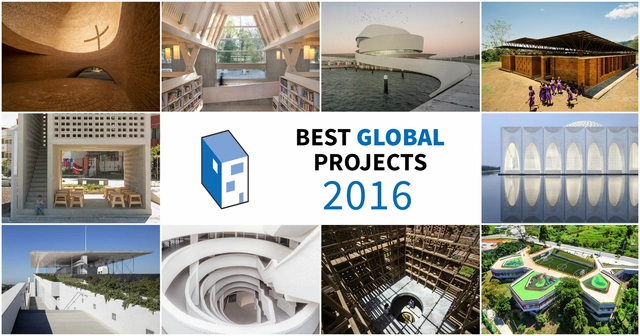
This serves as a preamble to consider the outstanding projects of 2016 according to the British critic Oliver Wainwright, whose map of the world appears to extend from New York in the West to Oslo in the East, with the exception of Birzeit in Palestine. The Global South represents more than 40% of the global economy and already includes most of the world’s megacities, yet has no architecture worthy of recognition? We wanted to highlight the following projects in order to expand the western-centric world view, enabling us to truly comprehend the extent of architectural innovation on a global scale.
We are inviting young architects / final year students, to build the First Children’s Nature Play Pavilion at Red Soil Nature Play. This is a blind fold jury competition; the selected top 3 entries will be given natural space of 1500 sq.ft at Red Soil Site. You are left to your own imagination with sensitivity towards young children and nature. We will grant/ fund the project. Each Pavilion (selected entries) will be built periodically (one by one) and will amaze the young children for 3-4 months at Red Soil Nature Play.
Building Trust are happy to announce that our latest workshop will be held in Cambodia to design and build a project made from bamboo. Building Trust have a number of sustainable design projects in South East Asia in 2016, ranging from schools and housing to wildlife conservation and healthcare. We are offering a hands on participatory workshop where participants will gain experience in sustainable building techniques and understand more about humanitarian design while building worthwhile projects that will have a huge benefit to the local community and local wildlife. Participants will gain an insight into a number of building techniques and architectural styles.
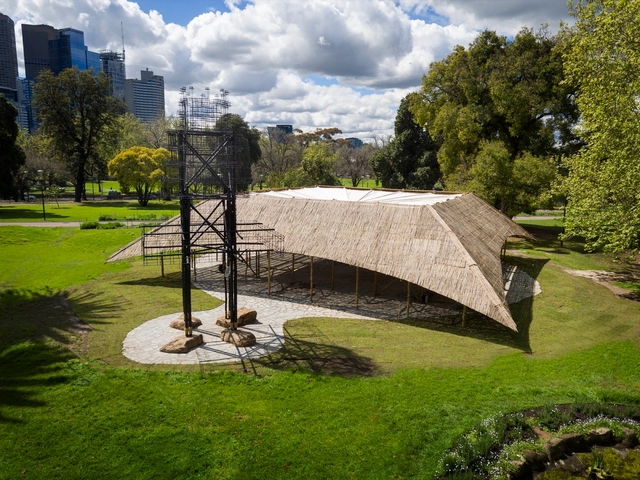
The 2016 MPavilion, designed by Indian architect Bijoy Jain of Studio Mumbai, has opened in Melbourne’s Queen Victoria Gardens. Over the next four months, the bamboo structure will play host to a free public program of over 400 talks, workshops, performances and installations.
Bijoy Jain’s design joins the growing international trend of “handmade architecture” as it becomes the largest bamboo structure in Australia, utilizing 7 kilometers of Indian bamboo, 50,000 kilograms of Australian bluestone, 5,000 wooden pins and 26 kilometers of rope to cover a 16.8 square meter area. The slatted roof panels are constructed from sticks of the Karvi plant and were woven together by craftspeople in India over a four month period.
In the late 20th century, restricted by an a small landmass and extreme terrain, the Hong Kong urban area grew to become one of the densest and most vertical places on the planet, with more buildings taller than 500 feet than any other city in the world. But instead of the steel or aluminum structures used as scaffolding in Europe and the Western Hemisphere, the majority of skyscrapers built in Hong Kong and much of Asia used scaffolding systems constructed out of bamboo.
To create the structures, the high strength, lightweight material is strapped together with plastic ties by construction crews, who also use the structure as a ladder for scaling the building. Despite using few safety restraints, crews are able to construct up to 1,000 square feet of bamboo scaffolding in just one day. To protect the structure, nylon gauze is sometimes draped along the outside.
Check out a series of GIFs and images showing how it works after the break. And if you're interested in learning more about bamboo construction materials, check out our Materials catalog.
View from the path. Image Courtesy of Vo Trong Nghia Architects
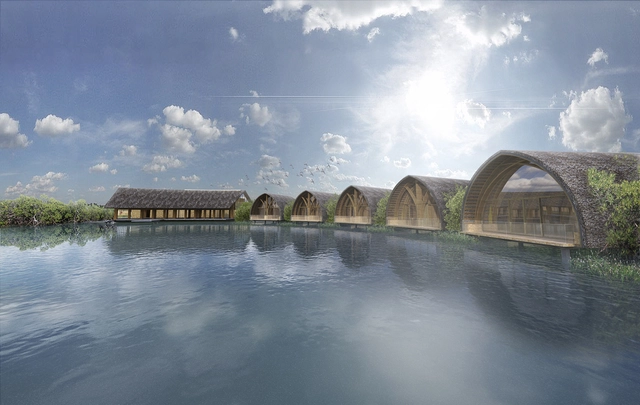
Vo Trong Nghia Architects has released plans for The Signature Spa on Phu Quoc, one of the major islands of Vietnam. Nestled into surroundings of vast forests and pristine beaches, the spa will serve as an addition to its neighboring 5-star hotel. The project has been tucked into the corner of the site to provide a serene atmosphere aimed at establishing “a compact and autonomous place of solace, wherein one can immerse themselves within the lush mangrove reservoir whilst nestled inside the bamboo [structure].”
Architect Nguyen Hoa Hiep of a21 studio, in collaboration with Saigon architecture students, have created a cocoon-inspired pavilion. This exhibition is organized annually by Handhome.net in Vietnam in order to connect older generations of architects with students.
Building Trust are happy to announce details of our latest workshop which will be held in Cambodia to design and build a project made from bamboo. Building Trust have a number of sustainable design projects in South East Asia in 2016, ranging from schools and housing to wildlife conservation and healthcare.
We are offering a hands on participatory workshop where participants will gain experience in sustainable building techniques and understand more about humanitarian design while building worthwhile projects that will have a huge benefit to the local community and local wildlife.
The countryside carries so much emotional weight and nostalgia through thousands of years of time. Currently, more than 100 villages disappear every day in China. On the other hand, the rise of city living standards and GDP require a more suitable tourist experience in the surviving villages. How can we combine the inheritance and preservation of villages with a countryside tourism business model? To provide a better ecosystem for lodge and inn, farm, organic agriculture and handmade crafts is the challenge that we are facing now!
Disaster can strike a community at any minute. Following the most costly earthquake in their history in April, hundreds of thousands of Nepalese residents were rendered instantly homeless. To help these people reorganize and get back to a familiar way of life, Barberio Colella ARC has designed a temporary structure using local materials “to make a house that can be built quickly, lightweight and compactly, durably and economically.”
Text description provided by the architects. Following up a year of development, Penda has unveiled their installation for Beijing Design Week (BJDW) 2015 – Rising Canes, a structural system made entirely of bamboo and ropes. Meant to be a speculation system for larger developments, the installation is fully modular, ecological and easy to expand in every direction. Bamboo was chosen as the main construction material for its long traditional roots in China and fantastic structural capability, as well as part of a desire to fight its current obscurity as a construction material.