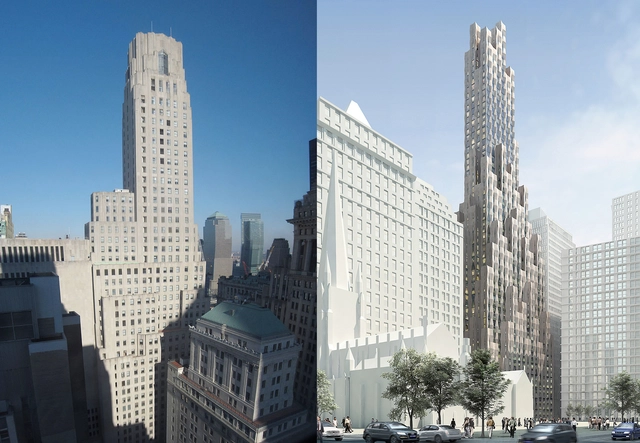
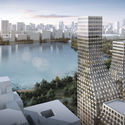
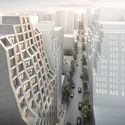
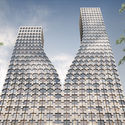
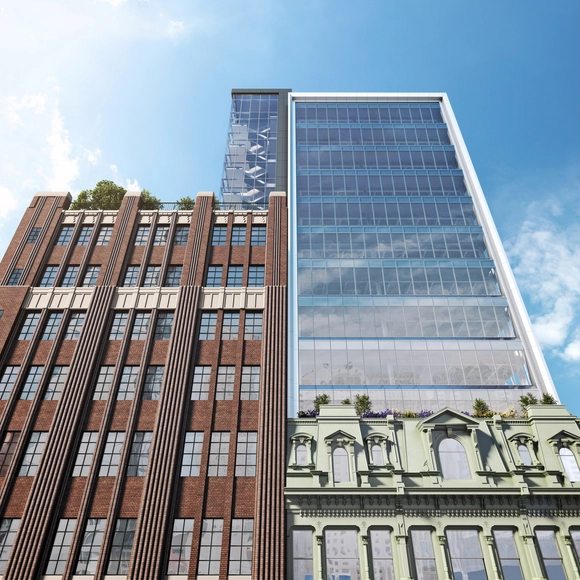
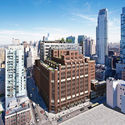
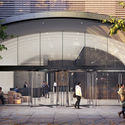
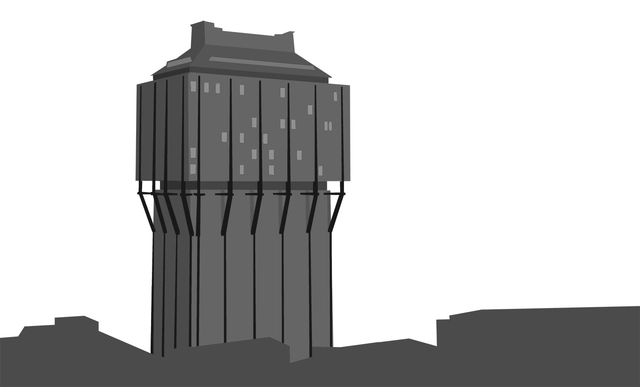
One Wall Street, before and after. Images: left, Via Wikimedia in public domain; right, Courtesy of Hollwich Kushner
The New York Timesrecently reported that over 40% of the buildings on the island of Manhattan wouldn’t be granted construction permits in 2017. Most of the culprits date back to the early 20th century when attitudes towards density, ceiling heights, column placement, and general living standards were different. This begs the question: what would modern iterations of New York’s signature structures look like today? Billed by the practice as “an obsessive-compulsive study of the city we love” HWKN’s New(er) York is a peculiar experiment that tackles this hypothetical.
Plans have been announced by Tishman Speyer for "The Wheeler", a glassy new addition above downtown Brooklyn’s iconic Macy’s store on Fulton Street. The design is a collaboration between Shimoda Design Group and Perkins Eastman, and incorporates 10 stories of dynamic office and mixed-use space that will sit atop the existing department store.
Paying homage to the renowned 19th century Brooklyn developer Andrew Wheeler, the new offices will come complete with 16 foot ceiling heights, an acre of combined outdoor terrace gardens and decks, an amenity floor, and 360,000 square feet of rentable space, all while capturing the surrounding views of Lower Manhattan, the Brooklyn Bridge, the Statue of Liberty and New York harbour from its vantage point above the existing architecture.
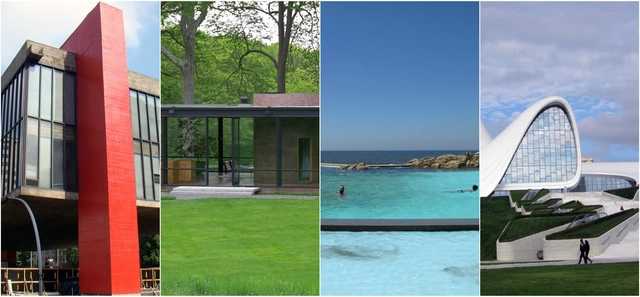
The "architectural pilgrimage" is much more than just everyday tourism. Studying and admiring a building through text and images often creates a hunger in architects, thanks to the space between the limitations of 2D representation and the true experience of the building. Seeing a building in person that one has long loved from a distance can become something of a spiritual experience, and architects often plan vacations around favorite or important spaces. But too often, architects become transfixed by a need to visit the same dozen European cities that have come to make up the traveling architect's bucket list.
The list here shares some sites that may not have made your list just yet. Although somewhat less well known than the canonical cities, the architecture of these six cities is sure to hold its ground against the world's best. The locations here make ideal long weekend trips (depending of course on where you are traveling from), although it never hurts to have more than a few days to really become immersed in a city. We have selected a few must-see buildings from each location, but each has even more to offer than what you see here—so don't be afraid to explore!
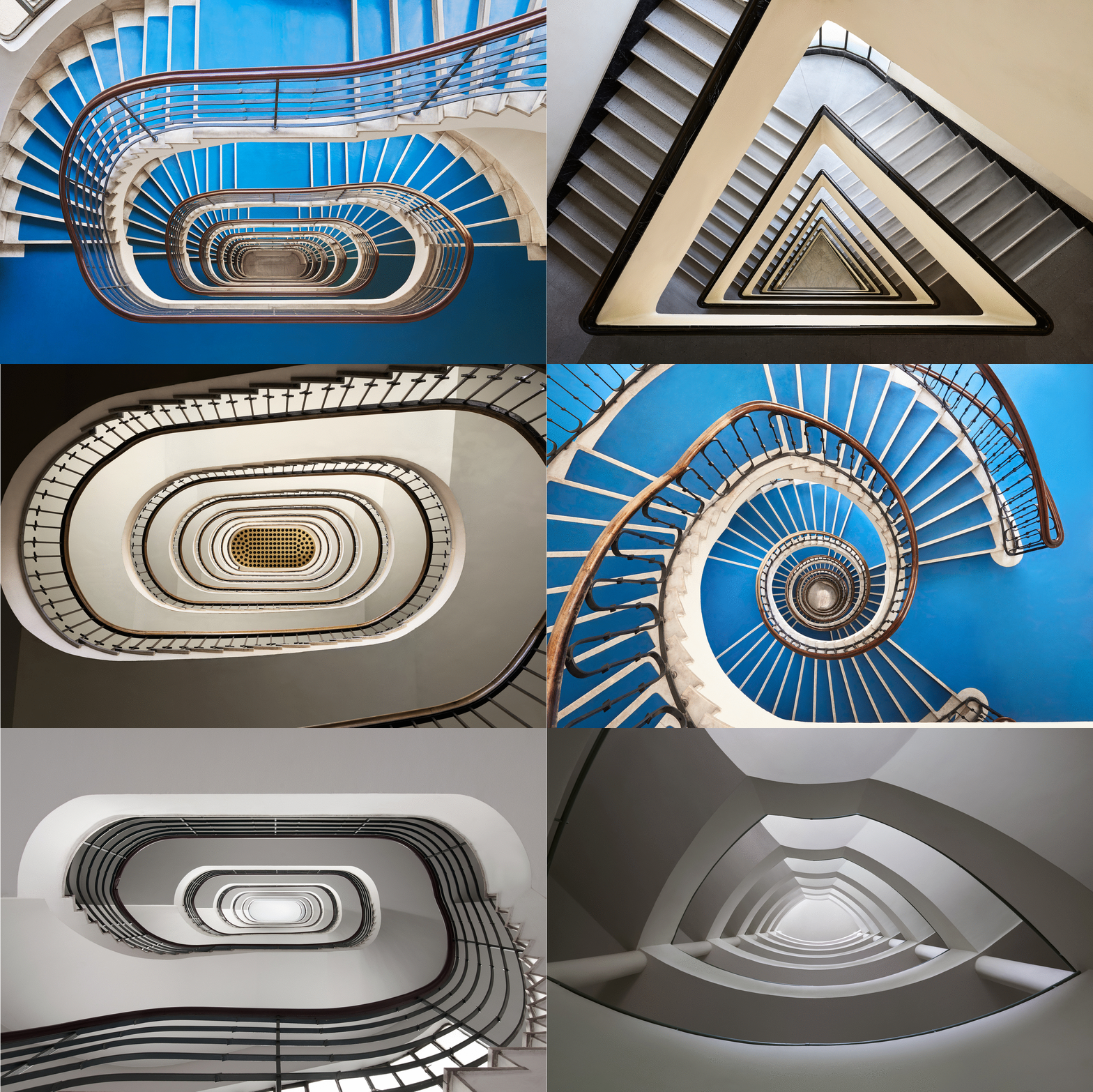
Fine arts and commercial photographer Balint Alovits has released Time Machine, his latest photo series documenting Art Deco and Bauhaus staircases throughout Budapest, Hungary.
Shown from the same central perspective, the photographs “create a new dimension by splitting space and time, staying within the visual limits of the project’s concept, while the perception of the architectural details evokes the idea of infinity.”
“I have always liked Art Deco and Bauhaus buildings,” said Alovits. “Whenever I step into one of these caracoles, I feel a certain pulling energy looking up from the bottom or down from the top. I wanted to collect and showcase all the different shapes and colors that these stairways feature.”
As long as there have been buildings mankind has sought to construct its way to the heavens. From stone pyramids to steel skyscrapers, successive generations of designers have devised ever more innovative ways to push the vertical boundaries of architecture. Whether stone or steel, however, each attempt to reach unprecedented heights has represented a vast undertaking in terms of both materials and labor – and the more complex the project, the greater the chance for things to go awry.
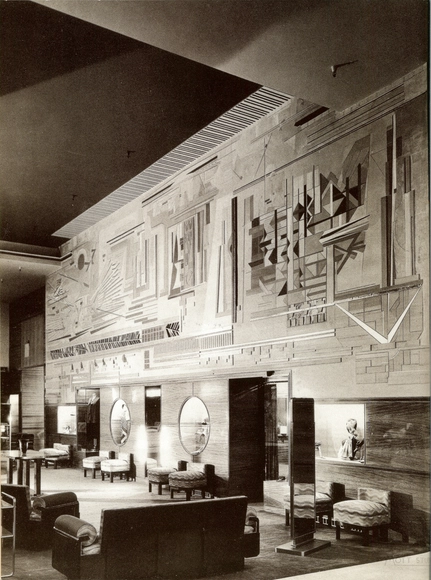
Gjura Stojano’s mural “The Spirit of Sports” was the centerpiece of the Sportswear Department. ImageCourtesy of Balcony Press
With its iconic copper-clad tower looming over WilshireBoulevard, the Bullock’s Wilshire has been a celebrated element of the Los Angeles cityscape since its opening in 1929. Known for its lavish Art Deco aesthetic, the department store made its mark as a prime shopping destination in a city filled with celebrities. But the Bullock’s Wilshire was more than a glamorous retail space; with a design centered around the automobile, it was to set a new standard for how businesses adapted to a rapidly changing urban environment.
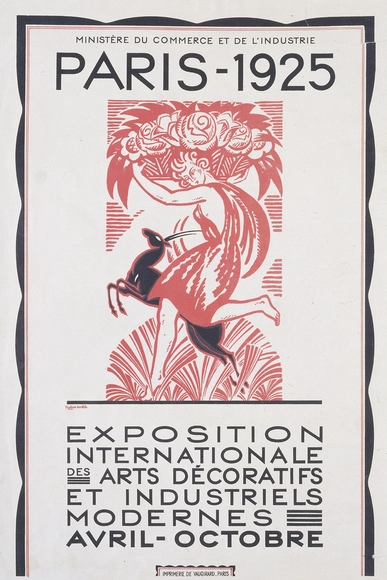
The Exposition’s poster, designed by Robert Bonfils. ImageCourtesy of the Victoria and Albert Museum
The end of the First World War did not mark the end of struggle in Europe. France, as the primary location of the conflict’s Western Front, suffered heavy losses in both manpower and industrial productivity; the resulting economic instability would plague the country well into the 1920s.[1] It was in the midst of these uncertain times that the French would signal their intention to look not to their recent troubled past, but to a brighter and more optimistic future. This signal came in the form of the Exposition Internationale des Arts Décoratifs et Industriels Modernes (International Exposition of Decorative Arts and Modern Industries) of 1925 – a landmark exhibition which both gave rise to a new international style and, ultimately, provided its name: Art Deco.
Dallas Architecture Forum, a non-profit organization dedicated to providing public education about architecture, design and the urban environment, will continue its 2015-2016 Panel Discussion Series on January 26, 2016 with “Making Fair Park Work.” Moderated by Mark Lamster, Dallas Morning News Architecture Critic, this panel is presented in partnership with the Dallas Festival of Ideas and the College of Architecture Planning and Public Affairs (CAPPA) at the University of Texas at Arlington.
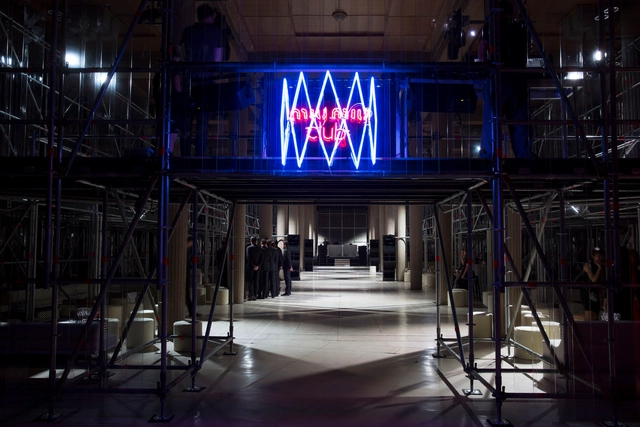
On Saturday, July 4, designer Prada and AMO—a research studio subset of OMA architecture—hosted The Miu Miu Club, a pop-up event, featuring dinner, a fashion show, and several musical performances in Paris, France.
Inside of the 1937 art deco Palais d-Iena, Paris’ current CESE government offices, the one-night event was held in the Hypostyle, using a scaffolding ring to create a “room within a room.” Strip lighting, metal grids, PVC sheets, and arrangements of luxurious furniture were also used to enhance the space.
No architect played a greater role in shaping the twentieth century Manhattan skyline than Ralph Thomas Walker, winner of the 1957 AIA Centennial Gold Medal and a man once dubbed “Architect of the Century” by the New York Times. [1] But a late-career ethics scandal involving allegations of stolen contracts by a member of his firm precipitated his retreat from the architecture establishment and his descent into relative obscurity. Only recently has his prolific career been popularly reexamined, spurred by a new monograph and a high-profile exhibit of his work at the eponymous Walker Tower in New York in 2012.
This article comes courtesy of Charlotte Neilson, the author of the fascinating design blog Casting Architecture. Her column, Through the Lens, will look at architecture and production design in TV and film.
The categorisation of period architecture generally remains firmly in the realm of the professional or amateur enthusiast - let’s face it, you can go through life without knowing the difference between a Corinthian and Ionic column without too much inconvenience. Oddly, however, most people are able to name a few of the main features of Art Deco architecture fairly easily - the curved corners, stylised forms, the use of bakelite and chrome, the transport motifs.
It’s interesting that this period is so much more familiar to us, considering it spanned quite a short timeframe compared to other architectural styles; the Arts and Crafts and Art Noveau movements, for example, which both occurred in a similar time frame to Art Deco, are much less known to the wider community.
It’s possible of course that Art Deco is just more omnipresent because of its universal appeal, or its uniqueness, but I think most of the credit should go to Monsieur Hercule Poirot.
Learn more about Agatha Christie’s contribution to Art Deco, after the break...
Like no other style, Art Deco represents a built manifestation of the interwar period’s enthusiasm and splendor. In London, buildings of this era reflect the elegance, progress and assertiveness that describe the modern metropolis age. Even today, these buildings have lost none of their aura and appeal, yet they lack any proper documentation.
Together, Niels Lehmann and Christoph Rauhut have worked tirelessly for the past three years researching and photographing London’s architectural Art Deco heritage. With your help, they will feature over 230 buildings with large-scaled photographs in the soon-to-be published book “Modernism London Style.” Follow this link to become a supporter and learn more.