"While artists work from the real to the abstract, architects must work from the abstract to the real."


"While artists work from the real to the abstract, architects must work from the abstract to the real."

In this article, originally published in Metropolis Magazine's Point of View blog as "The Real Problem with China's Ghost Towns" , author Peter Calthorpe explains the problems of these cities, predicts their grim future, and explores how the thoughtful planning behind the city of Chenggong could provide a more sustainable alternative.
We’ve all seen the reports on “ghost town” developments in China, showing acres of empty high-rise apartments and vacant shopping malls. These barren towns seem particularly ironic in a country planning to move 250 million people from the countryside to cities in the next 20 years. But this massive, unprecedented demand has been distorted by a number of factors unique to China. Flawed financial incentives for cities and developers, along with the poor phasing of services, amenities, and jobs create most of the problems. In addition, China’s emerging middle class is very comfortable (perhaps too comfortable) investing in real estate, so people often buy apartments in incomplete communities but don't move in, expecting that values will rise, or that they will live there someday. The result is a string of large, empty developments that remain speculative investments rather than real homes and communities. [See-through buildings are the worry now, but the real problems may come when they are full.]
While it’s hard to get data on vacancy levels in China, there are certainly many anecdotal examples across the country. An all-too-typical example is Chenggong, the new town planned for 1.5 million just outside of Kunming in the west. This freshly minted city boasts the growing Yunnan University, currently with 170,000 students and faculty; a new government center; and an emerging light industrial area. Under construction are the city’s new high-speed rail station and two metro lines connecting the historic city center.
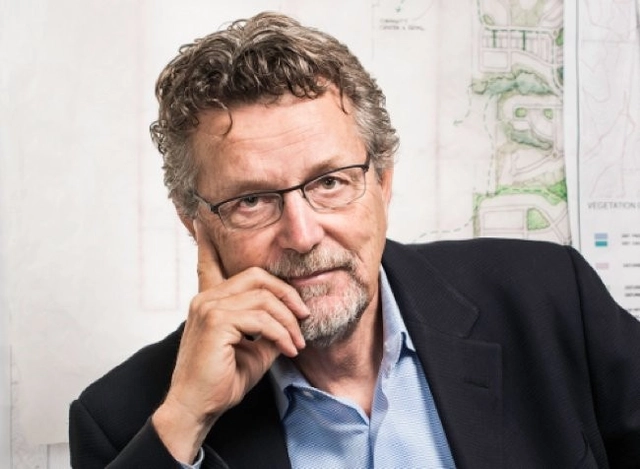
This article originally appeared on Metropolis Magazine's Point of View Blog as "Q&A: Peter Calthorpe."
The titles of Peter Calthorpe’s books trace the recent history of urban design in its most vital and prescient manifestations, starting in 1986 with Sustainable Communities (with Sim Van der Ryn) and followed by The Regional City: Planning for the End of Sprawl (with Bill Fulton), The Next American Metropolis: Ecology, Community and the American Dream, and Urbanism in the Age of Climate Change.
A founding member of the Congress for the New Urbanism and a past winner of the Urban Land Institute’s prestigious J.C. Nichols Prize for Visionaries in Urban Development, the Berkeley-based architect and planner has been at the forefront of urban design for more than three decades. In recent years, in addition to his firm’s continuing work in the United States, Calthorpe Associates has increasingly turned his attention to a country urbanizing at a pace unprecedented in world history: China.
Here Calthorpe talks about China’s unique planning process, the future of high-speed rail in California, and Architecture 2030’s new 2030 Palette, after the break...
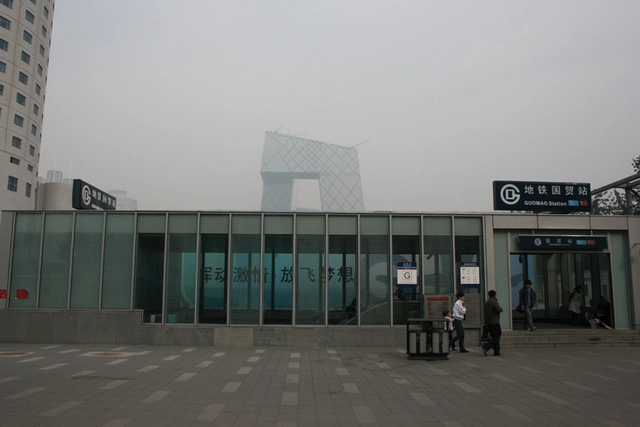
The problem with articles like “China’s Great Uprooting: Moving 250 Million Into Cities”, recently featured in The New York Times, is that they contribute to a misleading and simplistic narrative about China’s economic development, casting it as a story of “good” versus “evil”.
This was recently highlighted by a critique authored by the NYU Stern Urbanization Project in which The New York Times article in question was called out for being overly sensational and reductive in how it covered China’s policies concerning internal migration from the countryside to urban areas.

Toshiko Horiuchi MacAdam is known for her massive, colorful architectural sculptures/playgrounds. The most famous example of her work is the expansive net-structure inside the "Woods of Net" Pavilion at the Hakone Open Air Museum in Japan - which Horiuchi MacAdam knitted, entirely by hand, over the span of a year.
We took a moment to speak with Ms. Horiuchi MacAdam about the Pavilion and her other works, how they bridge the worlds of art and architecture, and how they irresistibly invite the world to play. You can read our interview, and see more images of her fascinating work, after the break...

In an article published by The Wall Street Journal called For Creative Cities, the Sky Has Its Limit, Richard Florida discusses the development of urban environments and their relative successes. As human migrations are trending towards big cities, the design and appropriation of space within these cities is increasingly important. Florida cites that trends indicate that by 2050 cities will make up 70% of the global population. With so many people, elevate density within cities will be unavoidable, but what Florida emphasizes is that it isn’t just density that makes a vibrant and thriving city. Citing Shanghai and New York City as examples of dense urban environments, Florida explains the differences in their relative architectural and urban developments and the prosperity that follows. The fundamental difference? The prevalence of mixed-use neighborhoods in New York City that overpower the innovation of strictly financial districts of either New York or Shanghai.
Let’s look at these examples after the break.

There is no other comic saga more influenced by architecture than Batman. Gotham, and the fictional architects that built the city, have been main characters since the first plots. Writer and architect Jimmy Stamp describes in these essay the fascinating architectural references and metaphors that have filled Batman stories for the last 60 years.
Batman, Gotham City, and an Overzealous Architecture Historian With a Working Knowledge of Explosives
By Jimmy Stamp
New York, Dubai, Tokyo, Moscow, Gotham. Every city in every atlas—real and fictional— has a unique character shaped by history and geography. More than a mere sense of place derived from architecture and planning, cities have a feeling that pervades the consciousness of those who live there until themselves become a a piece of the urban fabric, a fractional embodiment of the city itself. Perhaps more than any other person—real or fictional—Batman is integrally linked to his city, the city he has sworn to protect. In every sense of the word, he is a true avatar of Gotham. And Gotham City itself is an avatar, not only of the dreams of its fictional architects, but of our collective urban paranoia.
Read the full post after the break
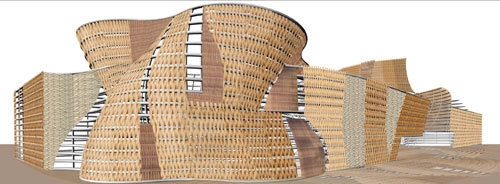
The Spain Pavilion will have a steel structure and a wicker cover. Spanish handcrafters will weave out different patterns by using different colors of wicker, said Benedetta Tagliabue, designer of the pavilion. The wicker will be covered by a special material that is water-proof. It will also keep the pavilion at a comfortable temperature, said Tagliabue.