The Waterpod ProjectTM has been floating around the New York area for the past few months gaining a lot of attention. Beginning in Newtown Creek, between Brooklyn and Queens, the Pod is moving down the East River and Hudson River. As reported by Melena Ryzik for The New York Times (view her articles here) this experimental project investigates the blend of community living and artistry. Showcasing artworks, performances and such, the WaterpodTM, is an eco-conscious environment that was designed “In preparation for our coming world with an increase in population, a decrease in usable land, and a greater flux in environmental conditions, people will need to rely closely on immediate communities and look for alternative living models; the Waterpod is about cooperation, collaboration, augmentation, and metamorphosis,” explained Mary Mattingly, a photographer who thought of the Waterpod idea.
DeStefano and Partnershave created a new commercial center for Ninbgo, China. Extending the existing canal system, the Yinzhou Fantasy Island master plan fuses the current wetlands and parks with the commercial aspects of the city as a way to balance the ecological with the cultural. The plan will not only include retail areas, but also entertainment, business, leisure and cultural facilities placed strategically along pedestrian boulevards in close proximity to mass transit systems.
Robert D.Henry Architects just finished the latest SHO Shaun Hergatt restaurant at 40 Broad Street in Manhattan, New York. The restaurant aims to “touch on all of the five senses” to create a full dining experience. “The more our senses are engaged synchronistically, the more powerful our experience; this viewpoint shapes everything we do now,” explained Henry.
The internationally acclaimed Herzog & De Meuron unveiled their re-conceptualized design for the Parrish Art Museum on the 14-acre Hampton site. The new design replaces the firm’s original idea which featured a villagelike cluster of pavilions scattered throughout the site. When the museum could not seem to raise the $80 million necessary to realize the project, they approached Herzog & de Mueron for a more modest proposal. The architects took the challenge and created a new building for less than a third of the original budget. The new museum’s long profile, which measures 94 feet wide and 634 feet long, houses galleries arranged in two long rows along a central corridor. The temporary walls allow the room sizes to be adjusted to account for the changing sizes of the temporary exhibits.
Kjellgren Kaminsky shared their proposal for a fish market and its surrounding square in Bergen, Norway. The five story building will house a market hall on the entrance and first floor and try to attract visitors and tourists who are passing by. “We believe that the traditional market would gain more visitors if it was combined with a modern marketplace fully equipped and under one roof,” explained the architects.
In case you didn’t know, a couple of weeks ago we started with our Facebook Fan Page (different from ArchDaily’s group on Facebook). The interaction that we have been experiencing with you has been awesome, so we decided to turn things upside down for a change.
Internationally recognized practice RMJM Architects have recently announced their groundbreaking $1 billon mixed-use complex for the Atasehir district, the growing residential and business area of Istanbul, Turkey. RMJM’s complex will allow the new business center to flourish by serving 20,000 people and providing for a variety of their needs. The project will be revolutionary for Turkey as it will become the country’s first LEED-certified mixed-use development upon its 2011 completion date.
More images and more about the complex after the break.
The Steel Structures Education Foundation organized a competition designed for students to fuse their conceptual ideas with the reality of physical structure. With the program and scale left to the discretion of the designer, the proposal had to emphasize the “essential relationship” between the exploration of form and material, with regards to surfaces, members and connections. As an academic project, students also had to use their details to communicate with the steel fabrication industry as a way to expose ”the opportunities and restraints inherent in realizing conceptual design.” “It is important for students of architecture to grasp the fact that structural design lies not just in the realm of the engineer, but can be a means for architects of arriving at a meaningful realization of architectural ideas,” explained the SSEF. The winner, student Matt Schmid from the University of Waterloo, designed a bird sanctuary in Niagara Gorge in Niagara Falls, Ontario, Canada.
Located in Phuket, Thailand, PaulStudio Architects‘Bluepoint Sales Pavilion provides a space for potential clients to enjoy the surrounding views. The elegant wooden structure gracefully compliments the landscape by “responding to the powerful contextual site conditions.”
Jacques Ferrier Architects were selected to design the French Pavillion at Shanghai Expo 2010. Their project ‘The Sensual City’ is a simple building with a big style French garden inside. Surrounded by water it appears to be floating.
The 6000 square meter pavillion will use advanced building materials and environmental protection technology including solar panels on top of the roof.
Located in Singapore, Telok Blangah Hill Park‘s newest addition includes “a fly-over-like infrastructure” that reaches 120 feet above the forest floor. The walkways are a respectful way to view nature as they provide a place for viewers to unobtrusively admire the landscape.
More images and more about the walkways after the break.
The structure of a brain cell is the dominant conceptual image for the pavilion. It aims to evokes the artistic and scientific richness of Belgium and the country’s central position within Europe.
The brain cell also refers directly to the role of Belgium as one of Europe’s main gathering centres and cross-points of 3 great cultural traditions: the Latin, the Germanic and the Anglo-Saxon. Belgium, closely connected to its surrounding countries, has always been a ‘place of balance’ where people have gathered with common interests that surpass their national needs.
TWS & Partners named their latest work Studio 2 in 1, as it accommodates the function of a home and a studio within one place. The studio is located in the urban setting of Jakarta, amidst the semi-detached housing units that are typical of the area. With a small site measuring 10 meter by 20 meter, the project aims to “elaborate the tropical, shaded, natural illuminated, and cross ventilation, breathing space regardless all the limitation of space.”
More images and further project description after the break.
Morphosis just shared with us their proposal for the Four Towers in One Competition. The competition (which Steven Holl Architects ultimately won) asked participants to design an office tower complex for the new Shenzhen Stock Exchange Headquarters in the Futian commercial business district. The area was in need of a unified urban plan that would include the Headquarters for the new office towers of Shenzhen Media Group, China Construction Bank, China Insurance Group, and Southern & Bosera Funds. For Morphosis’ proposal, rather than creating various disconnected vertical skyscrapers, the project aims to create one “cohesive, interwoven district.” By conceiving the sites as 3-dimensional envelopes rather than flat 2-dimensional footprints, the buildings can be interwoven to “facilitate a network of interlocking forms reminiscent of the venerated Chinese puzzle.”
More images and further project description after the break.
GAZ Arquitectoswere recently announced as the winners of the headquarters design for the Higher School of Music in Basque Country in San Sebastián, Spain. The proposal, entitled Muskiene, compiles a dense program in a relatively small site, causing the volumes to almost exceed local regulations.
More about Muskiene and more images after the break.
Design Studio 4of7 in conjunction with the University of Belgrade’s Graduate Program has spent a year exploring alternatives for the Port of Belgrade, a 110 hectare site on the river Danube bank in Southeast Europe. The port belongs to the central zone of the city and currently, the former industrial riverfront has attracted developers, city authorities, architects and planners to design its future potential. Over the last two academic terms, the Graduate Program has had the opportunity to work with the actual redevelopment of the site and exchange ideas with Daniel Libeskind Studio and Gehl Architects who are both working on the master plan.
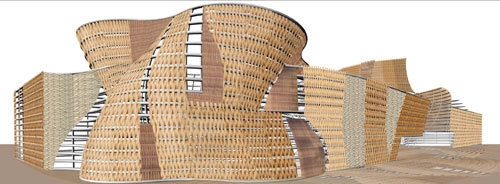
The SpainPavilion will have a steel structure and a wicker cover. Spanish handcrafters will weave out different patterns by using different colors of wicker, said Benedetta Tagliabue, designer of the pavilion. The wicker will be covered by a special material that is water-proof. It will also keep the pavilion at a comfortable temperature, said Tagliabue.