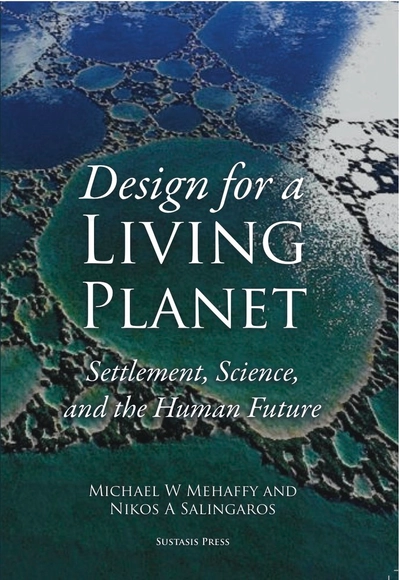
In their latest book Design for a Living Planet: Settlement, Science, and the Human Future, Michael Mehaffy and Nikos Salingaros examine recent developments in science that will inform and possibly even radically alter the future of architecture. The following is an adapted series of excerpts that summarizes the content of the book.
Architecture has always concerned itself with the future, and with the implications of findings from the sciences — as well as their practical applications to architectural craft. Today we do indeed see very exotic computer-designed aesthetic surfaces, splined forms, and generative schemes. To a non-scientist, this work might appear ultra-scientific and “modern”. We also see the symbolism of a turbulent, fractured Universe, wherein old ideas of meaning are facing anguishing post-modern challenges.
But from a modern physicist’s perspective, this architecture is still mired in the past.
As you may have seen, ArchDaily has been publishing UNIFIED ARCHITECTURAL THEORY, by the urbanist and controversial theorist Nikos A. Salingaros, in serial form. However, in order to explain certain concepts in greater detail, we have decided to pause this serialization and publish three excerpts from another of Salingaros’ books: A THEORY OF ARCHITECTURE. The previous excerpt explained the difference between “Pattern Language” and “Form Language.” The following excerpt will establish how these languages can combine to form the “Adaptive Design Method.”
Proposition: An adaptive design method arises out of a complementary pair consisting of a pattern language and a form language.
I have indicated very briefly what a pattern language and a form language are; we still need to understand what an adaptive design method refers to. Out of many contemporary approaches to design, there are very few that result in structures and environments that are adapted both to physical human use, as well as to human sensibilities. In the past, the opposite was true. Human use is straightforward to understand: the physical dimensions and geometry have to accommodate the human body and its movement.
By accommodating human sensibilities, I mean that environments should make human beings feel at ease; make them feel psychologically comfortable so that persons can carry out whatever functions they have to unselfconsciously, without being disturbed by the built environment in any way. This imposes a strong constraint on the design process to adapt to the many factors (both known and unknown) that will influence the user on many levels, including emotion. An adaptive design method should accommodate all these criteria, and this Chapter shows how this may be accomplished.
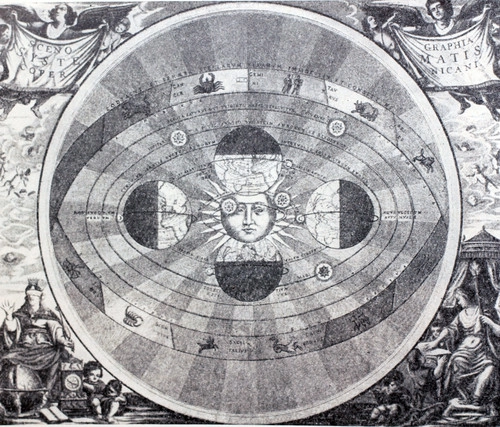
Illustration portraying Heliocentrism theory of Nicolaus Copernicus. Image Courtesy of Iryna1, Shutterstock.com
We will be publishing Nikos Salingaros’ book, Unified Architectural Theory, in a series of installments, making it digitally, freely available for students and architects around the world. The following chapter, part one of Chapter Two, outlines the scientific approach to architectural theory. If you missed them, make sure to read the introduction and Chapter One first.
In order to discuss any supposed contributions to architectural theory, it is necessary to define what architectural theory is. A theory in any discipline is a general framework that:
(1) explains observed phenomena;
(2) predicts effects that appear under specific circumstances; and
(3) enables one to create new situations that perform in a way predicted by the theory.
In architecture, a theoretical framework ought to explain why buildings affect human beings in certain ways, and why some buildings are more successful than others, both in practical as well as in psychological and aesthetic terms.
We will be publishing Nikos Salingaros’ book, Unified Architectural Theory,in a series of installments, making it digitally, freely available for students and architects around the world. The following chapter, "The Structure of Architectural Theories," posits that architecture, if it is truly to work with natural ecosystems, must adopt a scientifically-informed, systemic approach. If you missed the introduction, you may find it here.
Architecture is a human act that invades and displaces the natural ecosystem. Biological order is destroyed every time we clear native plant growth and erect buildings and infrastructure. The goal of architecture is to create structures to house humans and their activities. Humans are parts of the earth’s ecosystem, even though we tend to forget that.
Logically, architecture has to have a theoretical basis that begins with the natural ecosystem. The act of building orders materials in very specific ways, and humans generate an artificial ordering out of materials they have extracted from nature and transformed to various degrees. Some of today’s most widely-used materials, such as plate glass and steel, require energy-intensive processes, and thus contain high embodied energy costs. Those cannot be the basis for any sustainable solution, despite all the industry hype.
Resource depletion and a looming ecological catastrophe are consequences of detachment from nature, and a blind faith in technology to solve the problems it creates.
In the following months, we at ArchDaily will be publishing Nikos Salingaros' book, Unified Architectural Theory, in a series of installments, making it digitally, freely available for students and architects around the world. In the following paragraphs, Salingaros explains why we've decided to impart on this initiative, and also introduces what his book is all about: answering "the old and very disturbing question as to why architects and common people have diametrically opposed preferences for buildings."
ArchDaily and I are initiating a new idea in publishing, one which reflects the revolutionary trends awaiting book publishing's future. At this moment, my book, Unified Architectural Theory, 2013, is available only in the USA. With the cooperation of ArchDaily and its sister sites in Portuguese and Spanish, it will soon be available, in a variety of languages, to anyone with internet access. Being published one chapter at a time, students and practitioners will be able to digest the material at their leisure, to print out the pages and assemble them as a "do-it-yourself" book for reference, or for use in a course. For the first time, students will have access to this material, in their own time, in their own language, and for free!
The book itself arose from a lecture course on architecture theory I taught last year. Students were presented with the latest scientific results showing how human beings respond to different types of architectural forms and spaces. At the end of the course, everyone was sufficiently knowledgeable in the new methods to be able to evaluate for themselves which buildings, urban spaces, and interior settings were better suited for human beings.
This approach is of course totally different from what is now known as “Architectural Theory.”
Nikos Salingaros is unafraid of a controversial statement. A professor of Mathematics and Urban theory, he has been using his scientific approach to study architecture and urban environments for years, and has come to a conclusion: Modernism is just about the worst thing that happened to architecture.
As Salingaros explains, not only is it impossible to have any "Green" architecture within a modernist framework, but, moreover, Modernism encourages us to deny our biologically-evolved senses and embrace an unnatural, inhuman built world - and why? Because there's a whole lot of money and power behind those "modernist boxes." As Salingaros puts it:
Architectural Education ever since the Bauhaus, and continuing to the present day without interruption, teaches students to interpret built forms according to very peculiar abstract criteria, and not through their own biologically-evolved senses and cognitive intelligence. This is radical training in sensory denial: desensitizing people so that their interpretation of the world can be defined by others with an agenda.
I interviewed Salingaros to get to the bottom of his theories and understand his anti-Modern crusade. Read it all, including Salingaros' incendiary takes on Architecture education, sustainability, and urban planning, after the break...
Something surprising has happened with many so-called “sustainable” buildings. When actually measured in post-occupancy assessments, they’ve proven far less sustainable than their proponents have claimed. In some cases they’ve actually performed worse than much older buildings, with no such claims. A 2009 New York Times article, “Some buildings not living up to green label,” documented the extensive problems with many sustainability icons. Among other reasons for this failing, the Times pointed to the widespread use of expansive curtain-wall glass assemblies and large, “deep-plan” designs that put most usable space far from exterior walls, forcing greater reliance on artificial light and ventilation systems.
Partly in response to the bad press, the City of New York instituted a new law requiring disclosure of actual performance for many buildings. That led to reports of even more poor-performing sustainability icons. Another Times article, “City’s Law Tracking Energy Use Yields Some Surprises,” noted that the gleaming new 7 World Trade Center, LEED Gold-certified, scored just 74 on the Energy Star rating — one point below the minimum 75 for “high-efficiency buildings” under the national rating system. That modest rating doesn’t even factor in the significant embodied energy in the new materials of 7 World Trade Center.
What's going on with these supposedly "sustainable" buildings? Read on, after the break...