

-
Architects: Alejandro Soffia
- Area: 55 m²
- Year: 2024
-
Manufacturers: Villalba, Sudpanel
Mark Wigley asserts that architects, rather than builders, are talkers. "Architects do not make solid objects. They make discourses about objects," Wigley argues in “Typographic Intelligence” (2002). This becomes particularly relevant when linked to philosopher Michel Foucault's concept of discourse. In *The Order of Discourse*, Foucault argues that discourses consist of a series of statements or propositions that communicate a certain idea, defining everything that can be said about a topic by shaping a specific way of understanding reality.
Discourses, then, are not merely a specific glossary of words; rather, they encompass the meanings or ideologies conveyed through them. With this in mind, I want to suggest that architecture can be understood as a discipline in which a set of discourses operates, managed by a regulatory body that constantly validates which of them generate architecture and which do not. When examining the discourses that operate within architecture, we find that several can coexist and justify one another, while others ignore and exclude each other—shaping different statements of truth. There may even be discursive strategies that appear extinct due to disuse or deliberate concealment.
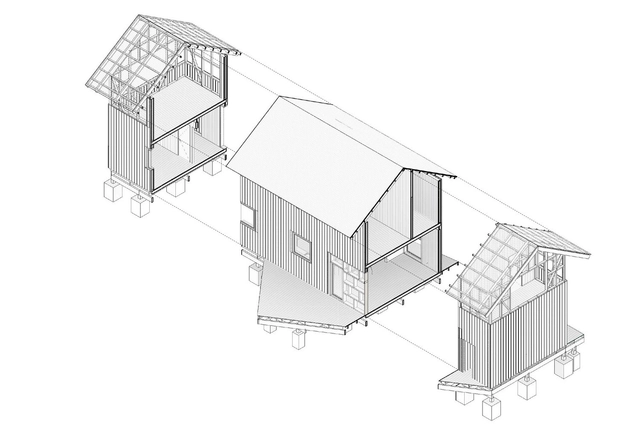
The current demands of the industry lead architects to design based on construction solutions that accelerate processes without compromising quality, while reducing waste and dependence on intensive labor. Among these options, SIP panels stand out as a modular alternative that combines thermal and acoustic insulation with speed and construction precision.
Named after their acronym, SIP panels are self-supporting elements consisting of a rigid foam core sandwiched between two structural claddings, typically OSB boards. Strong yet lightweight, these panels are manufactured under strict factory controls and transported to the construction site, facilitating the rapid assembly of floors, walls, and ceilings, while creating an airtight thermal and acoustic envelope. The thickness of the panel depends on the combined thickness of its components, and its weight typically does not exceed 20 kg per square meter.
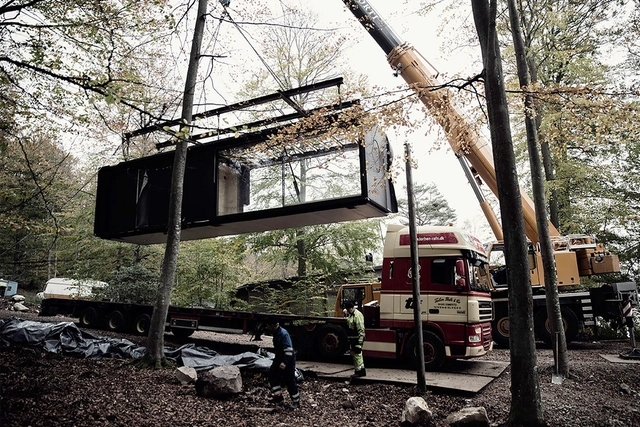
The popularity of pre-designed and pre-fabricated homes is growing, moving much of the construction process from the building site into factories. While countries like Singapore, Australia and the United Kingdom are increasingly adopting modular buildings to meet labor and housing shortages, Nordic countries like Sweden already build 90% of residential single-family houses in prefab wood. Despite the recent surge in interest, off-site building is by no means a new concept. In fact, the construction method has been present throughout history in many attempts to consolidate its use in construction: as far back as A.D 43, the Roman army brought with them prefabricated forts to Britain, while Japan has been building in wood off-site and moving parts in pre-assemblies for at least a thousand years.