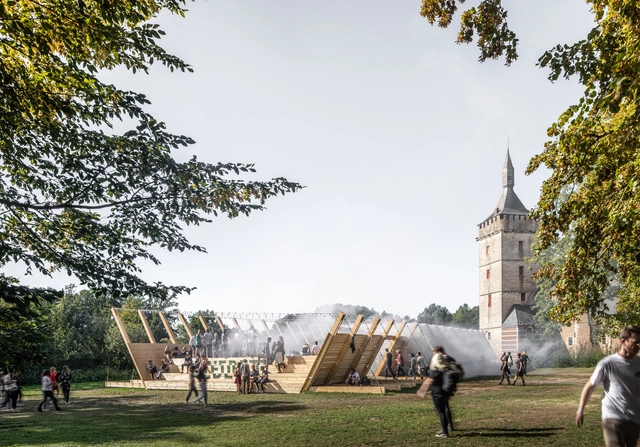
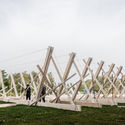
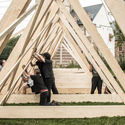
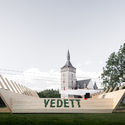
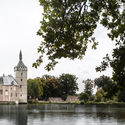
Kasteel van Horst, a 17th-century castle in rural Belgium, and the raucous music festival it hosts every fall are an unlikely pair. But for the past four years, the Horst Music and Art Festival hosted at the castle just outside of Leuven, Belgium has brought together international artists, musicians, architects, and designers for a weekend of creative celebration. For the fifth and final iteration of the festival this year, Tokyo-based architecture firm Atelier Bow-Wow will join the mix.
What can’t be done on the dance floor? Not much, said the 1960s Radical Design collective Gruppo 9999, which argued that discos should be “a home for everything, from rock music, to theater, to visual arts.” Other artists and designers—including New York bad-boy painter Jean-Michel Basquiat, architect Peter Cook of Archigram, and Manchester’s “cathedral of rave” creator Ben Kelly—saw the dance floor as a more subversive setting: one where boundaries could be blurred and thresholds crossed, where partying and politics could be woven together in the dark to channel a cultural revolution. Night Fever at the Vitra Design Museum stitches together this conception of the nightclub as a social Gesamtkunstwerk.





jeroenverrecht_3374.jpg?1519779276&format=webp&width=640&height=580)








jeroenverrecht_3270.jpg?1519779121&format=webp&width=230&height=230&crop=true)
jeroenverrecht_3280.jpg?1519779170&format=webp&width=230&height=230&crop=true)
jeroenverrecht_3302.jpg?1519779196&format=webp&width=230&height=230&crop=true)
jeroenverrecht_3202.jpg?1519778973&format=webp&width=230&height=230&crop=true)
jeroenverrecht_3374.jpg?1519779276)


.jpg?1465360444&format=webp&width=230&height=230&crop=true)
.jpg?1465360218&format=webp&width=230&height=230&crop=true)
