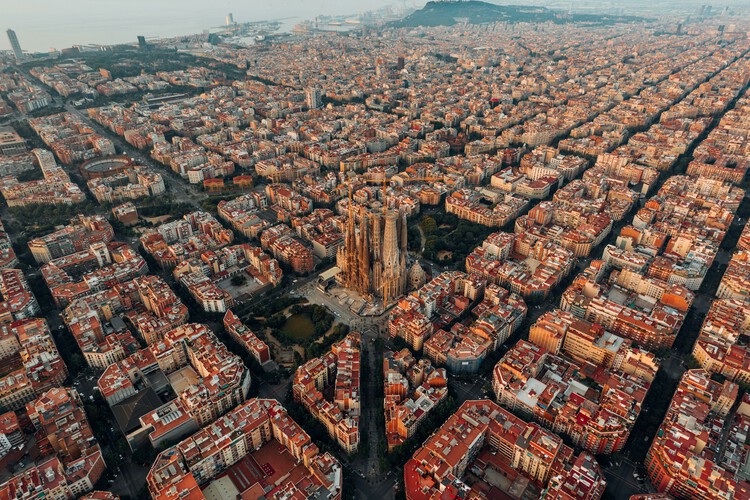
Barcelona is a city where architecture has long served as a laboratory of urban experimentation, each era leaving its mark on the city's fabric. From the dense streets of the Gothic Quarter to the ornate interiors of the Palau de la Música Catalana, the city expanded outward through Ildefons Cerdà's Eixample, a stage where Gaudí and his contemporaries challenged the rules of form, scale, and ornamentation. These experiments defined a local identity and culminated in the Sagrada Família, a vision that continues into the 21st century through the integration of advanced technology.
The city's twentieth-century transformation forged an architectural language with global influence. The principles of International Modernism are embodied in Mies van der Rohe's Barcelona Pavilion, while later developments—from Bofill's explorations in collective housing to the urban interventions of the 1992 Olympics—reshaped the skyline and the city's relationship to its waterfront. Subsequent contemporary projects continue to negotiate form, landscape, and urban scale, contributing to a layered and evolving city.
Manufacturers: Saflex, Antonio Lupi, Bulthaup, Carl Hansen, Cassina, +11Davide Groppi, De La Espada, FLOS, Gaggenau & Bora, House of Finn Juhl, Living Divani, Molteni & C, Moooi, Serge Mouille, Tato, e15-11
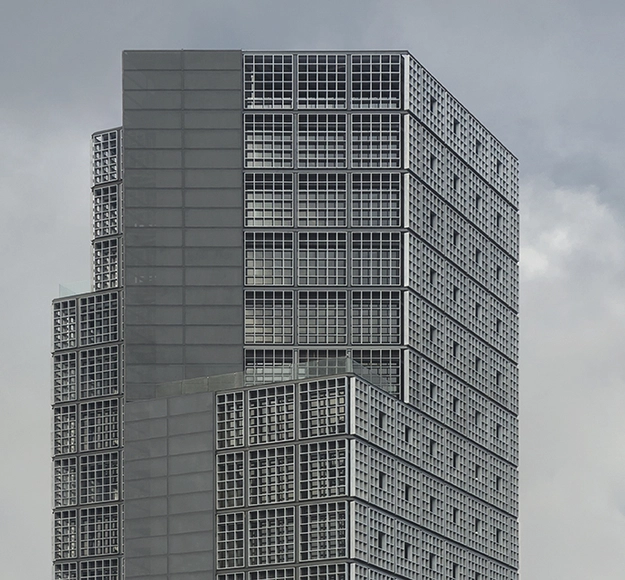
Modular coatings for facades and enclosures typically deliver fast and efficient solutions. However, many times they lack richness and character since they are repeated infinitely, without relating to the architectural design and its different functions and requirements.
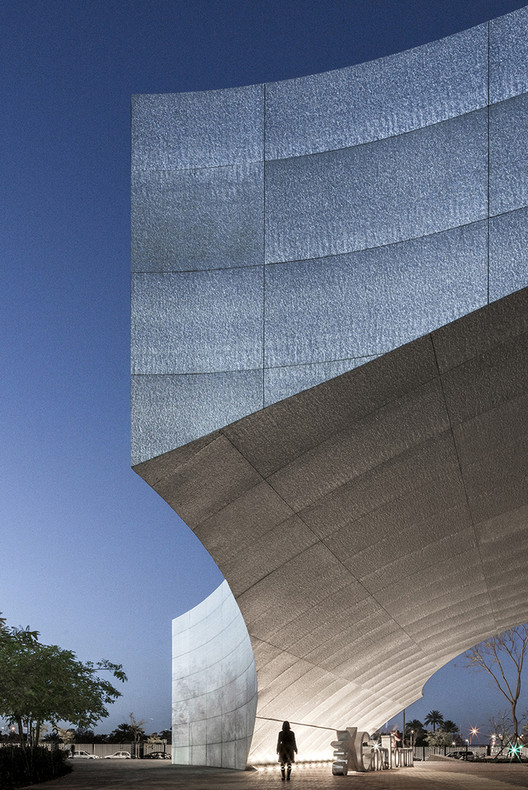
These aluminum foam panels are manufactured through an air injection process in molten aluminum, which contains a fine dispersion of ceramic particulate. These ceramic particles stabilize the air bubbles, and create aluminum foam panels which provide an interesting level of detail and variability, generating unique facades with different levels of texture, transparency, brightness, and opacity. These ultralight panels can be used as flat architectural sheets, are 100% recyclable and available in standard sized formats up to 3.66 meters long (custom longer panels also available).
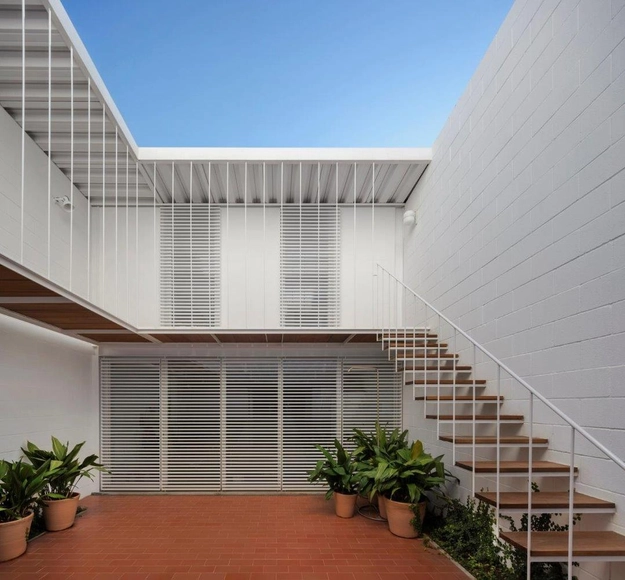
We would like to take a second to focus on the wonderful, yet often overlooked, inner courtyard. The inner courtyard is essentially a "contained outside space" made up of transparent walls, and a well thought-out drainage system is a must. Other elements such as furnishings, decks, vegetation, stairs, water are then added, complicating the space created. The inner courtyard also plays a role in the building's layout; in most cases it functions as the central point from which the other rooms and functions of the project are organized, giving them air and light when the façade openings are not enough.
Here is our selection of 13 stunning inner courtyards of houses and buildings that we have previously published on our site.