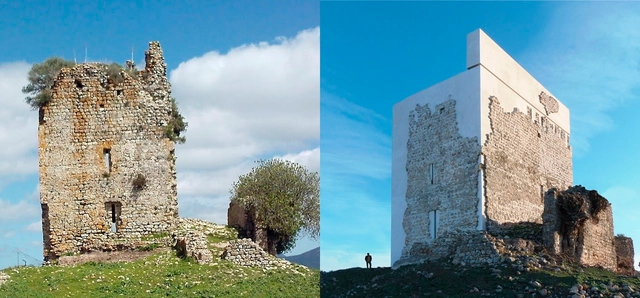
In 2011, after the partial collapse of the Matrera Castle in Cádiz, Spain (dating back to the 9th century) the city decided to restore the remaining tower, with the aim of preventing its collapse and protecting the few elements that were still standing.
The challenge fell into the hands of Spanish architect Carlos Quevedo Rojas, whose design received the approval of the Regional Government of Andalucía, in compliance with the Historical Heritage law 13/2007, which prohibits mimetic reconstructions and requires the use of materials that are distinct from the originals.
In the words of the architect: “This intervention sought to achieve three basic objectives: to structurally consolidate the elements that were at risk; to differentiate the additions from the original structure (avoiding the mimetic reconstructions that our law prohibits) and to recover the volume, texture and tonality that the tower originally had. The essence of the project is not intended to be, therefore, an image of the future, but rather a reflection of its own past, its own origin.”
The polemical restoration has provoked a broad international discussion about heritage restoration, and the Izquierda Unida group has said it will bring the case to the Andalusian Parliament’s Culture committee to see if the restoration was the result expected by the Ministry of Culture. On the other hand, while the building had previously received only sporadic visits, it has now become a new tourist attraction in the area.
Why has a restoration based on the anastylosis technique – which exists around the world – caused so much controversy? It is it really a “heritage massacre” as the media has said? Do you think it could have been carried out in a better way?
Join the debate and leave your comments after the break.