The world is in the palm of our hand thanks to technological and digital developments of the past two decades. Fast internet, new devices and applications have made us more self-reliant and give us more instant control of our own lives. This also goes for healthcare, a field in which the development of new tools and systems has taken a rapid pace. New products and services assist medical professionals and simplify the lives of clients and patients, enabling them to live their lives more independently.
The award is given in four categories: Category A: Built, Less than $25 million in construction cost; Category B: Built, More than $25 million in construction cost; Category C: Unbuilt, Must be commissioned for compensation by a client with the authority and intention to build (No projects were selected in this category this year); and Category D: Innovations in Planning and Design Research, Built and Unbuilt.
The ShiftxDesign Conference at Harvard, this February 19th, is an annual exploration of all things design. Launched in 2012, the conference is a collaborative effort between student groups at the Harvard Graduate School of Design, Harvard Business School, and Harvard College - and the only cross-school event of its kind. The event brings together creative thinkers, design luminaries, experts from a variety of backgrounds, and students to engage in and reinterpret the design process.
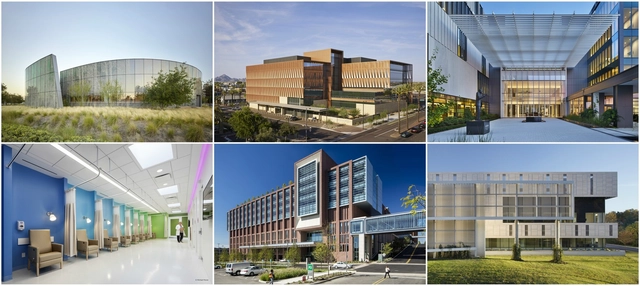
The American Institute of Architects (AIA) has selected seven recipients of the 2016 AIA National Healthcare Design Awards, given to the year’s best projects in healthcare building design and healthcare design-oriented research. Projects were selected for displaying “conceptual strengths that solve aesthetic, civic, urban, and social concerns as well as the requisite functional and sustainability concerns of a hospital.”
The award is given in four categories: Category A: Built, Less than $25 million in construction cost; Category B: Built, More than $25 million in construction cost; Category C: Unbuilt, Must be commissioned for compensation by a client with the authority and intention to build (No projects were selected in this category this year); and Category D: Innovations in Planning and Design Research, Built and Unbuilt.
The 5th Annual IIDA Healthcare Interior Design Competition honors and celebrates outstanding originality and excellence in the design and furnishings of healthcare interior spaces.
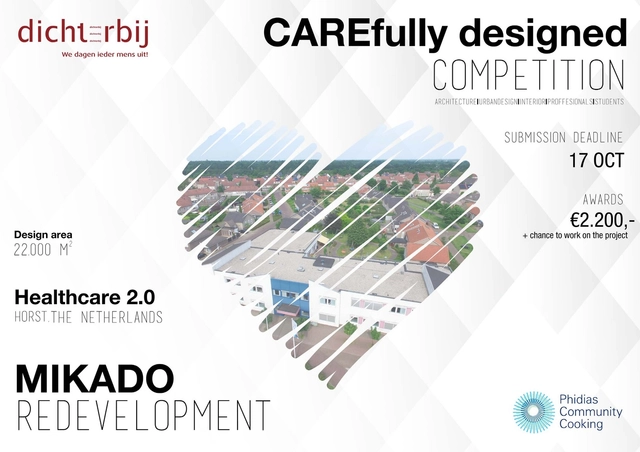
Dichterbij (a Dutch care institution that supports children and adults with intellectual disabilities) is looking for a new design for the Mikado site. Where formerly the care institution cared for about a hundred clients under intensive care, the number has now dropped to under fifty. A variety of influencing factors in the healthcare field, the relocation of residents, and the increasing age of clients, are making the building more difficult to fill.
International conference Building the Future of Health
Can the built environment help us stay healthy for longer? Yes it can! How? Find out in the city of Groningen in June 2016 during international conference Building the Future of Health.
Everyday, Americans all over the country go to work. They get in their cars, arrive at the office, and sit inside. Then, they go home, maybe watch some TV, and go to bed. 5 days a week. About 50 weeks a year.
Our built environment is where we now spend about 90% of our time. Unluckily for us, however, a recent Forbes article suggests that, most of the time, indoor air quality is actually worse than outdoor, to the point where it’s potentially hazardous: “paint, carpet, countertops, dry wall, you name it and chances are it’s got some sort of toxic ingredient.”
And yet we have little way of knowing just how bad our building’s “ingredients” are for us. Until now.
The forward-thinking firm is on the cutting-edge of a movement, instigated by clients and fast taking over the architecture world – towards “healthy” buildings (inside and out).
Read more about Perkins+Will’s revolutionary Transparency Project, after the break…

.jpg?1500915765&format=webp&width=640&height=580)