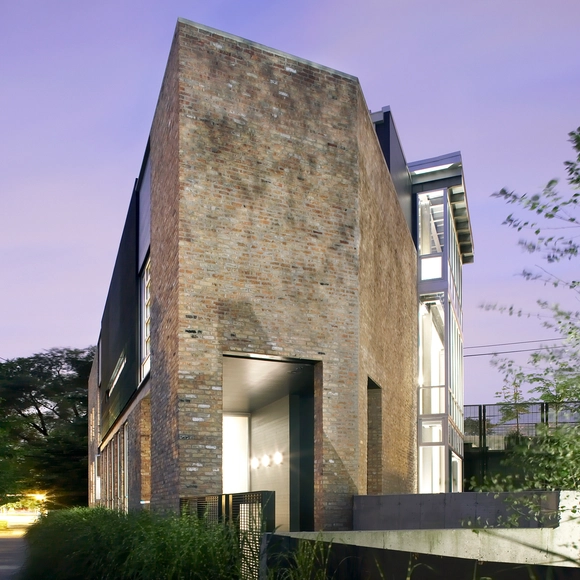
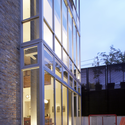
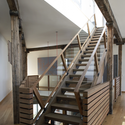
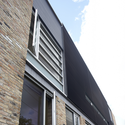
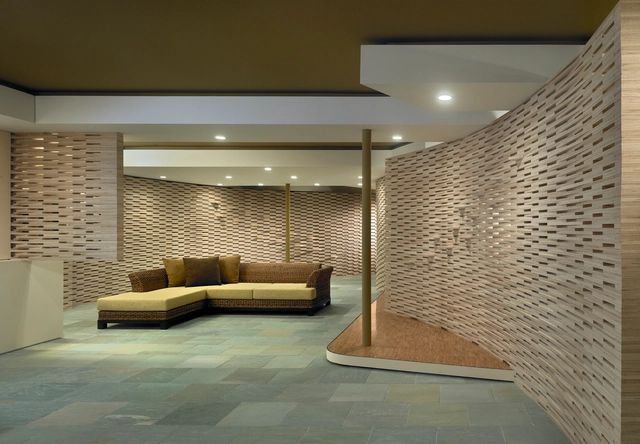
The architecture community recently lost Chicago architect Douglas Garofalo, FAIA. Founder of Garofalo Architects, he was a University of Notre Dame graduate and a professor at the University of Illinois at Chicago, serving as director (2001-2003) and co-founded the alternative design school Archeworks. Garofalo also was known for pioneering the use of computer technology in building design within the United States. His award-winning Korean Presbyterian Church in New York, a collaborative project with Greg Lynn and Michael McInturf, received international attention with its digital media approach and alternative solution to adaptive reuse.
This concrete, clover leaf-shaped structure, which was built in 1975, will likely suffer a fate common to many vacant and disused buildings. After approximately four years of vacancy, this Bertrand Goldberg-designed building will likely be demolished when ownership will revert to Northwestern University this year. Although Goldberg’s organic architectural designs – such as this one – were widely influential, none of his major Chicago works are protected by local landmark designation. Prentice Women’s Hospital was considered groundbreaking for its cutting-edge architecture, advanced engineering, and its progressive design approach to organizing medical departments and services. It received international press coverage and an award from Engineering News Record for its innovative tower and open floor-plate layout that eliminated the need for structural support columns. “You will not find the structural solution to Prentice, which is an exterior shell cantilevered off a core, anywhere else in the world” notes Geoffrey Goldberg, an architect and Bertrand Goldberg’s son. “Prentice was the only one in which this was achieved.”
The Urbana Illinois (140 miles South of Chicago) situated design team, Design With Company, has partnered with Min Chen to develop their latest project, Second Second City, which they have shared with us here at ArchDaily. Additional images of their vision for Chicago’s McCormick Place East and a narrative from the architects can be seen after the break.
Department of Unusual Certainties [DoUC] recently completed a submission to the Network Reset, Rethinking the Chicago Emerald Necklace, competition hosted by Mas Studio and the Chicago Architectural Club. Participants were asked to look at the urban scale and propose a framework for the entire boulevard system as well as provide answers and visualize the interventions at a smaller scale that can directly impact its potential users. Through images, diagrams and drawings the work should express what are the soft or hard, big or small, temporary or permanent interventions that can reactivate and reset the Boulevard System of Chicago. DoUC’s proposal focused on filling Chicago’s Emerald Necklace with a framework of posts, beams, ropes and counterweights - to produce a pick-and-choose- method of program management. Images of their entry and a description can be seen after the jump.
CHANGING ROOM, by Easton + Combs, is a mirage of the intimate in the realm of the public. As the daydream is to daily life, a momentary slippage that can re-qualify the onslaught of a quotidian continuum, so too is the CHANGING ROOM to the urban field.
“SFI 10 + 1″ will unite activists, designers, funders and policy makers as change agents to address the most pressing design challenges of the world today, challenging participants to integrate positive change design in their own practices. Going above and beyond the green design movement the “SFI 10 + 1″ will confront design processes to consider the broader social and economic well-being of communities and cities.
Opening the conference on March 25th will be keynote speaker Patrick Tighe of Tighe Architects. The conferences keynotes, panels, and workshops will also include the participation of Tom Fischer Dean of the College of Design at the University of Minnesota, Andrew Freear Director of Rural Studio, and Sergio Palleroni of BaSiC Initiative, Trung Le of CANNON Design, Christine Gaspar of Center for Urban Pedagogy, Quilian Riano of DSGN AGNC, and Michael Zaretsky Co-author of New Directions in Sustainable Design.
The SEED Design Awards, an international competition highlighting Public Interest Design, will be integrated in the “SFI 10 + 1″ as the winning recipients, featured after the break, will partake as key proponents in the conference experience.
More information about the “SFI 10 + 1″ conference can be found at their official website.
STL Architects, which has previously shared with us their UNO Master Plan for the Gage Park community of Chicago, has now submitted a modular school for the same client. Images and a description of the newly designed UNO School after the jump.
Chicago Children’s Museum’s mission is to create a community where play and learning connect. The museum’s primary audiences are children up through fifth grade including their families, along with school and community groups that support and influence children’s growth and development. In its current location at Navy Pier, the Museum lacks meaningful connections to the outdoors and is challenged with the heavyly commercial environment of what has become Illinois’ most popular tourist attraction.
Follow the break for more drawings of this projected Leed Gold project.
Following the success of last year’s competition, Architecture for Humanity Chicago, in collaboration with Archeworks, is proud to announce the Street Furniture Competition 2011. Read over the full competition brief after the break.
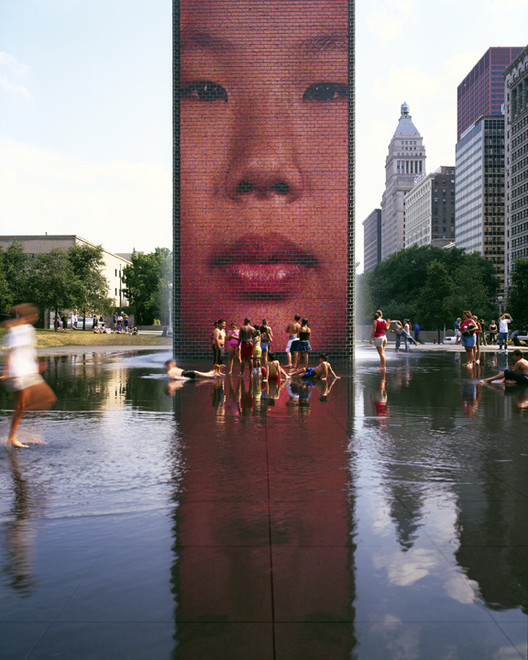
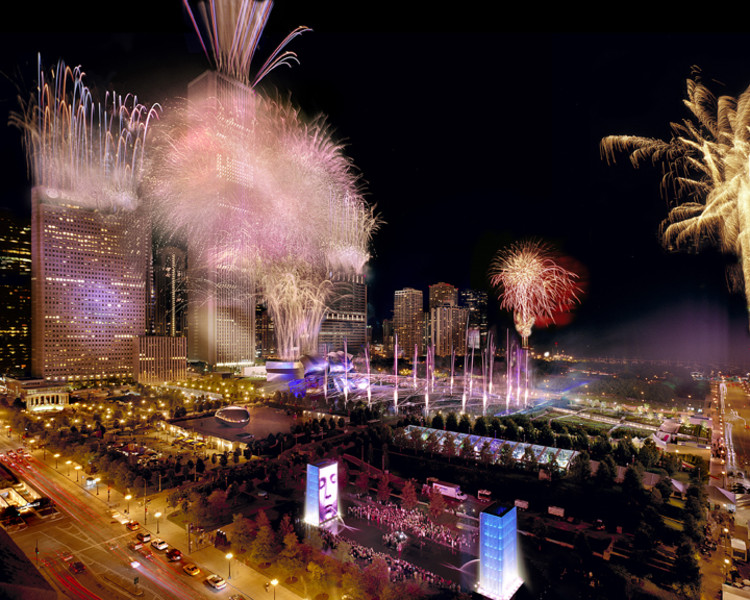
The Crown Fountain in Millennium Park is a gift to the people of Chicago by the Crown family. Located at the corner of Michigan Avenue and Monroe Street, this interactive piece is a poetic meditation on the elemental and sensual qualities of water and light. The world renowned Spanish artist Jaume Plensa was commissioned to create the work.
The international competition, NETWORK RESET, seeks to reactivate the entire boulevard system. The competition will focus on the urban scale and a larger framework for the system as well as smaller scale user impacts. NETWORK RESET aims to reactivate the entire Boulevard System of Chicago and to develop a quality transportation corridor.
STL Architects shared with us their UNO Master Plan in the Gage Park community on the southwest side of Chicago, Illinois. This Master Plan not only offers an opportunity to revitalize the existing neighborhood and make it more vibrant and pedestrian oriented, but it also acts as a catalyst by attracting new business and investments such as educational facilities, a civic center and open green space. More images and architects’ description after the break.