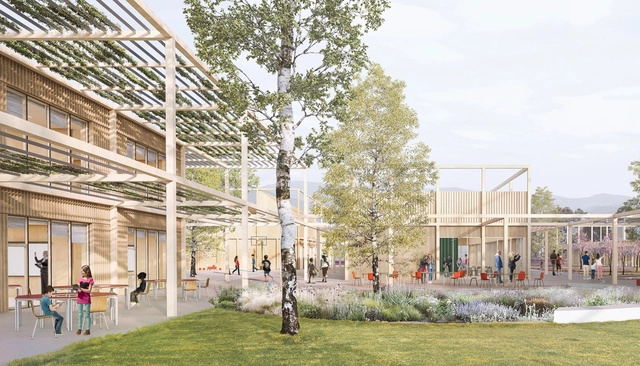
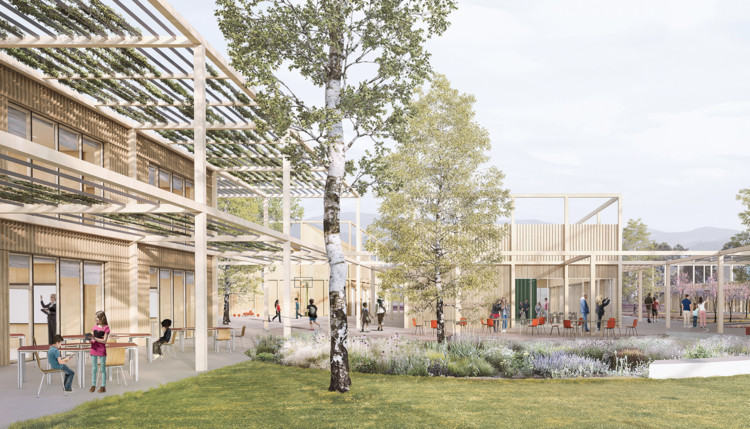
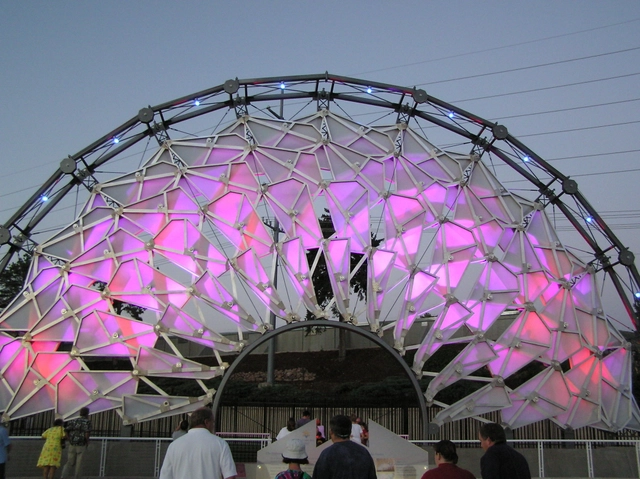
Ten years after a destructive earthquake rocked Italy's central Abruzzo region, many students still attend class in temporary modules similar to containers. Named winners of an international competition, SET Architects’ design for the new “Sassa School Complex” proposes reconstructing a place for students and the community to learn, gather, and grow. Inspired by the modularity and essential nature of climbing frame play structures, the architects describe the design as a metaphor for “freedom and social aggregation as a fundamental value for dynamic and innovative teaching.”
Four Towers In One (Competition). Image Courtesy of Morphosis
Despite what you may think, Thom Mayne isn't the "bad boy" of architecture - at least, not according to Thom Mayne. He sees himself more as a skilled negotiator than a starchitect (a phrase he hates) - after all, he reasons, how else would he have completed so many buildings? In this interview, originally published on Metropolis Magazine's Point of View blog as "Q&A: Thom Mayne," Andrew Caruso and Mayne discuss Morphosis, SCI-ARC, the early days of his career, and his architectural ethos.
Andrew Caruso: Your professional career began in the discipline of planning. What led to the shift toward architecture and your eventual partnership with Jim Stafford?
Thom Mayne: I started working at the Pasadena redevelopment agency doing low cost housing, and that’s where I met Jim [Stafford]. Coming out of USC, I had no background about Mies, Khan or Corbusier, for example. USC was very strong in being anti-historical, looking forward instead of backward. I was essentially naive.
Jim was a year ahead of me at USC and had part of the older regime at the school. When I met him at the planning agency, he started introducing me to history. I got fascinated by [Paul] Rudolph; and then it just took off. Jim guided me through this thought process, reestablishing me in the tradition of architecture.
Many would consider Greg Lynn the leader of computer-aided design in architecture - but Lynn himself begs to differ. He and the Canadian Centre for Architecture recently collaborated on "Archaeology of the Digital," the first in a series of exhibitions that will showcase the work of the earliest adopters of digital techniques in architecture. The exhibit, which opened on May 7, focuses on work by Frank Gehry, Peter Eisenman, Chuck Hoberman, and Shoei Yoh. In this interview, originally published in Metropolis Magazine as "Computer Control," Avinash Rajagopal speaks with Greg Lynn about some of the projects and the inspiration behind the exhibit itself.
SCI-Arc graduate Harris Silver has shared his experience passing through the Kalandia Checkpoint during his quest for "an uncanny truth" that would lead him to develop an architecture project in the city of Jerusalem.
The Kalandia Checkpoint is an opening in what Israel calls "The Security Fence" and what Palestinians call "The Apartheid Wall". Regardless of what you call the separation infrastructure, the checkpoint acts a modern gate to the city of Jerusalem.
After experiencing Kalendia first hand, I came away realizing that until I personally walked through the checkpoint, I was ignorant of the mechanism and tactics employed to humiliate and dehumanize everyone who passes through it. Which means I was not fully capable of participating in the Israeli-Palestinian discourse.
“I can hear with my knee better than with my calves.” This statement made by Bernhard Leitner, which initially seems absurd, can be explained in light of an interest that he still pursues today with unbroken passion and meticulousness: the study of the relationship between sound, space, and body. Since the late 1960s, Bernhard Leitner has been working in the realm between architecture, sculpture, and music, conceiving of sounds as constructive material, as architectural elements that allow a space to emerge. Sounds move with various speeds through a space, they rise and fall, resonate back and forth, and bridge dynamic, constantly changing spatial bodies within the static limits of the architectural framework. Idiosyncratic spaces emerge that cannot be fixed visually and are impossible to survey from the outside, audible spaces that can be felt with the entire body. Leitner speaks of “corporeal” hearing, whereby acoustic perception not only takes place by way of the ears, but through the entire body, and each part of the body can hear differently.