DesignIntelligence has released their 2016 rankings of the Best Architecture Schools in the US for both undergraduate and graduate programs. Nearly 1500 professional practice organizations were surveyed this year, as part of the survey's 16th edition, and were asked the following question: “In your firm’s hiring experience in the past five years, which of the following schools are best preparing students for success in the profession?”
This information, along with detailed accounts on the best programs that teach skills in design, communication, sustainability and technology, resulted in the 2016 rankings. The two top schools, Cornell for undergraduates and Harvard for graduates, held their positions as the best programs to attend, according to the study.
Without further ado, the top 10 undergraduate and graduate programs in the US are...
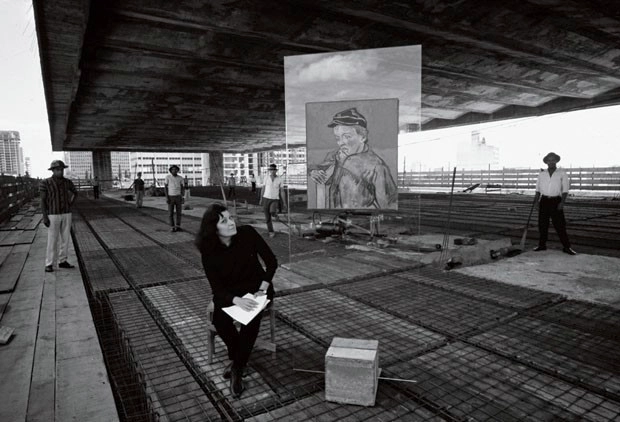
ArchDaily is continuing our partnership with Radical Pedagogies, an ongoing multi-year collaborative research project led by Beatriz Colomina with a team of PhD students of the School of Architecture at Princeton University, presenting a series of paradigmatic cases in architectural education. In this fourth example of Radical Pedagogies in Latin America, Vanessa Grossman (PhD Candidate in History and Theory of Architecture at Princeton University) presents Lina Bo Bardi's application for a chair at the Faculty of Architecture and Urban Studies of the University of São Paulo. Although the application was rejected by the faculty commission, the submitted essay still is a singular source of new ideas for architectural education.
"We performed hitherto a sort of tour throughout time and throughout the “theories” of architecture, dwelling upon one of the aspects and modes of interpretation: the critical aspect. But the experience of teaching has led us to assume, among students, a certain impatience. This impatience we know very well: it means that we no longer feel the sap flowing from the past, that we have almost constitutionally “cut the roots,” that the natural habit of a calm and methodical study no longer exists, despite the consciousness of an acquired cultural heritage. It is the impatience of those who no longer want to know things that do not produce a result soon, of things that do not serve solutions to the problems of immediate life."
—Lina Bo Bardi, Introduction to “Problems of Method,” the second and final chapter of Propaedeutic Contribution to the Teaching of Architecture Theory (1957) [p. 45 in the 1992 Brazilian edition].
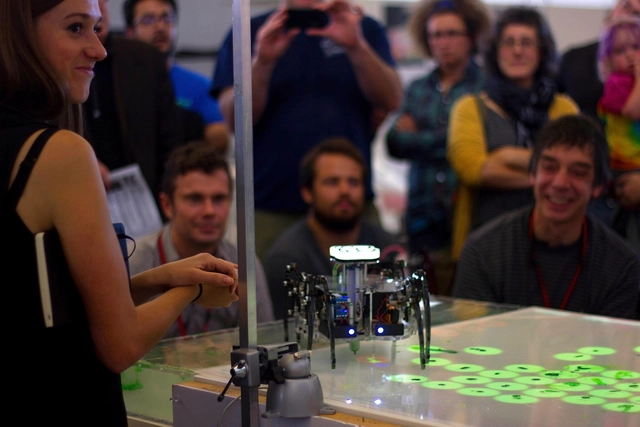
Tournaments in the Course "Culture of the Body," 1975. Courtesy of Archivo Histórico Jose Vial
ArchDaily is continuing our partnership with Radical Pedagogies, an ongoing multi-year collaborative research project led by Beatriz Colomina with a team of PhD students of the School of Architecture at Princeton University, presenting a series of paradigmatic cases in architectural education. Today, Ignacio González Galán (Adjunct Assistant Professor at Columbia University GSAPP) presents the most important —and living— example in architectural education in Latin America, the School and Institute of Architecture of Pontifical Catholic University of Valparaíso, led by architect Alberto Cruz with a group of artists: the poet Godofredo Iommi, the sculptor Claudio Girolla, and the architects Fabio Cruz, Miguel Eyquem, José Vial, Arturo Baeza, Francisco Méndez and Jaime Bellalta. The program's deep dialogue with poetry, arts and the craft of architecture is the main distinguishing feature of its pedagogy. Its ideals have been materialized in Open City, a space for architectural experimentation to the north of Valparaíso in which some professors and researchers live.
Starting in 1952, the Architecture School at Valparaiso offered simultaneously an elaboration of the intellectual project of modernity and a response to modern architecture as it had been institutionalized in Latin America. Led by Chilean architect Alberto Cruz and Argentinean poet Godofredo Iommi, its pedagogy bypassed architectural sources and turned to a wider set of references from the avant-garde in a quest for the “absolutely modern.”
Digital design and fabrication have combined with ubiquitous computing and globalization to change the field of architecture. At California College of the Arts in San Francisco, faculty and students in the Bachelor of Architecture, Master of Architecture, and Master of Advanced Architectural Design programs team up with companies, agencies, and community groups to make architecture that addresses the challenges and opportunities of economic growth, climate change, and technological disruption.
One ongoing initiative is a multi-year design research project showing how cities can redevelop their waterfronts without damaging marine ecologies. In the Buoyant Ecologies project, students and faculty from the school’s Digital Craft Lab work with external partners to show how innovative waterfront architecture can actually enhance marine ecologies. By teaming up with fabrication specialists Kreysler and Associates, scientists from Moss Landing Marine Laboratories, Autodesk’s Pier 9 Workshop, and the Port of Oakland, professors Margaret Ikeda, Evan Jones, and Adam Marcus recruited high-level experts to advise students and help them test their ideas.
https://www.archdaily.com/776499/prototyping-the-futureSponsored Post
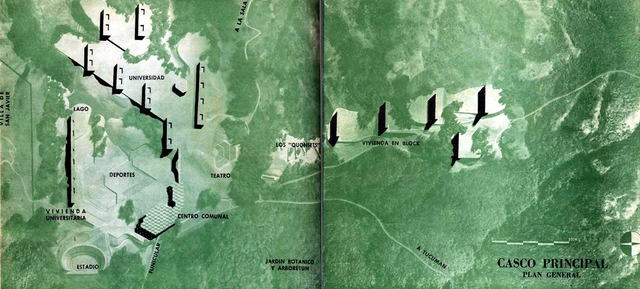
Ciudad Universitaria de Tucumán, in Revista Nuestra Arquitectura nº 254 (Sept. 1950)
ArchDaily is continuing our partnership with Radical Pedagogies, an ongoing multi-year collaborative research project led by Beatriz Colomina with a team of PhD students of the School of Architecture at Princeton University, presenting a series of paradigmatic cases in architectural education. In this article, Horacio Torrent (Full Professor at Pontificia Universidad Católica de Chile School of Architeture) presents the example of the Institute of Architecture and Urban Studies of the National University of Tucumán in Argentina, led by Jorge Vivanco with a group of invited Italian professors. The Institute's key radical approach was in the real materialization of their architecture, including actual commissions and clients, with the university's own campus being the most important of these projects.
In 1947, Italian professors Ernesto Rogers, Cino Calcaprina, Luigi Piccinato, Enrico Tedeschi and civil engineer Guido Oberti were invited to teach at the School of Architecture, Universidad Nacional de Tucumán. Jorge Vivanco, the school’s Dean, contacted the group of professors after attending the 6th Congrès internationaux d’architecture moderne (CIAM) in Bridgwater, England. Vivanco also appointed the Argentinian architects Eduardo Sacriste, Horacio Caminos, Hilario Zalba, José Le Pera, Rafael Onetto, and Jorge Bruno Borgato. Together, these professors took part in one of the most radical and short-lived experiences in architectural teaching in Latin America at the time.
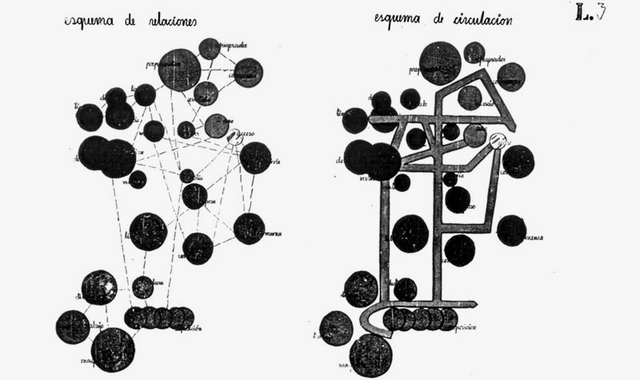
Scheme of relationships and scheme of circulation.Student work by Miguel Lawner at Tibor Weiner’s Architectural Analysis class, circa 1946. Image Courtesy of Miguel Lawner
Education is changing fast all over the world. In recent decades, a great number of small local initiatives focused on the individual person, pursuing creativity, curiosity and diversity, have been disrupting through the secular traditional model of education. We have also seen an increasing number of online initiatives which expand access to knowledge to people who didn't have it before - the only requirement is a computer with internet. And the best of it: most of them are open and free. But what about architectural education? Has it experienced the same transformation?
In partnership with Radical Pedagogies, an ongoing multi-year collaborative research project led by Beatriz Colomina with a team of PhD students of the School of Architecture at Princeton University, we will be publishing a series of paradigmatic cases in architectural education. In this article, Daniel Talesnik (PhD Candidate in History and Theory of Architecture at Columbia University) presents the first radical case in Latin America: the reform led by Tibor Weiner at the University of Chile influenced by the principles of Bauhaus.
“We as a profession have to encourage young architects to understand that the technology they’re using is merely a tool. They have to understand how to build the building that they’re creating, but also understand that this place is going to affect somebody. So what can we do to make it a place that—in a sense—I want to be a part of, that I want to attach to?”
Deborah Berke of Deborah Berke Partners has been appointed as the new dean of the Yale School of Architecture. Having served as an adjunct professor at Yale since 1987, Berke will be the first woman to lead the school. She will assume her position on July 1, 2016, during the architecture school's 100th anniversary, succeeding Robert A.M. Stern's 18-year term.
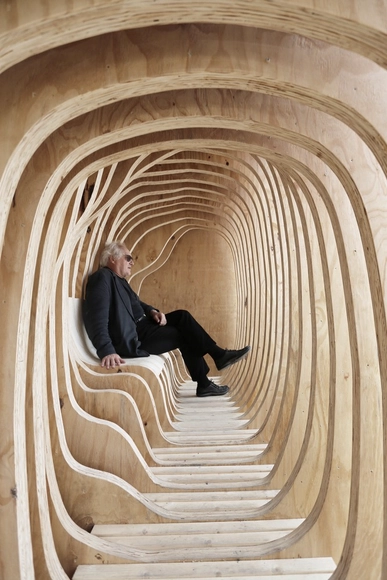
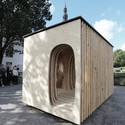
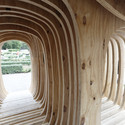
First-year architecture and urban planning students at the Estonian Academy of Arts have designed and created READER, a shelter based on the concept of removal from daily life, and focusing on oneself. Passers-by are invited to enter the shelter and “escape from the real world of problems into the fictional world of books.” And for those who don’t have a book on hand, the structure is meant to evoke the pages of a book through its ribbed wooden structure.
The National Council of Architectural Registration Boards (NCARB) has named the first 13 accredited architectural schools to implement the "Integrated Path Initiative." Each selected school has proposed a pre-graduation curriculum that would provide students with the necessary mix of education, work experience, and opportunities to complete the Architect Registration Examinations (ARE) to achieve licensure before graduation. The initiative was spearheaded by NCARB to shorten the time it takes for US architects to get licensed.
The 13 accepted schools represent "a wide range B.Arch and M.Arch programs in nine jurisdictions, including both public and private institutions," says NCARB. These schools are:
“The programs in this inaugural class exhibited a high degree of creativity, and are focused on strengthening the relationship between schools, the practice community, and licensing boards,” said Licensure Task Force (LTF) Chair Ron Blitch, a Louisiana architect who is a former NCARB President and current member of the NAAB Board of Directors and the Louisiana State Board of Architectural Examiners.
Unless architecture is truly your passion, Norman Foster thinks you should simply find something else to pursue. In the Louisiana Channel's latest, the prolific English architect advises the young to live "every living second of your life" doing what you love.
The great schools of architecture have been around since time immemorial, or at least that's how it can often feel. In London, a city particularly dense with institutions of this calibre, this is perhaps felt more acutely. How, then, do you develop an entirely new school in this tightly packed environment which has the potency and capacity to compete? Will Hunter, former executive editor of the London-based Architectural Review, began a process to do just this with an article in 2012. Following this, he set up the ARFA—Alternative Routes For Architecture—in order to explore different models for architectural education, calling upon professionals and academics to contribute to a series of informal discussions.
“When the tuition fees in the UK escalated to around £9000 per year in 2013, it got me thinking about different models for architectural education,” Hunter recalls. The casual meetings held around this time gradually become more serious until, “at a certain point, we decided to test them: to make a school.” The project gathered momentum from that point on and now, two years later, the London School of Architecture(LSA) are preparing to take in their first ‘trailblazing cohort’ of postgraduate students.
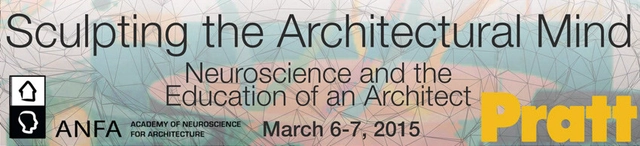
On March 6 and 7, New York's Pratt Institute will host "Sculpting the Architectural Mind," a conference exploring the connection between "Neuroscience and the Education of an Architect."
Examining the past and potential role of applied neuroscience within architectural education, the conference will touch on topics such as design cognition and the effect of digital media production. "Sculpting the Architectural Mind" is both analytical and speculative, searching for new means of integrating digital tools into the design process and questioning what effects such an approach would have upon the built environment. The themes will be explored over four sessions spaced over the conference's two days.
UK universities are failing to properly equip graduates with the necessary skills required for practicing architecture, according to RIBA’s 2014 Skills Survey. Of the 149 employers and 580 architectural students or recent graduates who responded to the wide-spread survey, a large majority criticized architectural education for prioritizing “theoretical knowledge ahead of practical ability” and agreed that most graduates are ill-prepared for work after studying at the university.
“I can think of no other profession where new graduates must wait a decade or more to be given significant responsibility because they have not acquired basic skills in university,” says Yarema Ronish, RIBA client adviser and director at Richard Morton Architects.
In the second decade of the twenty-first century, the built environment continues to be redefined on an unprecedented scale by global shifts of culture, economy, and geopolitical structures. Cities and countrysides are transforming differently from country to country; national and local governments continue to define specific legal frameworks impacting building practice; and value systems and social norms remain strongly bound to culture. At the same time, different regions around the world deal with similar changes, from urban sprawl and rapid urbanization to the consequences of an aging population and the lifestyle challenges of the middle class.
In the last two decades the spread of professional skills and new technologies around the world expanded the market for international design services. The looming new role of global professionals raises crucial questions regarding the knowledge and expertise of architects and urban designers: How can we learn from different cultures of building all over the globe? How can designers perform within the clash of cosmopolitanism and localism? Which design strategies and research approaches mediate between international and local conditions? How can a globally oriented designer engage with local mores and trades? Do practitioners who operate internationally have an ethical duty to assist in transferring new skills to local architects? These considerations underscore how globalism is affecting every practitioner, even those who never leave their home nations.
Drawings, technologies, clients, and workforces flow easily between networked continents and cultures. Yet designers are often confronted with the intractability of local circumstances. How can architects and urban designers critically contribute to the construction of a borderless, cosmopolitan culture that transcends national borders and identities?
https://www.archdaily.com/585676/the-berlage-s-master-of-science-in-architecture-and-urban-design-architectural-education-in-the-age-of-global-practiceSponsored Post
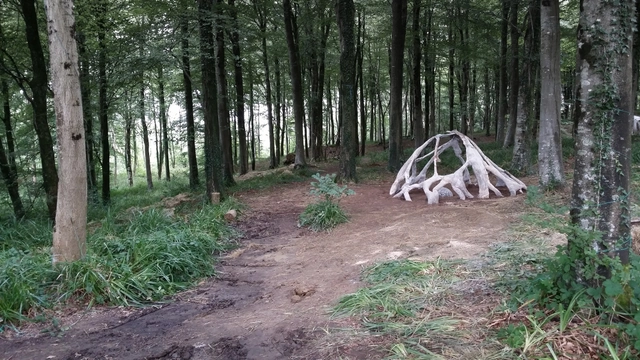
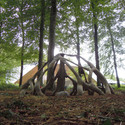
Created for AA DLAB 2014 - the annual summer workshop undertaken by the Architectural Association at their Hooke Park facility - the 4.4 metre wide "CALLIPOD" pavilion blends perfectly into the wooded surroundings, appearing as though the roots of nearby trees have sprung from the ground to create a dome in the depths of the Dorset woodland. However, despite its natural outward appearance, the process of creating CALLIPOD was highly technical, combining a detailed algorithmic exploration of form and structure with both digital and traditional methods of fabrication.
Becoming licensed is no easy feat for the recently graduated architecture student. The combination of required internship hours and exam scores proves a daunting obstacle for most, often taking years of work after college to surpass. Now, however, the National Council of Architectural Registration Boards (NCARB) is testing the waters for an alternative system that could grant licensure to students immediately upon graduation.