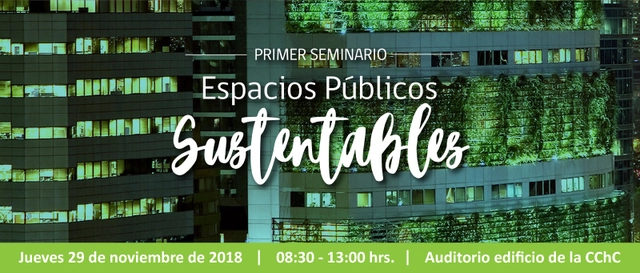
The Ministry of Housing and Urbanism (Minvu), in collaboration with the Technological Development Corporation (CDT) of the Chilean Chamber of Construction (CChC), is pleased to invite you to the First Seminar on Sustainable Public Spaces.
The Ministry of Housing and Urbanism (Minvu), in collaboration with the Technological Development Corporation (CDT) of the Chilean Chamber of Construction (CChC), is pleased to invite you to the First Seminar on Sustainable Public Spaces.

From November 28 to January 18, Galeria Plexi presents the exhibition "Fragmentos do Olhar," featuring a collection of key works by photographer Manuel Sá.

The Secretariat of Culture of the Municipality of Santiago de Cali, through the Undersecretariat of Heritage, Libraries, and Cultural Infrastructure, in collaboration with the Italian Cultural Institute of Bogotá, will host the seminar "Cataloging Heritage Buildings." The event aims to strengthen cultural heritage by creating spaces that promote the protection, dissemination, and appreciation of the unique values and characteristics inherent to Cultural Interest Assets, which represent a sense of identity for the city.
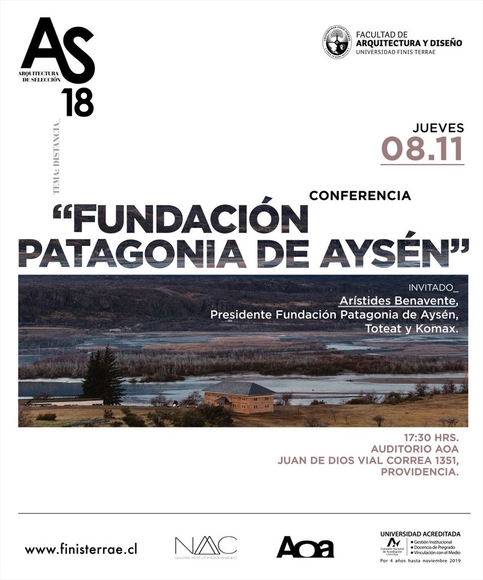
Arístides Benavente, president of Komax and Toteat, will deliver the lecture "Fundación Patagonia de Aysén," in which he will discuss his management efforts in developing the institution—which he founded and currently chairs—dedicated to contributing to the sustainable development of Patagonia through community-based tourism in the Cerro Castillo area.

On Friday, November 9, at 7:00 PM, the Fernando Castillo Velasco Auditorium will host the launch of the third ARQDOC of 2018, written by Thomas Weaver and published by Ediciones ARQ.

Seven of Latin America's leading architectural photographers gather at the MAE—the Museum and Archive of Architecture of Ecuador—to present seven distinct perspectives on modernity in an unprecedented photography exhibition.
The exhibitors—Leonardo Finotti (Brazil), Cristóbal Palma (Chile), Daniela Mac Adden (Argentina), Rafael Gamo (Mexico), Federico Cairoli (Argentina), Onnis Luque (Mexico), and Bicubik (Ecuador)—present brief, authorial essays on modern architecture in the Americas.
The exhibition is part of the parallel events of the XXI Pan-American Biennial of Architecture in Quito and will be open from November 15, 2018, through January 20, 2019.

For its fourth exhibition cycle, Espacio Odeón has invited Alejandro Martín Maldonado and Estudio Altiplano to serve as curators. They have chosen to launch an architecture competition that examines the spatial conditions of Odeón, along with its history, present, and future.
This competition invites any individual or collective—regardless of age, discipline, nationality, gender, or political affiliation—to submit architectural proposals. We are seeking submissions that consider the building's current state in programmatic, heritage, urban, and economic terms. We invite you to envision alternative futures and new directions, and to submit proposals that radically question the spatial condition of Odeón, the contingency of the void, and the potential of its ruins.

ICAMT - International Committee for Architecture and Museum Techniques of ICOM annually organises an important international conference bringing together experts from diverse disciplines such as architecture, museography, exhibition design, and museum studies.

There have been five major extinction events in Earth's history, the fifth being the obliteration of the dinosaurs by an asteroid some 65 million years ago. For many plant and animal species today, humans are now the greatest threat to their survival. This is known as the sixth extinction, and its grim ledger is the IUCN Red List of Threatened Species. The unrestrained destruction of animal habitats for our cities and food production is the equivalent of a slow-motion asteroid. And yet, it is only the human who has the capacity to prevent a real asteroid hitting Earth.

The third GADU International Congress on Gender, Architecture, Design, and Urbanism will take place from November 4 to 6, in both virtual and in-person formats at the Faculty of Architecture, Design, and Urbanism of the University of Buenos Aires, Argentina.
The event is organized as part of the activities of the GADU program, based at the Institute of Human Spatiality at FADU UBA.

Beyond AI_ded Design:
Looking Forward, Looking Backward
Thirty years after its founding, SIGraDi and the University of Chile invite the academic, professional, and creative community to participate in the 30th international congress of the Ibero-American Society of Digital Graphics, to be held in Santiago at the University of Chile from November 18 to 20, 2026.
This gathering marks a symbolic return to the University of Chile, which hosted SIGraDi 2006 two decades ago under the theme "The Human Factor." At that time, we invited participants to reflect critically on the role humans played in the emerging world of digital design. That critical look at the past—and the future—is more relevant than ever in the face of even more disruptive technologies.
In this spirit, we are proposing the concept of "AI_ded Design," a notion that updates the legacy of CAD (Computer-Aided Design) and projects it toward a new horizon where design, architecture, and urbanism are redefined by algorithmic structures, intelligent environments, and autonomous systems mediated by Artificial Intelligence.
We invite you to think beyond computer-aided design. We aim to open a space for discussion on a form of design where computation—increasingly transparent, ubiquitous, and autonomous—gives way to new forms of cognition, agency, emergence, distributed processes, and a necessary technological ethics that reconfigures design practices.
To stimulate this collective conversation, we propose four open questions:
What have we learned in these 30 years?
What have we improved in these 30 years?
What have we achieved in these 30 years?
What challenges are emerging in the relationship between humans, machines, and environments?

Smart City Expo World Congress (Barcelona, November 3-5) is the world's biggest and most influential event for cities and urban innovation. The event is a premier venue where a diverse community of industry executives, government leaders, researchers, urban pioneers and entrepreneurs gather annually to address complex issues to move cities toward a brighter future. This year's event will welcome over 27,000 professional visitors from more than 130 countries around the globe, 1,190+ exhibitors, 600+ speakers, and representatives from nearly 1,000 cities.

Introducing the Kinderspace: Architecture for Children's Development competition / Edition #4, an architectural challenge dedicated to crafting innovative educational spaces that enhance early childhood learning. As young children navigate their formative years, the environment in which they learn plays a pivotal role in their cognitive, emotional, and social development. Traditional educational settings often do not fully cater to the dynamism of early childhood, potentially stifling creativity and exploration.

The Mohamed Makiya Prize is part of Tamayouz Excellence Award's programme that champions and celebrates the best of architecture in the Middle East and North Africa. Every cycle, the prize is presented to the 'Architectural Personality of the Year', or the individual/organisation that has made the greatest contribution towards the advancement of architecture in a specific period. The winner will be celebrated during the biennial Tamayouz Excellence Award Ceremony.

We are excited to invite submissions for DARK MATTER: Revisiting the Architecture of Coal in Post-War Europe, an in-person conference hosted by the ACME (Architecture of Coal in Modern Europe) project (ERC Advanced Grant, 2024–2030), taking place at the Irish Architectural Archive, Dublin on 5+6 November 2026.

The 11th Docomomo North and Northeast Seminar will take place from November 4 to 7, 2026, in Belém (Pará), under the theme "Modernity in Transition: Climatic [Inter]changes." The in-person event will be open to the public and feature the participation of the academic community. The program includes lectures and roundtables, as well as paper presentations covering teaching, research, and outreach.

Celebrating the Dialogue Between Earthen Architecture and Landscape

What’s That Green? Governance Lab is excited to launch an open call for projects that demonstrate good practice in the long-term co-care and co-maintenance of urban green spaces together with civil society.
We are not looking for governance models where green spaces are solely managed by public or private actors, nor where citizens are acting entirely on their own. Our focus is on blended stewardship models - where cities, private organizations, and civil society care for green spaces together.