The KÖMMERLING Challenge is KÖMMERLING’s major initiative to contribute to a shift in the construction model, accommodating high-energy-efficiency projects with a viable construction budget by integrating the most efficient and innovative construction techniques. The starting point for this challenge was the unique ‘Edificio Zero KÖMMERLING Architecture Competition,’ held in 2017, which serves as the basis for the brand’s new offices in Spain. The vision of the KÖMMERLING Challenge is built on several pillars: the training of architects; the use of new methodologies that consider not only construction solutions but also processes and workflows; and placing special emphasis on project certification and its various phases.
The activity is hosted by architect and director of Escola da Cidade, Ciro Pirondi, who will address the theme "What is the architect for?"
A lecture on the role of the architect, delivered by the school's director, Ciro Pirondi, followed by a guided tour of the exhibition on the Osaka Pavilion by Paulo Mendes da Rocha, will take place on November 27. Registration is open. Free of charge.
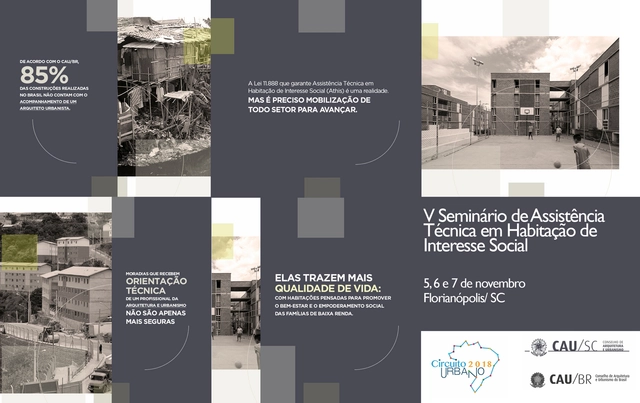
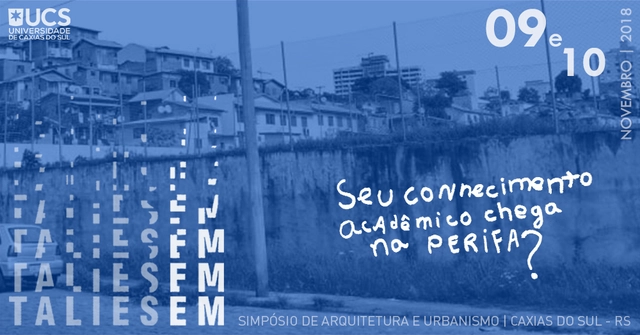
V Seminar on Technical Assistance for Social Interest Housing
With the goal of encouraging practices for Technical Assistance for Social Interest Housing (ATHIS), the Council of Architecture and Urbanism of Brazil (CAU/BR) mandated in 2017 that all state-level councils (CAU/UFs) allocate 2% of their budgets to support ATHIS initiatives. In alignment with CAU/BR guidelines, the Santa Catarina Council (CAU/SC) established the Special Commission for Technical Assistance (CTEC) in 2017. Composed of a group of architects and urban planners, the commission was tasked with coordinating the development of public and free technical assistance policies, as provided for by Law 11.888/2008.
Sidewalks, also known as public walkways, can be understood as multifunctional open spaces where a range of activities occur, from pedestrian flow to social interaction. From this perspective, public walkways have great potential to host green infrastructure solutions—such as rain gardens, bioswales, and stormwater planters—capable of providing a series of environmental services for cities. These include mitigating urban pollution (water, air, and soil), providing habitats for urban fauna, contributing to the control of stormwater runoff volume and velocity, and improving local microclimatic quality and thermal comfort for adjacent buildings through shading and evapotranspiration, in addition to serving as an aesthetic element. Currently, emerging ecological sidewalk design techniques that add value and attractiveness to properties are well-known, utilized, and proven.
In this seminar, Sinaenco proposes an analysis of the challenges involved in implementing the BIM Agenda in Brazil, considering the expectation that the methodology will be widespread in public works within 10 years. Starting in 2021, certain federal government agencies are expected to require BIM for the development of architectural and engineering models.
The Pichincha Architects Association (CAE) and the Ecuador Architecture Archive Museum (MAE) present two exhibitions that offer a journey through the history and memory of architecture through subtle evocations.
Thirty years after the death of architect Luis Ramiro Barragán Morfín in November 1988, the time is right to critically re-examine a figure who has left an indelible mark on the global history of architecture.
The IAB-MG Urban Kindness Award was conceived, developed, and launched by the Minas Gerais Department of the Institute of Architects of Brazil 24 years ago, in 1993. Since then, its objective has been to encourage diverse initiatives from both individuals and legal entities that contribute to improving the quality of urban life. The core idea is to reward and value the small acts and attitudes of citizens that help make city life better every day. Urban Kindness refers to attitudes, gestures, and interventions that foster a new perspective on the city, promoting the preservation of its cultural and natural heritage and expanding the concept of citizenship.
The launch of the book ART-quitectura will take place on November 20th. This is the 14th work by architect Luis Alonso, founding partner of the firm Alonso, Balaguer y Arquitectos Asociados—one of the most international and prolific Spanish architecture firms today—in which he showcases 10 of his projects developed across different countries.
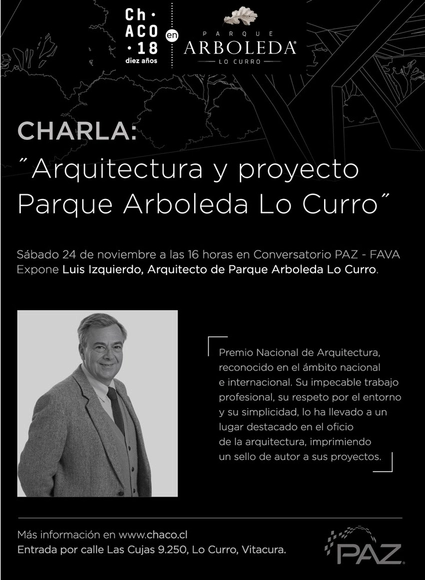
We invite you to join us for the new edition of the Chile Arte Contemporáneo (Ch.ACO) fair, one of the most significant events in the country and South America, which is celebrating its tenth anniversary this year. The event will take place from November 23 to 26 in Vitacura, at the Parque Arboleda Lo Curro project by Inmobiliaria Paz, a building designed by the renowned architecture firm Izquierdo Lehman. More than 6,000 square meters will host works from over 60 exhibitors representing 15 countries, including galleries from Chile, Argentina, Peru, Colombia, Mexico, Ecuador, France, Spain, Germany, the United Kingdom, the United States, and China. As in the last two years, the fair will be divided into four sections, three of which (Focus, Planta, and Nave de Ediciones) will be curated. Together, these sections will feature works by more than 300 national and international artists. Furthermore, the initiative will feature various talks organized by the Fava Foundation and Paz Corp, designed to serve as a platform for visibility and interaction for the artists participating in the tenth edition of the Ch.ACO Fair, as well as to provide an introduction to public art and architecture. A highlight is the presentation by National Prize winner Luis Izquierdo, the architect of the project hosting the fair, which is scheduled for Saturday the 24th at 4:00 PM. Parque Arboleda Lo Curro, the center of the exhibition, is a modern and avant-garde project built on thick pillars that rise across four hectares of green space. The placement of the buildings was specifically designed to house a large central park, developed by the prominent landscape architect Juan Grimm—a space that inspires and gives its name to this project.
ArpaFIL is a gathering focused on architecture, heritage, and the arts, held annually since 1995 as part of the Guadalajara International Book Fair (FIL). Since its inception, it has served as a forum where specialists and masters of architecture gather to promote, disseminate, share, and debate ideas with emerging professionals and the general public.
O Infinito Vão arrives in Brazil between November 6th and 9th
The "Infinito Vão" exhibition arrives in Brazil from November 6th to 9th. A group of architects involved in the exhibition on 90 years of Brazilian architecture—currently on display at the Casa da Arquitectura (CA) – Portuguese Centre for Architecture in Matosinhos, Portugal—will participate in a series of talks and debates at the Instituto Moreira Salles in São Paulo. The program features Portuguese architect Inês Lobo, among many other professionals from various generations and backgrounds. Admission is free.
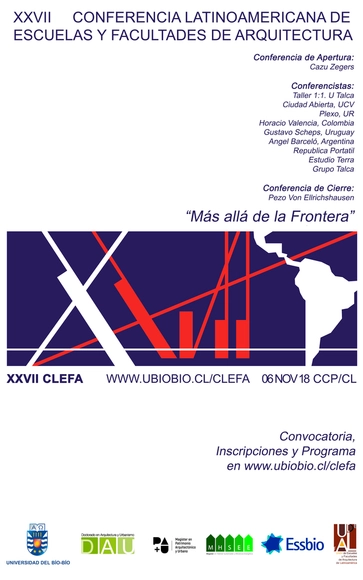
The XXVII Latin American Conference of Schools and Faculties of Architecture (CLEFA) will take place on November 6 at the Universidad del Bío-Bío's Concepción campus. Over four days, various academics, professionals, and students will present on topics concerning the training of architects in Latin American academic institutions.
This year, delegations from Latin American and Caribbean countries will participate, alongside special guests—including Cazu Zegers, Taller 1:1 U. Talca, Pezo Von Ellrichshausen, Grupo Talca, Estudio Terra, Angel Barceló, Horacio Valencia, and Gustavo Scheps—with a program of activities relevant to the central theme: "Beyond the Border."
Learn more about the event through the words of its organizers below.
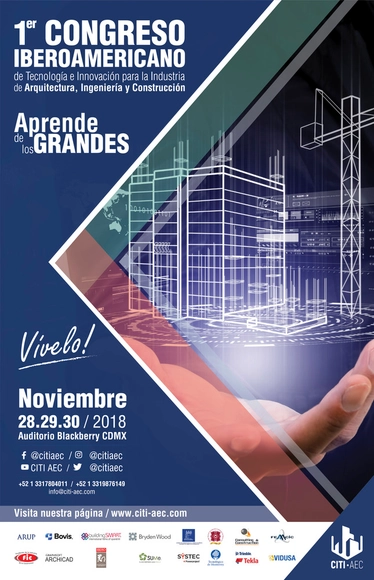
The Ibero-American Congress on Technology and Innovation brings together more than 30 national and international leaders from the construction industry. This three-day event explores advancements and developments in the sector from a cutting-edge perspective, specifically designed for professionals and students seeking growth, training, professional updates, and the development of new ideas.
This Sunday, November 11, we invite you to a day of public space activation featuring two winning proposals from the IDB and Placemaking Latinoamérica México 2018 Urban Interventions Competition:
Vivian Abenshushan (Mexico City, 1972) is a writer, editor, and independent cultural agent.
In recent years, her practice—both individual and collective—has focused on exploring aesthetic and discursive strategies that confront the processes of contemporary capitalism and its structures of cultural production, as well as the relationships between art and political action, community processes, interdisciplinary intersections, and experimental writing practices.