Making its debut this October, Weaving Dialogues is the public programme of Time Space Existence 2025, designed as a platform to enrich ECC Italy’s biennial architecture exhibition as a space for exchange and reflection. Extending the exhibition’s themes into wider conversations, it brings together voices from the show to engage with this year’s recurring topics: Repair, Regenerate, and Reuse. The inaugural edition of Weaving Dialogues will take place on 9 and 10 October in the iconic venue of Palazzo Michiel in the heart of Venice.
Held at New York City's Rockefeller Center, home to World Monuments Fund (WMF)'s global headquarters, the 2025 Summit welcomes experts and audiences from around the globe for a one-of-a-kind event.
Scaling for Enough – How do we scale solutions while knowing the limit of "enough"? Imagine a construction industry not only driven by profit and growth, but also by sufficiency, care, long-term visions, and urgent action. This year's theme at Building Green CPH is "Scaling for Enough", unfolding across five stages at Lokomotivværkstedet in central Copenhagen on 29–30 October. Together, we will explore concepts such as moderation and sufficiency in a time when construction must both slow down and reduce emissions, while simultaneously finding solutions that create more affordable housing. Join us in identifying our real needs and, with sufficiency in mind, discovering solutions that can truly make a difference and ensuring they become widely accessible.
Small Lots, Big Impacts Design Competition, cityLAB – UCLA, 2025
This panel discussion will explore how the right to housing—in Los Angeles and globally—isn’t just a political, legal and economic issue, but also an architectural one. What does the right to housing mean in practice? And how can designers contribute? Moderators Dana Cuff (cityLAB UCLA) and Karen Kubey (University of Toronto) will be joined by architect Julie Eizenberg and Professor of Urban Planning Ananya Roy to discuss these urgent questions and examine promising housing models, laying the groundwork for ways forward.
Keller Easterling is a designer, writer and the Enid Storm Dwyer Professor of Architecture at Yale. She is currently working on a book about land activism in the US after the Civil Rights Movement. Other books include, Medium Design (Verso 2021), Extrastatecraft: The Power of Infrastructure Space (Verso, 2014), Subtraction (Sternberg, 2014), Enduring Innocence: Global Architecture and its Political Masquerades (MIT, 2005) and Organization Space: Landscapes, Highways and Houses in America (MIT, 1999). Easterling is also the co-author (with Richard Prelinger) of Call it Home, a laserdisc/DVD history of US suburbia from 1934-1960.
Rooms that resonate, colours that breathe – the exhibition presents a multifaceted chapter of Ingeborg Kuhler's œuvre bringing together travel sketches, watercolours and technical drawings to create a dialogue that renders architecture tangible as visual poetry.
2025 Call for Nominations: PAVE Global Educator of the Year
The PAVE Global Educator of the Year Award honors and celebrates a full-time educator for their outstanding accomplishments and commitment to design education.
This international competition challenges students to design a Store-within-a-Store snacking destination for Hershey inside a grocery store. Three winners each receive $4,000, Gala travel, and $1,000 educator stipends.
The Chungbuk Art Center Construction Project aims to expand key infrastructure to lead the future of performing arts in Chungcheongbuk-do (Chungbuk). This initiative aims to strengthen its position and improve its functions as a leading provincial performing arts facility. Beyond merelyproviding a performance space, theproject aims to serve as a cultural hubthat links and enhances the region's artistic potential.
The goal is to design a perforation pattern that transforms how natural light enters indoor spaces, blending art, comfort, and sustainability. Your idea could change users feel and interact with spaces such as classrooms, hospitals, offices, or homes.
The goal is to design a multifunctional façade system that integrates smart technologies, such as IoT sensors, sun-shading, BIPV, or embedded heating/cooling systems. Your concept should enhance sustainability, comfort, and performance by responding intelligently to environmental conditions.
Join us for FRAME Conclave on TO DRAW: OCTOBER 02, 03, 04 (2025) at National Institute of Oceanography, PANAJI, GOA, INDIA.
FRAME is instituted as an independent, biennial professional conclave on contemporary architecture in India curated by Matter and organised in partnership with Takshila Educational Society.
Beauty is Resistance: art as antidote at browngrotta arts (October 11 - 19) explores how aesthetic creation—especially within textile, fiber, and material-based practices—serves as a form of radical defiance, cultural preservation, and political voice. In an age of political polarization, ecological crisis, and commodification, beauty might seem like a luxury—or a distraction. But for the artists in this exhibition, beauty is not a retreat from reality. It is a strategy of survival, remembrance, and resistance. Beauty is Resistance will feature more than two dozen international artists who harness the power of beauty not as escape but as agency: to mourn, to protest, to remember, to heal, and to imagine.
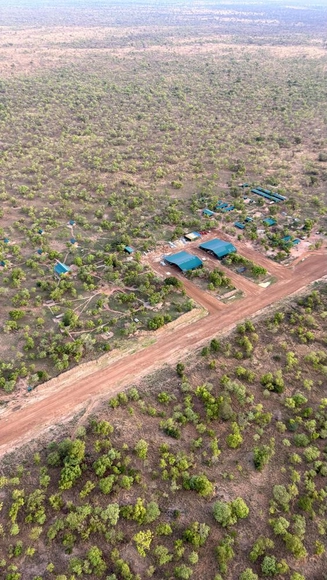
This areal footage shows the existing infrastructure on camp
African Parks, in partnership with the Government of South Sudan; Ministry of Wildilfe Conservation & Tourism (MWCT), manages Badingilo National Park as part of its mission to restore and protect Africa's natural heritage. Covering over 10,000 km², Badingilo hosts the largest land mammal wildlife migration on the planet and will act as the operational hub for several national parks in the region. Headquarters location (coordinates): 5° 6' 26.9094" N, 31° 54' 11.6676" E, within Badingilo National Park .
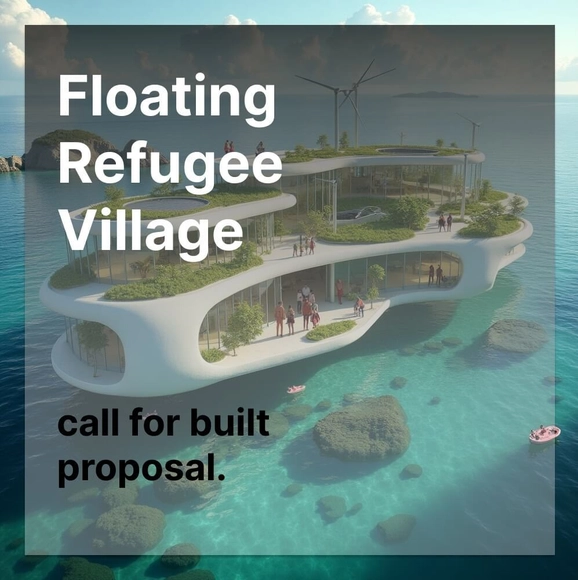
Premise With rising sea levels and intensifying climate events, coastal populations worldwide face unprecedented displacement, creating a new generation of climate migrants. Traditional land-based refugee solutions are often temporary, resource-intensive, and fail to provide long-term dignity or stability. This competition challenges architects and designers to radically rethink humanitarian architecture by proposing a new paradigm: a buoyant, self-reliant community. The Floating Refugee Village is envisioned not as a temporary camp, but as a permanent, adaptable, and thriving habitat that harmonizes with its aquatic environment, offering a resilient future for those displaced by our changing planet.