Brazilian state capitals have become the setting for an unusual trend: motels are moving away from highways and into city centers, offering an increasingly wide range of entertainment-related services. The motel, which originated in Japan about 400 years ago, is a lodging format that generates R$ 4 billion annually in Brazil and accounts for approximately 25% of all lodging in the country's capitals.
The current process of urban development is linked to a global inability to resolve a chronic problem often treated as invisible: the rise in the homeless population. Given the difficulty of addressing the housing deficit and the severity of the situation faced by those without shelter, it is both necessary and relevant to consider emergency solutions that can at least alleviate their suffering and improve their basic living conditions.
Consequently, competition #024 from the Projetar.org portal invites students to design a portable individual shelter for the homeless.
Following the confirmation that the Architecture and Urbanism Biennial will return to Santiago after two editions in Valparaíso, the countdown has begun for the close of the call for applications to select the next curator and their team, who will define the conceptual and curatorial framework for the upcoming edition of the event.
While the 2017 edition, "Diálogos impostergables" (Unpostponable Dialogues), addressed national issues that the discipline needed to confront beyond design itself, for the upcoming edition, the Colegio de Arquitectos de Chile is seeking a curatorial team to address the processes of urban renewal, heritage conservation, and densification currently shaping Chilean cities. In this context, the XXI Biennial will be held in Santiago's Barrio Biobío, a historic commercial district in the Chilean capital currently undergoing simultaneous processes of conservation, gentrification, and real estate speculation.
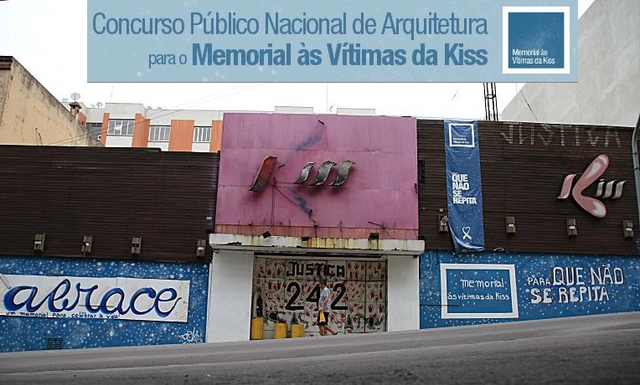
On January 27, the fifth anniversary of the Kiss nightclub tragedy, the National Public Architecture Competition for the Kiss Victims Memorial was launched in Santa Maria. The competition is a partnership between the city government, the Institute of Architects of Brazil (IAB RS), and the Association of Families of Victims and Survivors (AVTSM).
Architects from across Brazil may submit their projects via the competition website until March 19. Proposals must adhere to an estimated construction budget of R$ 3 million. The winning project is scheduled to be announced on April 10.
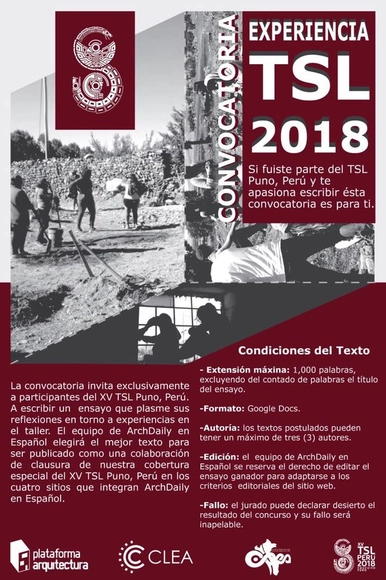
Chucuito, a Peruvian town at 3,800 meters above sea level, welcomed students and architects from across Latin America in late March to reflect, debate, design, and build public facilities during an intense ten-day workshop. This was the spirit of the XV Latin American Social Workshop Puno (XV TSL Puno), directed by the Latin American Coordinator of Architecture Students (CLEA) and the Peruvian Organization of Architecture Students (OPEA).
As part of our intensive on-site coverage, ArchDaily en Español has been publishing articles on the various discussions and reflections that have emerged from the event. To date, we have covered the construction details and the themes addressed by facilitators and students; soon, we will share a first-person account of our team's experience in Peru.
However, this coverage would be incomplete without the perspectives of the 250 students who participated in the workshop. If you attended the XV TSL Puno, have a passion for writing, and have something to say about it, this open call is for you.
The Instagram photography competition for the XIV Spanish Biennial of Architecture and Urbanism (XIV BEAU) is now open. The event is curated by José Morales and Sara de Giles, with Jesús Marina and Elena Morón serving as directors of photography activities.
The FABRICATE Call for Works is open and the organisers are looking for innovative projects from research and industry to be a part of this international event. Call Deadline: 3rd July 2026 Call Details: https://www.fabricate.org/ Submission Guidelines: https://www.fabricate.org/submission-guidelines-2027/ Submission Stage 1 consists of an Abstract of 600-800 words with 10-15 embedded images that declare and clearly demonstrate the specific research innovation as built, and in the development of being built. High quality images of design and fabrication processes should predominate the selection, with 3-4 images of the work as complete. The 2027 Edition focuses on rethinking extractive models of architectural production, learning from local contexts, and empowering more diverse communities of designers, makers, and builders. FABRICATE is looking for work that engages meaningfully with material, social, and environmental questions across diverse scales and geographies. Since its inception FABRICATE has played an important role in promoting innovative work at the intersection of design and making—bringing forward projects that challenge how architecture is conceived, materialized, and constructed. It has been a platform not only for technological advancement, but also for new ways of thinking about practice, materiality, and impact. While FABRICATE has often been associated with advanced manufacturing and robotics, this year FABRICATE is also interested in broad critical shifts in the field. The event is co-chaired by Areti Markopoulou (Institute for Advanced Architecture of Catalonia) and Xavier De Kestelier (Hassell) aiming to strengthen ties between industry and research. FABRICATE 2027 will take place on the 14th and 15th May, 2027, in Barcelona, Spain, organised by IAAC and hosted by COAC (Col·legi d'Arquitectes de Catalunya). Any updates regarding the calls and tickets will be posted on the FABRICATE website and Instagram Channel (@fabricateconference).
Van Alen Institute has spent more than 130 years at the intersection of design ambition, education, and civic life. Today, we are a driving force behind community-led urban design, which believes that local knowledge and care enrich the design process. Our archive—comprising thousands of competition boards, jury records, photographs, and correspondences—is one of the most significant collections of American architectural history in existence. Much of it has never been seen by the public.
Architects, designers, and multidisciplinary teams across Europe: this is your opportunity to help shape the future of sustainable construction. At revalu, we are launching an open call for innovative projects that prioritize lower-carbon architecture through the use of local, bio-based, and environmentally responsible materials.
For this issue of Dearq, "Tectonic Matter," we are seeking contributions that treat tectonics not as a style or a fetish of detail, but as a rigorous field in which architecture's material realities, its sourcing, craft, labor, structural systems, fabrication protocols, and performance criteria become inseparable from how space is perceived, inhabited, and understood. Who can submit: We welcome submissions from architects, historians, theorists, engineers, educators, and researchers. Interdisciplinary and context-specific approaches are encouraged, provided they remain anchored in tectonics as a conceptual and practical field of architectural invention. The editors invite submissions of research articles, case studies, visual essays, and projects will be accepted, provided they are original and unpublished and comply with the journal's editorial policy. Guest editors: Nader Tehrani (The Cooper Union, USA) Julián Palacio (The Cooper Union, USA) Rafael Villazón (Universidad de los Andes, Colombia)
ArchDaily is looking for a Projects Team Lead to guide the curation and strategic development of one of the platform's core content pillars: built projects. This role sits at the intersection of editorial and architectural judgment, data-driven strategy, and team leadership, shaping how architecture is selected, presented, and amplified to a global audience.
The Projects Team Lead will oversee the direction, performance, and evolution of project content on ArchDaily. This includes defining curation standards, supporting a distributed team of curators, and aligning editorial output with broader platform goals.
Call for Pecha Kucha - 6th biennale svizzera del territorio - Handle with care
Participation is free of charge. The winners of the call will be announced by August 2026. The selected Pecha Kucha presentations will be included in the programme of the 6th biennale svizzera del territorio. Selected contributors will be entitled to free accommodation and full access to all three days of the biennale.
The Estonian Academy of Arts Faculty of Architecture invites abstract submissions for the upcoming EKA Arh Conference 2026: To Be Continued…, a biennial international peer-reviewed conference held as a satellite event of the Tallinn Architecture Biennale.
Taiwan will open the first Taiwanese publicly funded center for architecture in December 2026. The opening will be celebrated with an exhibition titled Democratic Architecture—Architectural Democracy.
ArchDaily is looking for a proactive and curious architect to be part of our Projects Collaborator Program. As a part-time program participant, you will be working with the team in charge of curating and coordinating all built project publications on ArchDaily.
The second edition of EDGE Architecture Festival Budapest (EDGE Fest), organised by Építészfórum, will take place on 18-19 June 2026 in Budapest at Dürer Kert and the industrial venues of Hengermalom.
As part of the CONTEMPORANEA programme, the House of Architecture of Rome promotes the Call for Proposal 2026, addressed to architects, planners, landscape architects and/or conservation specialists, and aimed at selecting a research project to be developed through the use of the space known as "Monitor P" at the Casa dell'Architettura of Rome for a three-month period, between April and June 2026.
Frank Lloyd Wright’s Martin House (Buffalo, New York) is pleased to announce a call for applications to its Creative Residency Program. The residency provides individuals from multiple disciplines a thought-provoking environment in which to produce new works of the imagination inspired by one of the great examples of 20th century architecture. Applications to the 2027 season will open on March 30, 2026 and close on April 24, 2026. They will be accepted in two distinct categories. The Artist Program supports the development and presentation of creative works as they relate to Martin House. The Researcher Program provides opportunities to conduct research that will lead to published texts or projects in various fields, again as they relate to Frank Lloyd Wright and Martin House. Creative makers who are selected to participate will generally spend 2-4 weeks onsite either consecutively or incrementally within the residency term: June - October, 2027. Residents are also expected to deliver a free public program, performance, exhibition, or other creative presentation in order to share their Martin House-inspired work with the larger public. Residents will receive a stipend of $5,000. Travel expenses of up to $1,000 will also be provided to residents who are from outside the Buffalo-Niagara region. The Creative Residency Program is an opportunity for the Martin House to respond to and engage with our community. We anticipate that it will lead to more robust interpretations of Frank Lloyd Wright, the Martin House, and the people who once lived and worked here so as to expand the dialogue as to what great architecture is and why it matters.
There’s a housing crisis. Construction projects are facing delays. There’s concern about the declining role of the architect. Despite this, remarkable architecture is still being created.
Arabia Interrotta. Garofalo Fellowship exhibition, presented as part of the symposium of the same name, curated and organized by Zehra Ahmed (Garofalo Fellow, 2024–25). Courtesy of UIC School of Architecture.
The School of Architecture at the University of Illinois Chicago (UIC) is now accepting applications for the “2026–27 Douglas A. Garofalo Fellowship. Named for the architect and educator Doug Garofalo (1958–2011), the nine-month visiting faculty teaching and research fellowship provides emerging designers the opportunity to teach design studio and seminar courses and conduct independent research, culminating in a public lecture at the Graham Foundation for Advanced Studies in the Fine Arts and an exhibition or public conversation at the school.