In October 2018, the second edition of the Wood and Architecture exhibition, organized by the Universidad San Sebastián School of Architecture in Puerto Montt, was held in the main hall of the Puerto Montt Historical Museum. The exhibition featured work resulting from an invitation to ten young Chilean architecture firms to participate in a small wood architecture brief: a mountain shelter for a Patagonian national park. The images, plans, and models from these exercises in wood exploration, alongside models, drawings, and photographs of various expressions of woodworking by students and faculty of the USS School of Architecture, were visited by more than 3,500 people.
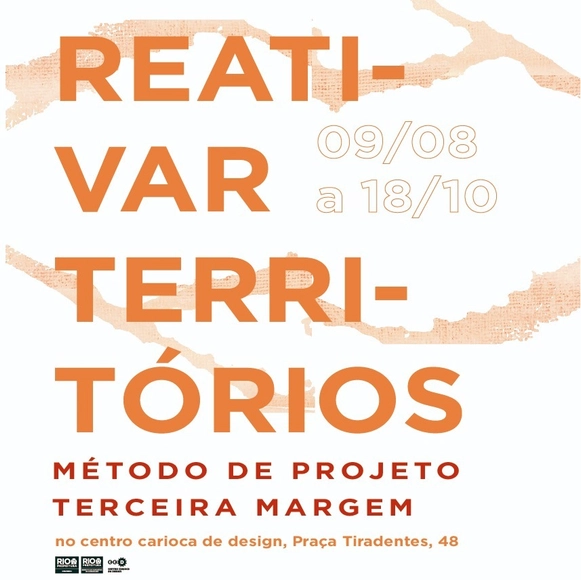
Reactivating Territories exhibition: Terceira Margem method | Design: Julia Sá Earp
Terceira Margem focuses on creating projects that can Reactivate Territories—that is, articulating the experience of building with the Earth itself, with the autonomy of inhabitants, and with experiences that can animate their bodies, whether human or otherwise.
AFFR (Architecture Film Festival Rotterdam) is the world’s biggest international platform for films about the city and architecture. In this eleventh edition, the festival is once again programming a stunning selection of works about current themes related to society and the city. Broader and more topical than ever, the programme includes world premieres and films never previously screened in the Netherlands.
Encuentro Helvex 2019 aims to create a convergent space for design, innovation, and architecture. As the first event of its kind in Mexico, it features a series of plenary sessions led by renowned experts in these fields. The goal is to foster dialogue and participation among various working groups to propose solutions to industry challenges, with a focus on sustainability and global benefit.
The World Urban Forum (WUF) is the world’s premier conference on urban issues. It was established in 2001 by the United Nations to examine one of the most pressing issues facing the world today: rapid urbanization and its impact on communities, cities, economies, climate change and policies.
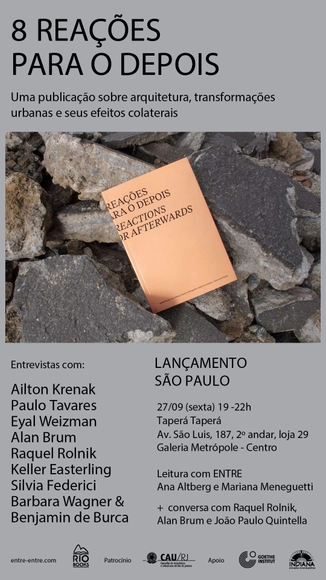
On September 27th, at 7:00 PM, the launch of "8 Reactions for the Aftermath" will take place, organized by ENTRE and coordinated by Ana Altberg, Mariana Meneguetti, and Gabriel Koslowski.
Series opens conversation about minimalism at the {CURA} headquarters in October
A new series of meetings opens a conversation on minimalism between Isis Gomes, of the slow fashion brand Saint Studio, and Mariana Schmidt, partner at MNMA—a studio that integrates disciplines with a strong visual appeal—at the {CURA} headquarters this October.
The Architecture and Urbanism Week (SAU) at UNIFAP is an annual event organized as a university extension initiative. It is primarily student-led, with at least one tenured faculty member serving as the director and primary liaison. This year’s edition, VIII SAU: Create Yourself, City!, aims to present and discuss the Creative Cities Network program by the United Nations Educational, Scientific and Cultural Organization (UNESCO). The program seeks to foster international cooperation among cities that invest in culture and creativity as drivers of sustainable development. The theme will be explored through three tracks focused on the city of Macapá, Amapá: Creative processes in the city; Perception and memory of the city; and Sustainability and self-management practices. For this edition, SAU is accepting submissions of academic work in three distinct categories: scientific articles, graphic works (physical models, photography, video, and sketchbooks), and posters. These will subsequently be published in the event proceedings. Over the course of the four-day event, the organizers aim to bring together students, faculty, researchers, and professionals to discuss the theme through lectures, roundtable discussions, workshops, and networking opportunities.
The tenth edition of the Construverde International Forum & Expo on Sustainable Design and Construction, themed "The Sustainable Business Revolution," presents an engaging agenda covering the circular economy, organizational sustainability, energy transition, green finance, health and well-being, technology, and innovation. These cutting-edge trends are transforming the construction industry to advance toward sustainable, low-carbon urban development that is resilient to the effects of climate change.
ESSAYS IN ARCHITECTURE: Analyzing, Imagining, and Reinventing
To the regular student of architecture, journalism may seem as a largely outlandish field. It is, however, largely untapped as a source of intellect. It is this source that Dayananda Sagar College of Architecture (DSCA), Bengaluru, India, one of the renowned architectural institutions of India is looking to explore through its venture of an essay writing competition.
Fluvial Metropolis - Design Afternoons / Drawn Conversations. Design Laboratory (LABPROJ) at the Faculty of Architecture and Urbanism (FAU USP)
The Design Laboratory (LABPROJ) at FAU USP (School of Architecture and Urbanism) will host activities focused on architectural projects for fluvial urban infrastructure every Thursday afternoon at the Centro Cultural São Paulo (CCSP), as part of the 12th International Architecture Biennial of São Paulo.
The First Iberian Bamboo Symposium aims to introduce a wide range of European stakeholders to the benefits of bamboo and its contributions to various areas that help meet sustainable development goals and the Paris Agreement, while encouraging new partnerships, programs, and research on bamboo applications in European markets. Participants and speakers come from a broad spectrum of sectors across European countries and bamboo-producing nations, including international experts, policymakers, and private sector representatives.
On October 5th, from 2:00 PM to 6:00 PM, IED (Istituto Europeo di Design) will host its second annual Open Day. The event invites high school students and prospective applicants to an afternoon of activities, including discussions and a creative challenge, offering attendees the opportunity to explore the college and its undergraduate programs in Graphic and Digital Design, Fashion Design, and Product and Service Design.
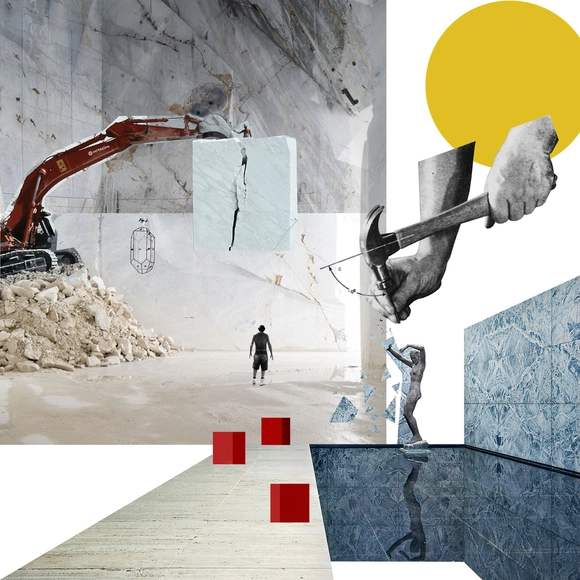
Because architecture is essentially space, the language employed by architects organizes and relates it, defining its boundaries and characterizing the space itself. Interior spatial organization follows diverse patterns: sometimes emphasizing compactness, while at other times expanding or wrapping around a central void, reviving traditions, or initiating new interpretations to bring the building's massing to life. It challenges conventional functional approaches, pursues the poetics of circulation, and incorporates elements of surprise. Depending on the site, the massing may be compact or extended, adapting to the topography and either blending into or contrasting with its surroundings, yet it never ignores the landscape. Within the urban fabric, architecture may turn inward, becoming abstract, or it may strengthen its relationship with the street, seeking continuity and fostering social interaction. Light is treated beyond its functional capacity to highlight boundaries, forms, materials, textures, and colors—whether through dramatic plays of light and shadow or by filtering it indirectly to create subtle spatial atmospheres. The use of materials—particularly brick, the protagonist of these works—creatively explores their expressive and structural qualities. The goal is for architecture to maximize resources by leveraging site conditions, ensuring sustainability, utilizing new technologies, reusing materials, or prefabricating components, all while maintaining a lasting architectural language that serves as a witness to its time.
Jesús D’Alessandro Martínez, guest of this chapter, will present "Santo Domingo, or How to Grow Under the Sun," sharing his experiences from his work as the current Director of the Strategic Plan for Santo Domingo, Dominican Republic, where they have successfully achieved a new urban vision.
Last quarter, Tesla delivered 95,000 electric cars to customers from around the world. Needless to say, the electric car revolution is coming at a rapid pace as people around the world choose to buy an electric vehicle instead of a gas car.
The question then becomes, what will happen to all the gas stations? There are over 130,000 gas stations in the US alone and many are family-run small businesses who don't have endless resources to prepare for the coming tectonic shift.