Can the workspace influence human creativity? What are the strategies for fostering a culture of innovation within a company? Will machines replace humans in the office design process? These and other topics will be discussed at WORKTECH 2019 Buenos Aires, the international conference on the future of work, brought to Argentina by Contract Workplaces, a regional firm specializing in the design and construction of high-performance workspaces.
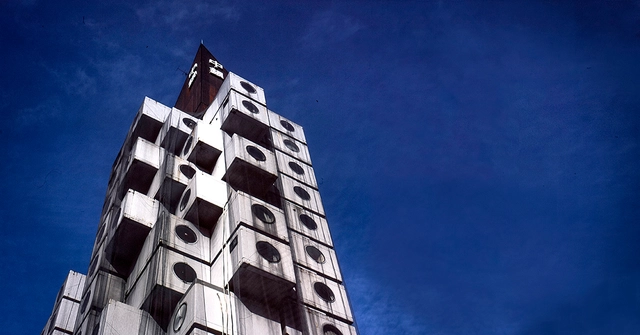
A course on Japanese architecture held in October 2019, presented by Gabriel Kogan. The program consists of 4 classes (split over two weeks, on Mondays and Thursdays), each focused on conceptual themes of production in Japan. The goal is to construct a brief genealogy of contemporary Japanese architecture through the study of historical and modern works. The lectures will explore fundamental elements of Eastern aesthetics and their presence in contemporary times.
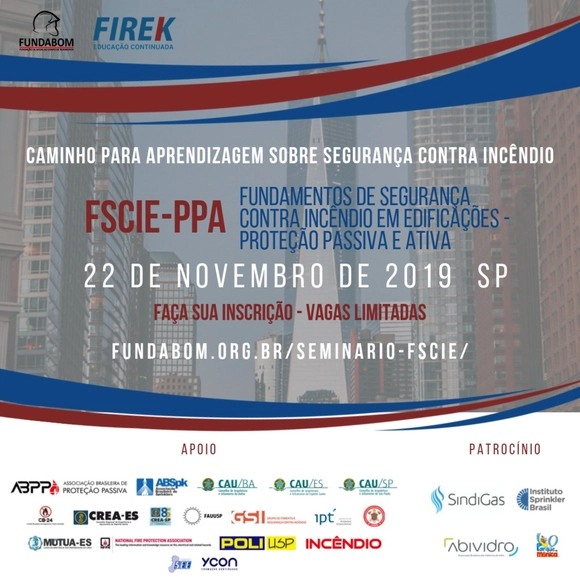
The seminar "Fundamentals of Fire Safety in Buildings: Passive and Active Protection" aims to present existing passive and active fire protection measures in buildings, systematized in a book that provides quick and easy access to information.
- The meeting brings together Clara Reynaldo of CR2 Arquitetura, Lua Nitsche of Nitsche Arquitetos, and Marta Moreira of MMBB; the goal is to stimulate reflection on the role of women in architecture.
{CURA} Gathers Architects for the "Women on Site" Event
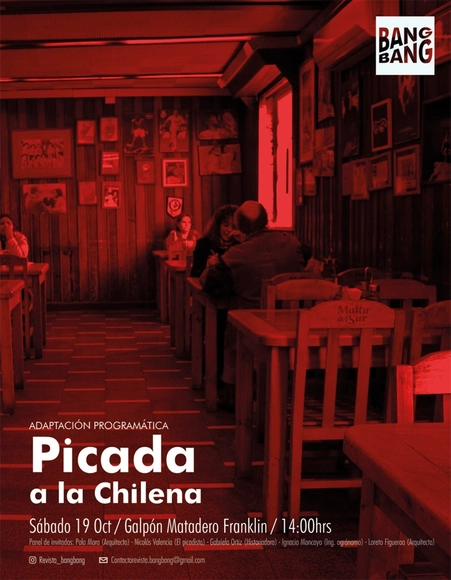
Photographer Matias Olate, Graphic design Juan Valdés Seguel
This edition of Bang Bang magazine explores the programmatic adaptation of picadas in Chile, recognizing how they have endured over time and within the collective cultural memory. To this end, we analyze four picadas: La Piojera, El Quitapenas, Las Pipas de Einstein, and Los Canallas.
Launch of the second ARQ Docs of 2019, The Architectures of Prediction: Truth is in the Tower, by Francesca Hughes, Director of the School of Architecture at the University of Technology Sydney, Australia. During her visit, she will deliver the keynote lecture, "The Architecture of Error."
The role of the playground in schools is a question that invites reflection from both the fields of education and architecture. Historically, playgrounds have been viewed as spaces for recreation, rest, and breaks in the learning process, in contrast to classrooms, which are defined as the primary setting for pedagogical activity. This secondary status is being challenged by contemporary pedagogies, which recognize that learning processes occur everywhere. Consequently, it is essential to reflect on the architectural brief for school spaces, particularly regarding the playground as a significant site for education.
Laws, norms, standards, rules, regulations, orders, ordinances, protocols, codes. Like any endeavor that unfolds in the public sphere, architecture must submit to laws that exist outside of it, while simultaneously maintaining its cohesion through adherence to laws internal to its own field. However, architecture appears to be more than the mere application of these internal laws or simple submission to external ones.
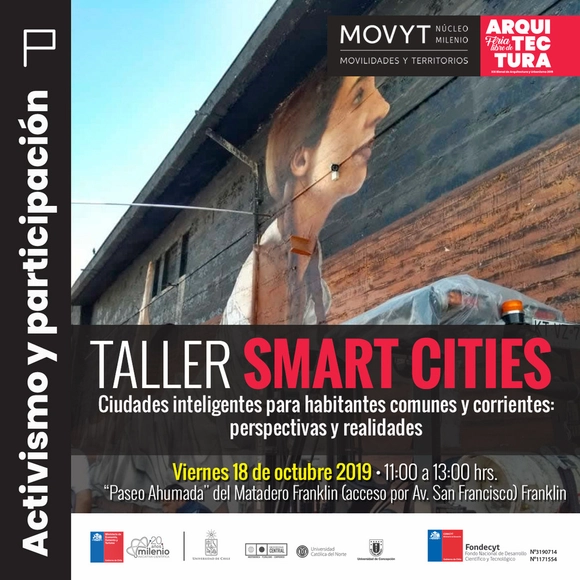
The concept of Smart Cities has become a recurring theme in visions of the city of the future. But what about the average citizen? If we ask acquaintances or passersby, very few have heard of the topic.
On Tuesday, October 22, the launch of the third volume of the Ediciones ARQ "trazos" series will take place: 'Dibujo y Observación. Una práctica persistente en Alberto Cruz'.
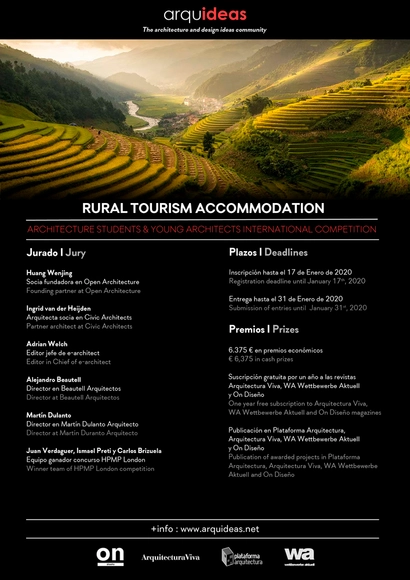
Visit arquideas.net to learn about the prizes, competition rules, and our prestigious jury.
The objective of this competition for architecture students and young architects, Rural Tourism Accommodation (RuTA) Vietnam, is to propose an accommodation space for tourists arriving in this region of the country in search of its scenic beauty. It should be a place of rest where nature—enhanced by rice terraces—and the rural world play a leading role.
This book compiles the most significant texts written by Emilio Tuñón, selected from those published in the CIRCO MRT coop. bulletin. CIRCO was a unique, heterodox publication—now shrouded in myth—that was not for sale and was received monthly by mail by a select few (a few hundred, in reality), including the cream of the architectural intelligentsia.
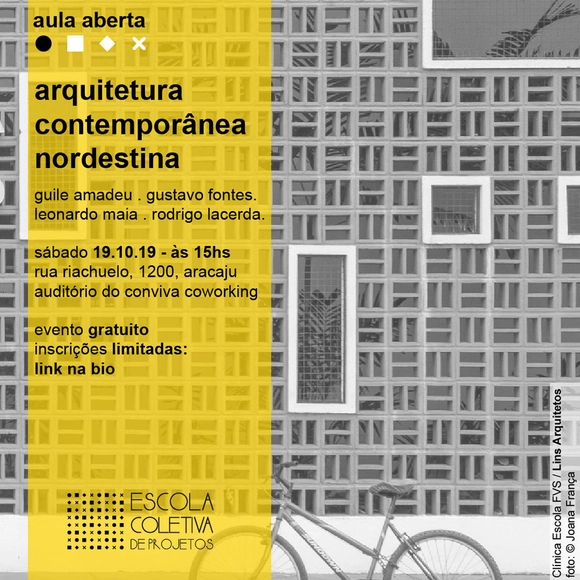
Escola Coletiva de Projetos was conceived from a desire to deepen reflection, debate, and the (re)formulation of more critical thinking regarding architecture, urbanism, and construction, particularly as they relate to the Brazilian Northeast—its climate, customs, ways of life, and cities.
Dichotomies of Power is an exhibition by the firm Dellekamp/Schleich, contextualized within a historical moment of change in Mexico. Part of the Abierto Mexicano de Diseño 2020 program, this exhibition invites visitors to use their interpretive skills to immerse themselves in three dimensions of the representation of power: the real, the symbolic, and the imagined.
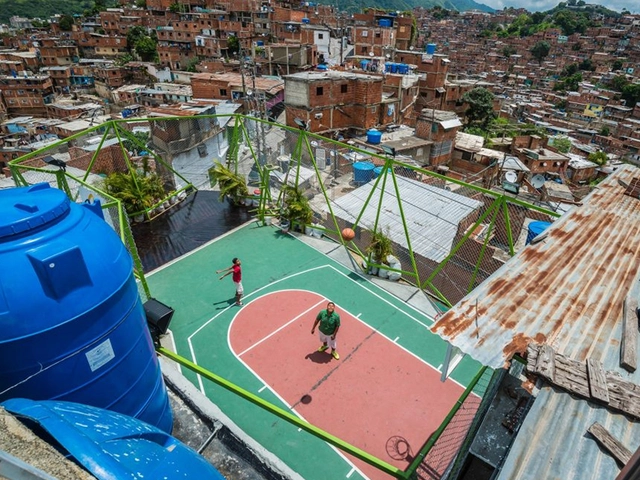
Presentation of the work of this Venezuelan architecture collective by co-founder Marcos Coronel. The collective defines itself as a territorial political action structure focused on developing infrastructure strategies and operations in environments characterized by unconventional urban conflicts.
Following the success of the 2017 Antalis Interior Design Award, which featured over 500 entries from 29 countries, Antalis is pleased to announce a new edition of the competition.